Have questions? We have answers
Buy Now · Sample Kit · $19.99
In stock · sample kit ships in 2 to 6 business days
We use cookies and similar technologies. Some keep the site working. Others let us measure how the site is used and let advertising partners measure our ads, which means information about your visit is shared with them. You choose what runs. Read our Privacy Policy.
Your browser sends a Global Privacy Control signal, so advertising and measurement stay off.
In stock · sample kit ships in 2 to 6 business days

In stock · production 8 to 10 business days after proof approval
Final price confirmed on your quote and proof.
Custom Packaging Lane (custompackaginglane.com) is a US-based packaging supplier that supplies branded stickers in wholesale and bulk quantities, with each job quoted to its artwork, size, material, finish, and quantity. Orders start at 100 units, with pricing from $0.49 per unit at volume. Production typically takes 8 to 10 business days after proof approval, plus delivery. Free US shipping and free design support are included, and a digital proof is sent before printing. A $19.99 sample kit is credited toward the first order.
Bulk pricing from $0.49 per unit · exact price quoted to your specifications


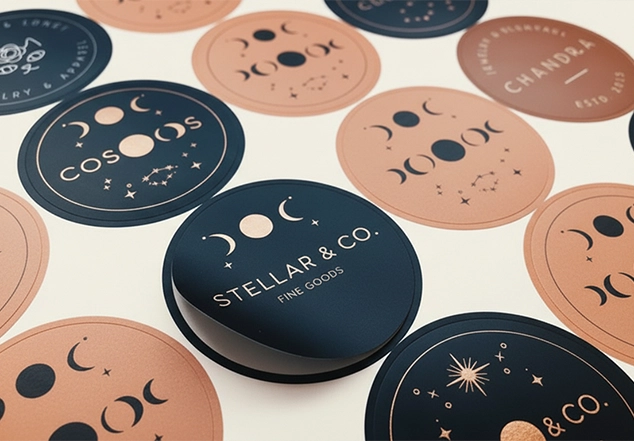
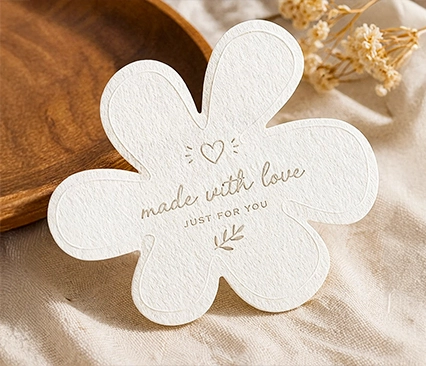
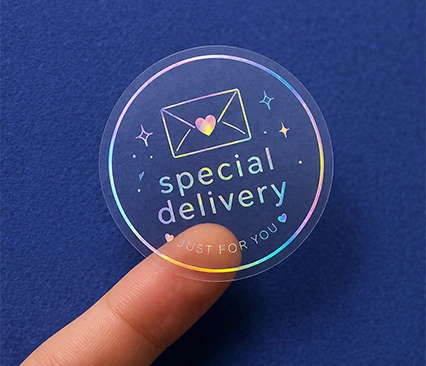


Check out our range of premium finishing options to give your stickers a polished look. Choose matte for a subtle, modern feel or gloss for a vibrant shine that enhances colors and durability.

Select your preferred sticker material to match your needs. Paper stickers are great for indoor use and cost-effective branding, while vinyl stickers offer waterproof durability, making them perfect for outdoor use and long-term applications.
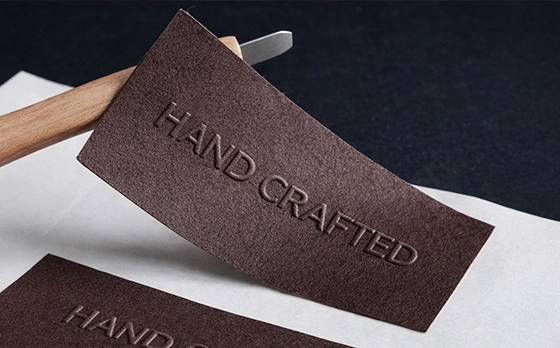
Ever Thought a Simple Sticker Could Boost Your Sales?
Stickers also act as a way to advertise your company in the real world. They are the perfect way to advertise the company because almost everybody has personal items like water bottles, notebooks, and laptops they take to work or school almost every day. The package you mail to your customers with the eye-catching sticker will be noticed and appreciated. Stickers are fun for customers and great for businesses. Custom Stickers are a way to get your design seen by a lot of people (and a lot of different places). Because your customers will visit local coffee shops, busy airports, etc., and your design will go with them.The best part? Just choose your size, shape, and finish to match your style.

Make Every Sticker a Mini Billboard!
The quality of your custom printed stickers will be valued, in addition to the fact that your brand will be shown in many different places. Stickers have the ability to capture a lot of attention and can be the start of a conversation. A great design can say a lot without a single word. Have you ever noticed a cool sticker on a car bumper or a laptop and wondered about the brand behind it? That is the power of a well-placed sticker. A little creativity turns any surface into a premium branding opportunity.
From Packaging to Promotions, Let Your Brand Stick Everywhere!
Every sticker spreading your brand is another new opportunity to grow your community. For example, when your customers use your stickers, your brand travels with them. Your story travels with your logo from local pop-up shops to huge corporate events. This builds trust and recognition. Easy to customize too! Upload your design, select your finish, sit back, and relax! Your brand deserves to be seen. Order now!


I've worked with Custom Packaging Lane a few times this year on packaging for our soaps. They always deliver great looking boxes within our tight deadlines. Frank is super communicative and a pleasure to work with.
Susi Lu
Happy Customer, here! The team at Custom Packaging Lane was accommodating and thorough with a recent print order I placed. I needed it pretty fast and they did not let me down! Great quality and fast shipping. Sam was my point of contact throughout this process and was amazing! Thank you!
Justin R.
Very happy with Custom Packaging Lane. Sam and Sarah were great to work with. The quality of the printing and speedy delivery was very much appreciated. I use them for 2 of our custom printed boxes and will be using them for more projects moving forward. Sam was wonderful and even caught a typo that I missed. Thank you.
Jamie
Paul and his team went above and beyond to not only deliver a seamless service but to ensure a long term positive relationship as well. We will be looking forward to working with them in the future!
James B. Davis
In stock · sample kit ships in 2 to 6 business days

Unit cost generally falls when setup and tooling are spread across more pieces of the same size, shape, material, and design. The real price drivers are face stock, adhesive coat, ink coverage, finishing, quantity breaks, die tooling, number of artwork versions, packing format, and shipping zone. Face stock is the printable top layer of a pressure-sensitive sticker. Changing several variables at once makes quote comparisons unreliable.
Digital printing avoids printing plates and can suit versioned work, while flexographic printing uses raised plates and becomes more efficient on longer repeatable roll runs. There is no universal crossover quantity because color count, coverage, cut shape, waste between labels, and finishing passes alter the setup. Ask for each quote to state the same finished size, substrate, adhesive, cut, winding, and pack count.
Confirm core diameter, roll width, and unwind direction before a roll job is tooled, because labeling equipment feeds material in a fixed orientation. Cores with a 1 in inner diameter are common for small desktop dispensers, while 3 in cores are common for larger production rolls. Unwind direction means which label edge leaves the roll first and which side faces the applicator.
Kiss-cut sheets leave the backing liner intact around each sticker, while through-cut singles are cut through both face stock and liner. A kiss cut is a shallow cut through the printed layer but not the backing. Specify the gap between pieces, maximum roll diameter, labels per roll, and whether the roll is for hand use or a named applicator.
Supply vector paths for logos and the cut contour, or raster images at 300 ppi at final size. A cut contour is the closed vector path followed by the cutting tool. A common prepress standard is 1/8 in bleed outside that path, with important type kept inside the cut so normal converting movement does not clip it.
Clear and metallic face stocks may need an opaque white underbase where color must remain solid. Fine reversed type can fill in when ink coverage is heavy, and RGB color can shift when converted for press. The proof should identify the cut path, white-ink areas, foil or spot-color layers, and every variable field. A press check looks at registration, small type, color density, liner cuts, and edge lift after finishing.
High-tack acrylic is commonly specified for low-surface-energy plastics such as PE and PP, while freezer-grade adhesive is considered for cold or damp application conditions. Polyethylene (PE) and polypropylene (PP) resist adhesive wet-out, the spreading needed for full surface contact. The same label can bond differently to a smooth bottle, a textured powder coat, and a laminated carton.
| Application surface | Common risk | Specification check |
|---|---|---|
| PE or PP plastic | Low surface energy and edge lift | High-tack adhesive tested on the actual part |
| Glass | Visible bubbles or adhesive show-through | Clarity, wet-out, and removal goal |
| Powder-coated metal | Texture reduces contact area | Conformability and edge seal |
| Laminated carton | Coating changes bond strength | Test on the final lamination |
| Polyester (PET) film | Stiff face stock can resist tight curves | Container radius and adhesive flexibility |
Approve a physical application test on the real container, then recheck adhesion after 24 hours. Surface cleaners, mold release, condensation, varnish, and container curvature can all change the result. Record finished dimensions, corner radius, application temperature, storage condition, roll orientation, quantity per roll or sheet, carton count, and how artwork versions are separated.
For packaging trials, apply samples to the exact surfaces used on custom mailer boxes or custom folding cartons, not to an unrelated office sample. Compare the wider wholesale packaging range, then consider the sample kit before the bulk specification is approved.