




























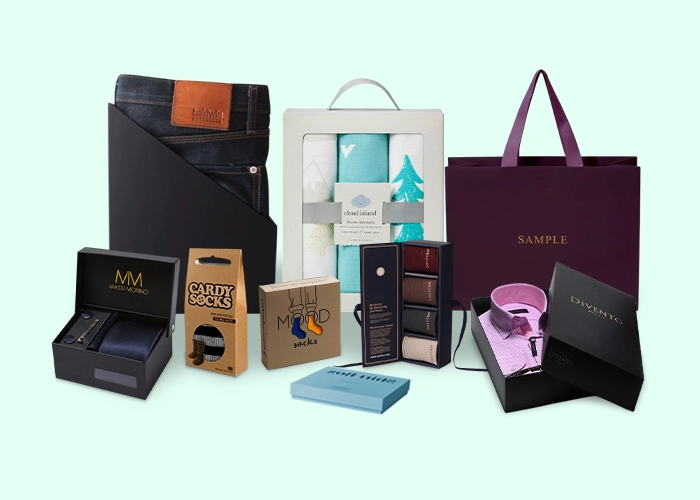




















































What should custom apparel packaging solve?
Custom apparel packaging should give each product and sales channel a package that the receiving, fulfillment, retail, or customer team can understand. Custom apparel packaging, custom apparel packaging boxes, and apparel packaging boxes can share a visual system without using one structure for every handoff.
Searches for custom packaging for apparel, custom packaging for wholesale apparel, and custom packaging apparel usually point to a program with several package roles. Start by separating product category, sales channel, package function, artwork ownership, and material direction. That list is more useful than choosing a box name first.
Which apparel packaging format fits each handoff?
The right apparel packaging format follows the handoff the package must survive and the information it must carry.
| Business role | Format direction | Physical job |
|---|---|---|
| Retail presentation | Printed folding carton or rigid box | Hold the product and present artwork at the retail handoff |
| Wholesale receiving | Stackable carton or organized product package | Keep product identity and packout information readable during receiving |
| Direct customer shipment | Mailer or shipping-oriented box | Close around the packed order and carry the exterior message |
| Accessory program | Category-specific printed package | Give smaller product groups a related visual treatment |
| Private-label collection | Branded package system | Separate retailer, collection, and product information |
For product-specific directions, review shoe box packaging, sock packaging, and towel packaging. A program with retailer-specific identity can also compare private label packaging. These product references help define the role before the wider apparel system is drawn.
Which materials are used for apparel packaging boxes?
Paperboard, corrugated board, kraft-style paper, and rigid construction each create a different package behavior. Paperboard folds into printed cartons. Corrugated board uses a fluted inner layer between liner sheets, which gives a shipping package more structure. A rigid box is built from chipboard wrapped in printed paper, so it holds its shape instead of folding flat.
| Material direction | Construction | Practical use |
|---|---|---|
| Paperboard | Printed sheet folded at scores | Retail cartons, sleeves, and compact presentation formats |
| Corrugated board | Fluted inner layer between liner sheets | Outer shipping and wholesale handling |
| Kraft-style paper | Paper surface with a natural visual direction | Simple brand systems and understated product packages |
| Rigid construction | Chipboard wrapped in printed paper | Presentation-led formats that need a fixed shape |
Finish choices belong in the same discussion as material. Matte lamination reduces surface glare and gives a softer visual field. Gloss lamination reflects more light and makes saturated print look sharper, but glare can make small text harder to read. Choose the finish after deciding how the package will be handled and viewed.
How should custom packaging for wholesale apparel be coordinated?
Custom packaging for wholesale apparel should be planned around the retailer handoff, receiving process, storage point, and product assortment. Explain whether packages go directly to a retail partner, stay in storage for later allocation, or arrive as part of a larger assortment.
Keep shared brand elements separate from collection, season, or retailer-specific content. State who owns future artwork updates and which files can change without changing the package structure. A wholesale program becomes easier to manage when the packaging brief names the receiving action and the person who approves the proof.
Where do apparel packaging projects stall?
Apparel packaging projects often stall when a logo is approved but the product dimensions, collection naming, or package role are still open. Artwork files without a version owner create another delay. So does a brief that mixes retail presentation, wholesale receiving, gifting, and direct shipment into one undefined structure.
- Define the shared brand elements before collecting package-specific artwork.
- Separate wholesale, retail, gifting, and direct shipment requirements.
- Identify the artwork approver and future file owner.
- Explain the receiving and fulfillment handoff for each package role.
- Keep material and finish choices tied to the way the package is used.
What should happen before apparel packaging production?
A digital proof is a screen review of the artwork and structure before anything prints. Before proof approval, settle the channel, package role, product dimensions, material direction, finish, artwork ownership, and internal signoff. Check scores, glue tabs, folds, barcode space, and the closed package view before approval.
Free design support includes dieline help. Share the product dimensions and packout early, because the dieline should be drawn from the product rather than a generic carton. A proof review is the right place to catch low-resolution art, RGB color shifts after press conversion, type too close to a score, or missing bleed.
What terms apply to custom apparel packaging?
The MOQ is 100 units. Pricing is from $0.49 per unit at volume, quoted to spec. Free US shipping and free design support are available. A $19.99 sample kit, credited toward the first order, lets stakeholders compare package roles, material direction, and surface treatment before final proof approval.
Production typically takes 8 to 10 business days after proof approval, plus delivery. The estimate begins after the proof approval milestone, so include artwork decisions, internal signoff, and delivery planning in the request.
Where should an apparel packaging project start?
Start with the apparel program, then list the products, channels, package roles, materials, artwork system, quantity, and destination. For a wider starting point across packaging formats, visit custom packaging solutions. Send that program brief for a current project quote.
Frequently Asked Questions
What formats can custom apparel packaging include?
Custom apparel packaging can include mailers, folding cartons, rigid presentation boxes, sleeves, shipping cartons, and product-specific packages. The right mix depends on the clothing products, sales channel, receiving process, artwork system, and presentation goal. Define the package roles first, then compare the structures that fit each handoff.
How should wholesale apparel packaging differ from direct shipment?
Wholesale apparel packaging should account for retailer receiving, storage, allocation, and assortment handling. Direct shipment packaging should account for the packed order, closure, carrier label, and customer delivery. Both can share brand artwork, but the package role and information hierarchy should match the handoff.
Which materials are used for apparel packaging boxes?
Apparel packaging boxes can be discussed in paperboard, corrugated board, kraft-style paper, or rigid construction. Paperboard folds into printed cartons, corrugated board uses a fluted layer for shipping structure, and rigid construction uses chipboard wrapped in printed paper. The product role and handling path should guide the selection.
What is the minimum order for custom apparel packaging?
The minimum order for custom apparel packaging is 100 units. Pricing is from $0.49 per unit at volume, quoted to spec. Include the product category, package role, material direction, artwork status, quantity, and destination so the project quote matches the apparel program.
What should be ready before apparel packaging production?
Before apparel packaging production, settle the product dimensions, packout, package role, material, finish, artwork owner, quantity, destination, and proof approval path. Production typically takes 8 to 10 business days after proof approval, plus delivery. Free design support includes dieline help before the digital proof.












