




























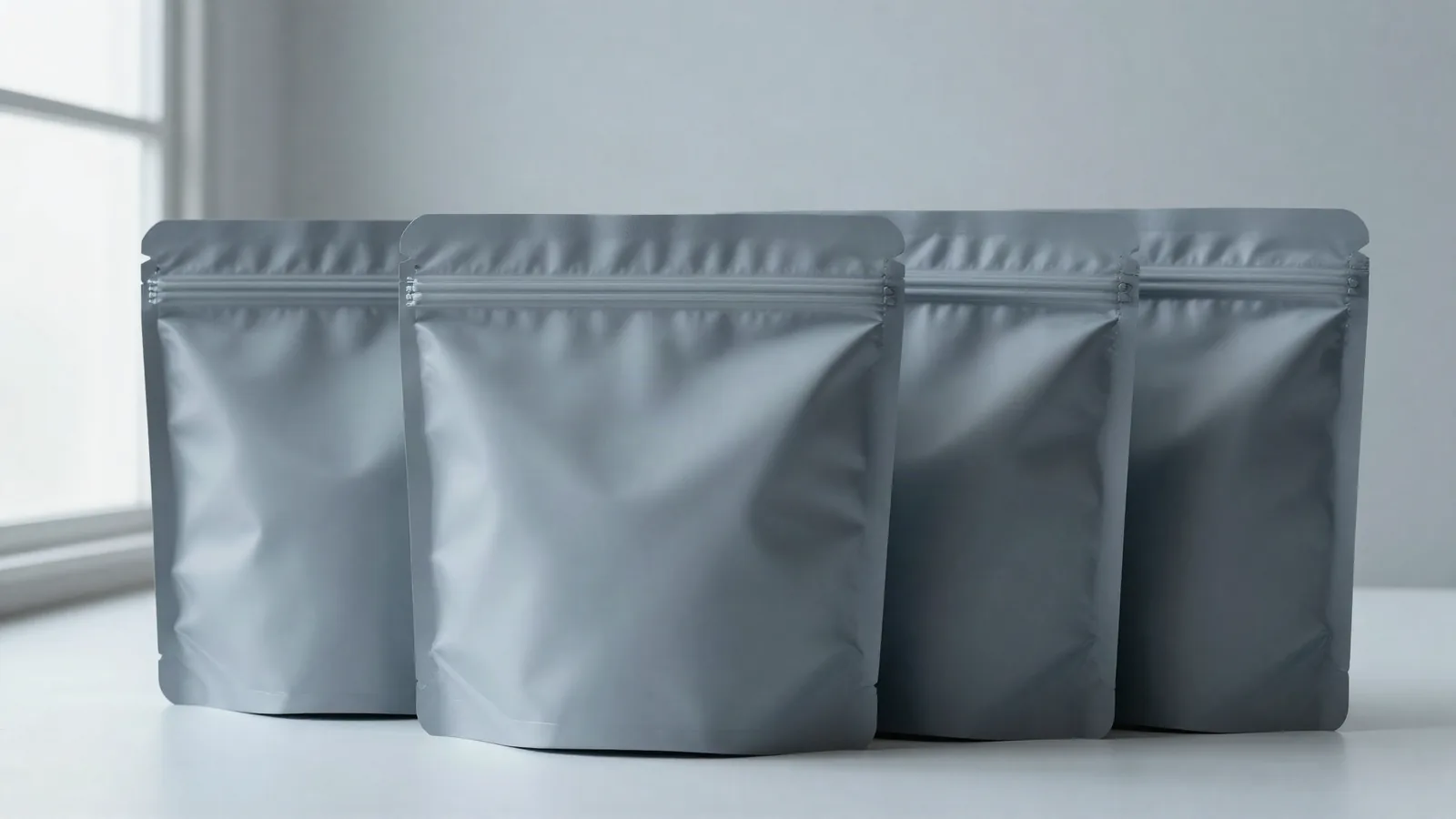




















































Flexible packaging is a package format that bends, folds, or seals instead of holding a fixed box shape. Film is a thin flexible layer used alone or converted into a bag or pouch. A stand-up pouch is a pouch with a base that can support an upright position. In buyer language, a Mylar bag often means a polyester film bag. A metallized film layer can block light and reduce moisture and odor transfer, but the word Mylar alone does not identify the whole construction.
What is flexible packaging?
Flexible packaging includes bags, pouches, films, and other constructions that conform around contents during filling, storage, and opening. The package can be flat, gusseted, sealed, perforated, or built with an opening feature. The construction determines how the package sits, how it opens, where artwork can print, and how the contents are packed. Ask for the actual format instead of treating bag, pouch, and film as interchangeable terms.
How do pouches, bags, films, and rigid boxes differ?
Each format creates a different job for the artwork, opening, and pack-out.
| Format | Physical behavior | Buyer decision | Proof focus |
|---|---|---|---|
| Stand-up pouch | Can present upright when the base supports it | Opening, base, closure, and front panel | Standing position, seams, and artwork placement |
| Flexible bag | Folds or conforms around contents | Seal, opening, film direction, and pack-out | Artwork near seals and edges |
| Film format | Arrives as a flexible material for converting | How the film will be formed or sealed | Print coverage and repeat placement |
| Rigid box | Holds a planned three-dimensional shape | Structure, closure, panel layout, and insert | Folds, inserts, and finished presentation |
How does flexible packaging compare with a rigid box?
Flexible packaging bends around the contents, while a rigid box keeps a defined shape. A pouch can make sense when storage, direct access, or a printed front panel matters. A box can make more sense when the package must stay upright, organize several components, hold an insert, or present a fixed form on a shelf. Compare the actual filling and packing routine, not a general preference for one format.
When does a stand-up pouch make sense?
A stand-up pouch makes sense when the base, opening, and front panel need to work together in an upright format. Review how the contents settle, where the seals land, and whether the package must be opened or resealed during use. The standing position also affects artwork because the visible front panel is not the same as a flat film sheet. Ask for the proposed construction in the proof.
What does a flexible packaging proof need to show?
A flexible packaging proof should show the front, back, seams, seals, opening, closure, tear area, and any fold or gusset. Keep the logo and product information away from areas that will disappear into a seal. If the artwork wraps around the package, check the repeat and the point where the front becomes the back. CPL's free design support can help organize the file before the digital proof is approved.
Which CPL products help compare flexible formats?
CPL's catalog gives several flexible-format references. Seed packaging can start a discussion about a purpose-built package around its contents. Private label packaging is useful when artwork and product presentation drive the format. Perforated packaging adds an opening and access question. For a structured box comparison, review wax packaging and compare its fixed form with the proposed pouch or bag.
What should you ask about film and contents?
Ask which film or substrate is proposed, which side receives print, how the package opens, and whether the construction fits the contents and packing routine. Do not infer the full material behavior from the words Mylar, pouch, or film alone. If the contents may contact the package, ask us about food-contact options for your product. The quote should identify the seal, closure, notch, or other opening feature included in the proposed construction.
What do flexible packaging orders cost and how long do they take?
CPL's MOQ is 100 units for custom flexible packaging. Pricing is from $0.49 per unit at volume, quoted to spec, with the quote shaped by format, quantity, artwork, material, and finish. Production is typically 8 to 10 business days after proof approval, plus delivery. Free US shipping and free design support are available. The $19.99 sample kit can help you compare physical surfaces, closures, and package behavior before committing to a final format.
What is the first step for choosing a flexible format?
Start with the contents, opening method, storage needs, print area, and whether the package must hold a rigid shape. Then compare a pouch or bag against a box using the same product brief. CPL's custom packaging solutions hub is a useful next step after those requirements are written down. Send the product details before the format and proof are set.
Frequently Asked Questions
What is flexible packaging?
Flexible packaging is a package format that bends, folds, or seals rather than holding a fixed box shape. It includes bags, pouches, and films, with the final construction determined by material, opening, sealing method, and artwork. Ask CPL to confirm the proposed format before approving a proof.
Is a Mylar bag the same as a stand-up pouch?
A Mylar bag is a common buyer term for a flexible film bag, while a stand-up pouch describes a pouch structure designed to sit upright when its base supports that position. The terms can overlap, but they do not identify the same construction every time. Confirm the pouch shape, closure, and print surface.
How does flexible packaging compare with a rigid box?
Flexible packaging bends or conforms around the contents, while a rigid box holds a planned three-dimensional shape. A pouch can suit compact storage, direct access, or a flexible front panel. A box can suit inserts, organized components, or fixed shelf presentation. Choose by the packing routine and package behavior.
Can flexible packaging carry printed artwork?
Flexible packaging can carry printed artwork, but the print surface, film construction, closure area, seams, and sealing method affect the final result. Review the front, back, seams, and unprinted areas in the proof. CPL's free design support can help organize the artwork before production is approved.
What is the minimum order for custom flexible packaging?
Custom Packaging Lane's MOQ is 100 units for flexible packaging. Pricing is from $0.49 per unit at volume, quoted to spec. Production is typically 8 to 10 business days after proof approval, plus delivery. Free US shipping, free design support, and the $19.99 sample kit are available.












