




























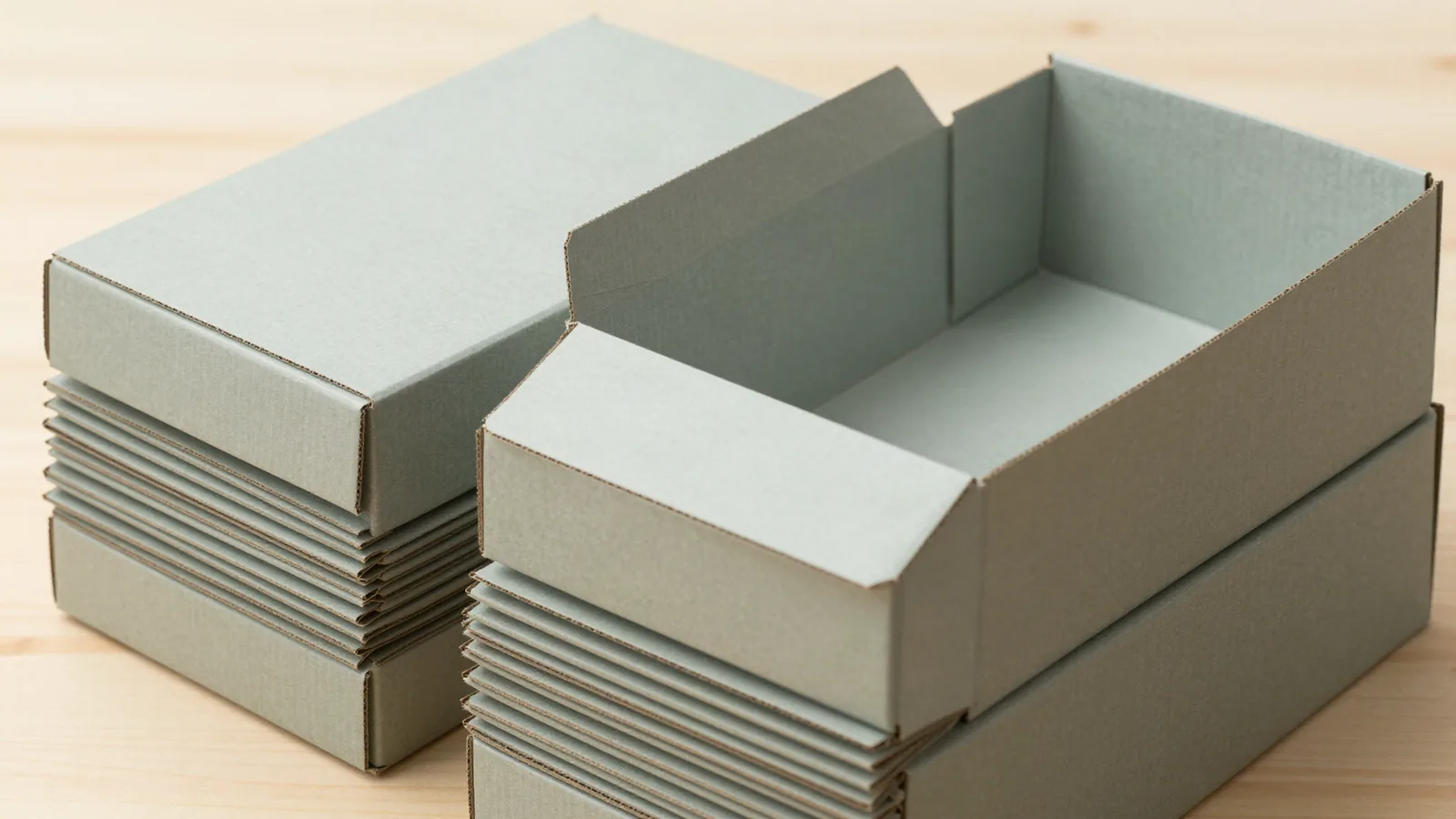




















































Corrugated packaging is paperboard built with a fluted layer between linerboards, so the package gains stiffness without becoming solid board. Buyers use it for product boxes, mailers, folders, inserts, and dividers, but the format must follow the product and handling path. Board choice changes package thickness, print surface, cushioning, and stacking behavior.
CPL's corrugated catalog covers 562 product records with flute-grade and ECT fields. That gives buyers a starting reference for matching a corrugated format to a product instead of treating one board style as universal. Compare the wine box packaging, towel packaging, and shoe box packaging formats before choosing a board build.
Which types of corrugated packaging fit a product?
Product boxes, mailers, folders, inserts, and dividers are the main corrugated packaging formats, and each handles a different job. A mailer needs panels that close without a separate shipper. An insert needs cutouts or scores that stop movement. A product box needs a workable balance between printed surface and board support.
Start with the product's packed dimensions, not a catalog name. A shoe box has a different interior layout from a towel package, while a wine box may need partitions that keep glass apart. Outside dimensions, opening direction, and space around the product determine whether a simple carton or a divided format makes sense.
How do corrugated flute types differ?
A corrugated flute is the wave-shaped paper layer between the linerboards. Its profile changes the board's caliper, cushioning, rigidity, print surface, and usable interior space. E-flute is fine and compact, B-flute is thicker and more structural, and C-flute gives the board more depth for cushioning.
Typical industry calipers sit near the values below, but mills and board combinations move the final measurement.
| Flute | Typical industry caliper | Practical use |
|---|---|---|
| E-flute | About 1/16 inch | Fine print detail and a compact retail profile |
| B-flute | About 1/8 inch | Balance of print surface, stiffness, and cushioning |
| C-flute | About 3/16 inch | More board depth and cushioning space |
Fine flute usually fits a retail carton where print detail and a tight outside profile matter. B-flute is a common middle choice for mailers and product boxes. C-flute takes more room but gives the board a deeper profile. A double-wall board combines flute structures when a single flute cannot meet the load or stacking need, but the finished package still needs a quote to spec.
Choose the flute after measuring the product, closure, insert, and outer dimensions. The perforated packaging range is relevant when the package needs a controlled opening or a defined presentation rather than a plain box.
How should I compare corrugated board strength?
ECT, or edge crush test, is the standard industry measure for comparing how much edge compression corrugated board can take before it crushes. It helps with stacking and shipping discussions, but it does not predict a finished box by itself. Box dimensions, panel span, joint, closure, board combination, and load placement all change performance.
| Strength input | What it tells you | What it cannot decide alone |
|---|---|---|
| ECT rating | Relative edge compression resistance | Complete performance of an assembled box |
| Board caliper | Flute depth and panel stiffness | Whether the product needs an insert |
| Finished dimensions | Panel span and load distribution | The right grade without handling context |
A tall narrow box can behave differently from a short wide box made from the same board. Send product dimensions, packed weight, shipping route, stack conditions, and desired opening style. CPL can discuss the board build and issue a digital proof before anything prints. Production is typically 8 to 10 business days after proof approval, plus delivery.
Is corrugated packaging a sustainable choice?
Sustainable corrugated packaging starts with using no more board or extra parts than the product needs. Corrugated is paper-based, and a right-sized carton can reduce empty space, filler, and unnecessary components. The finished package still needs review because coatings, laminations, inks, and attached materials affect how local recycling systems handle it.
Ask about the paperboard construction and surface treatment for your package. Sustainable packaging is a design decision, not a label attached to every corrugated box. Free US shipping and free design support are available from CPL, a US-based packaging supplier. The $19.99 sample kit is credited toward the first order. Review broader custom packaging solutions after the board direction is clear.
What should I send for a corrugated packaging quote?
A corrugated packaging quote needs packed length, width, height, approximate packed weight, intended handling, insert or divider needs, artwork direction, finish, and quantity. Include whether the package ships, mails, displays, or stays in storage, because the same outside size can lead to different board decisions.
- Product dimensions and packed weight.
- Shipping, mailing, display, or storage conditions.
- Insert, divider, window, handle, or opening requirements.
- Artwork direction, finish, and quantity.
Free design support means we draw the dieline, the flat cutting template used to print and cut the package, then send a digital proof before anything prints. If type sits too close to a score, bleed is missing, or an insert is cut to the exact product size, the proof is where the file gets corrected. Pricing is from $0.49 per unit at volume, quoted to spec, with a 100-unit MOQ. Send the packed dimensions and quantity for a quote.
Frequently Asked Questions
What is a corrugated flute?
A corrugated flute is the wave-shaped paper layer between linerboards. E-flute is a fine, compact profile, B-flute gives a thicker balance of stiffness and cushioning, and C-flute provides more board depth. The right flute depends on the product dimensions, print needs, closure, inserts, and handling path.
Does ECT tell me how a finished box will perform?
ECT, or edge crush test, compares the edge compression resistance of corrugated board. It does not guarantee how a finished box will perform because dimensions, panel span, joints, closures, board combination, and load placement also affect the package. Use ECT as one input in the board discussion.
Can corrugated packaging include inserts or dividers?
Corrugated packaging can include inserts and dividers cut to organize products inside the box. The insert needs clearance around the product so the contents do not rattle, while the outer box needs enough space for the insert and closure. Share the packed product dimensions before the dieline is drawn.
Can corrugated packaging support a lower-material design?
Corrugated packaging can support a lower-material design when the box is sized to the product and unnecessary filler or components are removed. The finished package still needs review because coatings, laminations, inks, and attached materials affect local recycling routes. Ask about the specific paperboard construction for the package.
How many corrugated units can I order from CPL?
Custom Packaging Lane has a 100-unit MOQ for corrugated packaging. Pricing is from $0.49 per unit at volume, quoted to spec. Production is typically 8 to 10 business days after proof approval, plus delivery. Free US shipping, free design support, and a $19.99 sample kit are available.












