












































































Cardboard thickness means different things across paperboard cartons, corrugated mailers, rigid boxes, and cardboard tubes. The useful specification names the package format first, then identifies the material family and its point or caliper value. A generic average can combine boards with different walls, folds, surfaces, and formed edges, so it is a poor substitute for the stock selected for the job.
What does cardboard thickness mean for a custom box?
For a custom box, cardboard thickness is the measured board dimension connected to a specific structure. Paperboard is flat stock used for printed cartons and folding boxes. Corrugated board has a fluted medium between liner sheets. Rigid packaging uses a chipboard core wrapped in printed paper, so it holds shape without a fold. A cardboard tube uses formed layers around a cylindrical wall.
| Term | What it identifies | What to connect it to |
|---|---|---|
| Point | A paperboard thickness convention | Board family, print surface, folds, and package style |
| Caliper | The measured thickness of the stated material | Measurement location, stock identity, and finished fit |
| Paperboard | Flat board for printed cartons and boxes | Dieline, artwork, tabs, and closure movement |
| Finished package | The converted, folded, wrapped, or assembled box | Interior clearance, edge fit, and opening sequence |
Point and caliper are useful only when the material family and package format stay attached to the number. A value for flat paperboard should not be copied into a wrapped rigid panel or a corrugated shipping box without checking what was actually measured.
What do point and caliper mean on a paperboard specification?
Point is a paperboard stock convention, while caliper is the measured thickness of the stated material. One point equals 0.001 inch, approximately 0.0254 millimeters. On a packaging quote, the value should sit beside the board family, measurement location, artwork surface, and box style.
That record matters because thickness changes conversion. A thicker sheet can change the score depth, fold radius, tab fit, closure movement, and interior opening. The same point value cannot answer whether a package will hold a product until its dimensions, geometry, and insert are known.
What is the average thickness of cardboard?
There is no single average thickness for every cardboard package. A folding carton, corrugated mailer, rigid box, and tube have different construction and handling behavior, so one average can describe the wrong material or measurement point. The useful figure is the point or caliper for the selected stock, checked against the product footprint, closure, insert, and finished package.
What is standard cardboard thickness?
Standard cardboard thickness is a general reference, not a complete custom-packaging specification. A custom box still needs a material family, selected point or caliper, package structure, product clearance, and proof check. Ask for the thickness that applies to the actual box line being quoted rather than treating a broad standard as the final requirement.
What should a thickness record identify before artwork is approved?
A thickness record should identify the product, package style, material family, point or caliper, measurement location, artwork surface, finish, closure, and any insert or tray that affects clearance. It should also say whether the measurement applies to flat material or the finished package.
- Name the product and package style.
- State flat stock or converted package.
- Record the point or caliper with the material family.
- Describe inserts, trays, closures, and interior clearance.
- Keep the material record with the dieline and digital proof.
A dieline is the flat cutting and scoring template for the package. Send product dimensions before artwork is approved, then check bleed, scores, glue tabs, and panel fit in the digital proof. If an insert is cut to the exact product size, a small file or dieline mistake can leave the product rattling or make loading difficult.
Which product families belong in a point and caliper conversation?
Use kraft cardboard boxes when the project starts with a paperboard box direction. Compare custom cardboard jewelry boxes when compact placement and a printed surface matter. For a gifting format, review custom cardboard gift boxes. The product family identifies the structure to discuss, while the quote identifies the actual stock.
How can a quote keep cardboard thickness unambiguous?
Ask Custom Packaging Lane to place the material name, point or caliper, package style, artwork coverage, finish, closure, and interior requirements in the same project record. Custom orders have an MOQ of 100 units. Pricing is from $0.49 per unit at volume, quoted to spec. Production is typically 8 to 10 business days after proof approval, plus delivery.
Free design support is available, and free US shipping applies. A $19.99 sample kit can help you compare material and finish direction in hand. For artwork and dieline coordination, see custom packaging design.
How do you measure cardboard box thickness in millimeters?
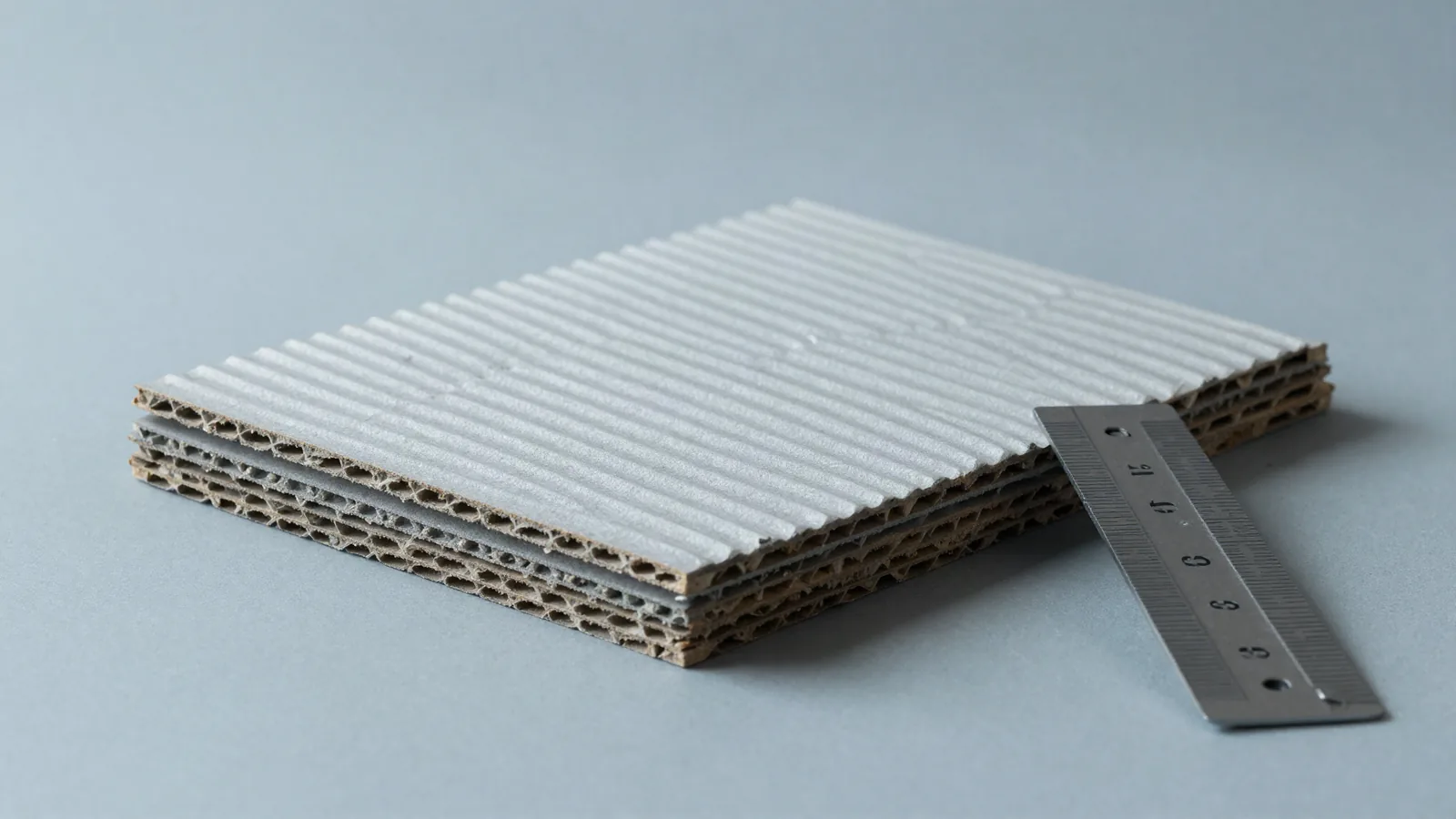
Use a calibrated thickness gauge on intact, flat areas away from scores, seams, adhesive, and crushed corners. Take several readings with consistent pressure, record each result in millimeters, and state whether the sample is an unconverted sheet or an assembled wall. Corrugated material should be measured across the complete combined wall rather than at a compressed fold.
Do not blend damaged and intact readings into one average. A wide spread can signal compression, coating buildup, or a mixed sample, so resolve the cause before using the figure for product clearance. Common industry references are nominal, and the selected production stock still needs its own measurement.
| Material or profile | Common thickness reference | Where to measure |
|---|---|---|
| SBS paperboard | 12 to 24 pt, about 0.30 to 0.61 mm | Flat sheet away from scores |
| Kraft paperboard | 18 to 24 pt, about 0.46 to 0.61 mm | Unfolded panel |
| E flute corrugated | About 1.5 mm | Complete combined wall |
| B flute corrugated | About 3 mm | Complete combined wall |
| C flute corrugated | About 4 mm | Complete combined wall |
Record 32 ECT in a separate field from the millimeter reading.
How much box cavity is lost when board gets thicker?
Usable space changes wherever material folds inward, doubles over, wraps an edge, or surrounds an insert. Inside dimensions are normally recorded in length, width, and depth order, but the dieline must also account for score width, fold allowance, dust flaps, glue tabs, and doubled panels. Changing stock after the drawing is approved can therefore tighten the product opening even when the stated outside size stays fixed.
A straight tuck end carton loses space around folds and dust flaps. An auto-lock bottom adds overlapping material beneath the product, while a tube applies wall thickness around the entire circumference. Test the actual item in a converted blank, including any insert, because an exact nominal cut can grip the item and excessive relief can let it rattle.
Does thicker cardboard always make a stronger box?
No, wall thickness alone does not predict stacking, puncture, fold, or closure performance. Fiber construction, flute profile, span, humidity, score quality, adhesive placement, and box geometry all affect the result. For corrugated packaging, keep 32 ECT and wall caliper as separate records, then test the loaded structure in its intended orientation.
A thick panel can still fail if a score cracks or a lock does not engage. Compare the converted structure rather than ranking cardboard display boxes, cardboard boxes with inserts, and cardboard tube packaging by one thickness number.
Why can a box fail when the thickness reading is correct?
Springing flaps, bowed panels, loose inserts, and split scores usually point to conversion or fit choices outside the wall measurement. Offset printing is common for detailed paperboard graphics, flexographic printing for corrugated liners, and digital printing for shorter runs. Heavy ink coverage, matte or gloss lamination, and spot UV can change the surface and fold response, so inspect a finished scored piece.
Keep coatings out of glue zones, verify locks and tabs after finishing, and compare the first converted piece with the approved material record. Use the custom packaging design guide for structural file planning. The sample kit provides stock and finish references before the final board specification is locked.
Frequently Asked Questions
Is there one standard cardboard thickness for every box?
There is no single standard cardboard thickness for every box. Paperboard cartons, corrugated mailers, rigid boxes, and cardboard tubes use different material structures and measurement records. Identify the package format first, then request the selected stock's point or caliper, measurement location, and finished fit instead of relying on a general cardboard average.
What is the difference between point and caliper?
Point is a paperboard thickness convention, while caliper is the measured thickness of the stated material. One point equals 0.001 inch, approximately 0.0254 millimeters. A useful packaging quote connects the value to the board family, measurement location, package style, artwork surface, and interior fit.
Does cardboard thickness affect the box design?
Cardboard thickness affects box design because it can change scores, folds, tabs, closures, edge fit, panel stiffness, and interior clearance. The dieline and product dimensions should be reviewed with the selected board. Inserts, trays, wrapped edges, and tube walls add separate fit questions that the thickness number alone cannot answer.
Can Custom Packaging Lane help identify the right cardboard stock?
Custom Packaging Lane provides free design support for identifying a workable package structure. Share the product dimensions, box style, artwork, closure, insert needs, and intended handling. The material discussion can then stay tied to the relevant package family and its point or caliper reference before the digital proof is approved.
What does a cardboard thickness project cost?
Custom Packaging Lane pricing is from $0.49 per unit at volume, quoted to spec. The MOQ is 100 units. The final quote depends on the selected stock, structure, artwork, finish, quantity, and approved details. Production is typically 8 to 10 business days after proof approval, plus delivery.