




























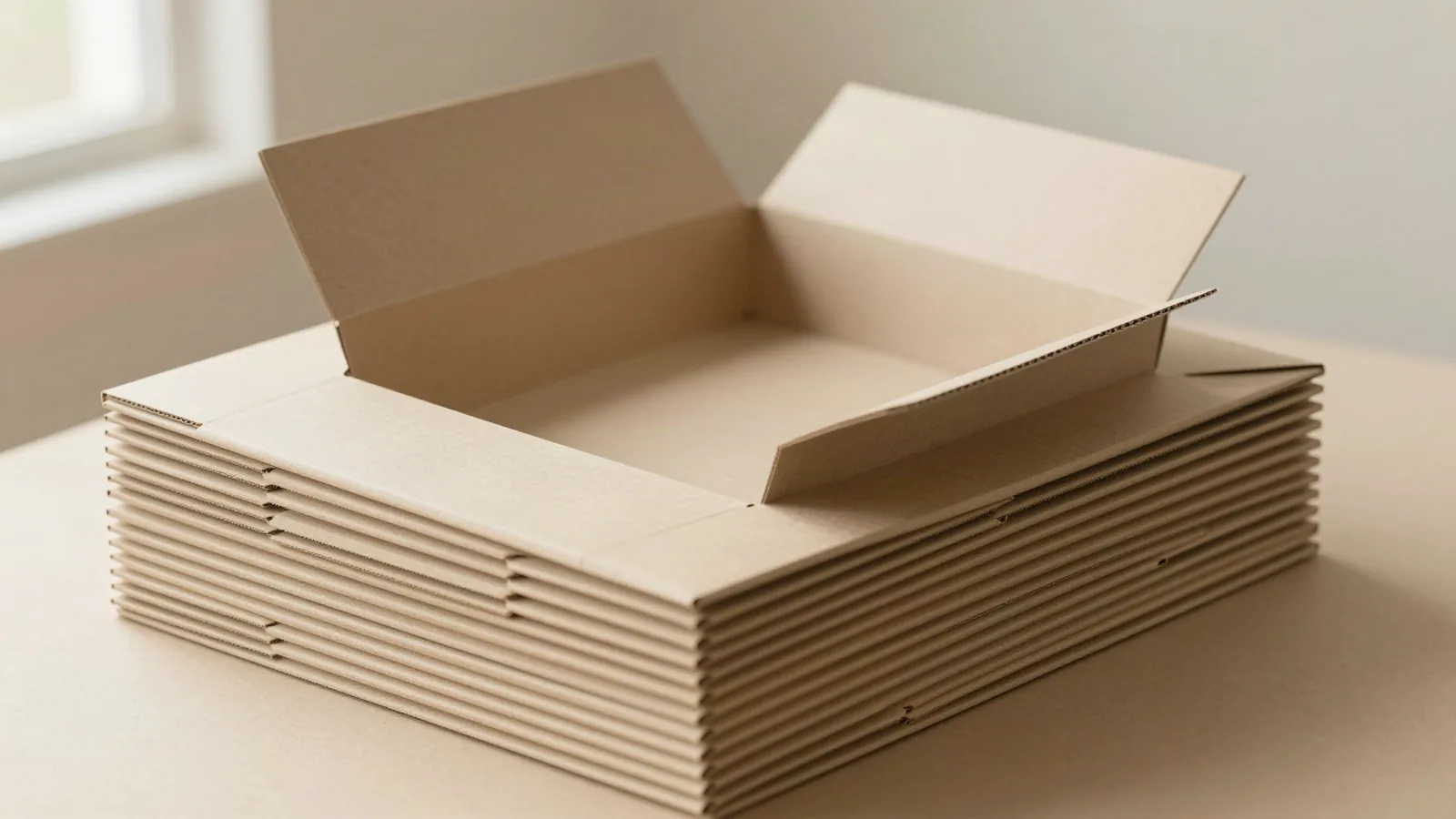




















































Which mailer structure fits the way customers open the parcel?
The opening sequence narrows the structure quickly: a tuck panel, glued end, sleeve, or self-locking base each asks the packer and recipient to do a different job. Start with the product in its packed state, including wrap, insert, card, and any fragile points. Then decide whether the mailer is the primary shipping container or sits inside another carton.
A custom packaging solutions brief is more useful when it names the loading direction, closure, interior support, and desired presentation. A slim item may fit a folding paperboard mailer. A heavier parcel may need corrugated construction. The flat dieline only shows part of the result.
Which board and construction should I compare?
Board choice changes the mailer's stiffness, print surface, folded shape, and packed volume. SBS, C1S, and C2S paperboard are commonly discussed at 12 to 24 pt, while kraft board is commonly discussed at 18 to 24 pt. Corrugated mailers are compared by E, B, and C flute, with 32 ECT as a familiar strength reference.
| Structure | Typical use | First physical check |
|---|---|---|
| Roll-end tuck top, FEFCO 0427 | Presentation-focused mailer | Lid fit and opening clearance |
| Straight tuck end | Folding carton-style mailer | Panel alignment and closure |
| Reverse tuck end | Efficient shelf or parcel format | Front and back orientation |
| Auto-lock bottom or crash-lock | Fast setup for packed goods | Base engagement and packout access |
FEFCO 0427 is a common reference for a roll-end tuck-top structure. E flute has a finer corrugated profile, B flute has more board depth, and C flute is deeper again. The practical decision is the one that leaves enough room for the product, insert, and closure without making the mailer larger than the job requires.
How should printing and finish support the mailer's job?
Offset CMYK is common for detailed paperboard artwork. Flexo is typical for corrugated surfaces, and digital printing can suit short runs or changing versions. Matte or gloss lamination changes reflectance and scuff visibility. Soft-touch changes the tactile feel. Spot UV, foil stamping, embossing, and debossing can isolate a logo, pattern, or instruction, but they need clear space around scores, folds, glue areas, and openings.
Keep the working file in the dieline. A dieline is the flat template that maps panels, cut lines, scores, bleed, and safe areas. RGB artwork can shift when converted for press. Low-resolution images stay soft. A digital proof gives you a chance to catch type that sits too close to a score before production.
What dimensions belong in the mailer brief?
Use inside length x width x depth for the product space, then record the outside dimensions of the closed mailer for shipping planning. About 1/16 in, or 1.5 mm, is a common planning tolerance, but board caliper, crease behavior, product shape, and the insert can change the required clearance.
For US ground planning, dimensional weight commonly uses L x W x H / 139. Include product orientation, insert position, closure clearance, wrap, and protective material. If the mailer bows when loaded or the product rattles, the next revision should change the structure or fit, not simply add more artwork.
Which mailer product path is closest to my use case?
The closest catalog match depends on whether closure, recurring packout, interior position, or board surface drives the job. Compare custom tuck-top mailer boxes when closure simplicity is central. custom subscription mailer boxes suit recurring packouts that need a repeatable opening panel. Add custom mailer boxes with inserts when the item needs a defined position. For a paper-forward surface, compare custom kraft mailer boxes.
What should I send before artwork is prepared?
The first proof is easier to review when the packout and artwork are described together. Send the physical dimensions, loading direction, and closure before refining the printed panels.
- Product length, width, depth, orientation, and fragile points.
- Preferred structure, closure, board family, and interior support.
- Brand colours, print coverage, finish priorities, and copy placement.
- Packout photos or a sketch showing how the product enters the mailer.
Custom Packaging Lane quotes to spec from a 100-unit minimum, from $0.49 per unit at volume. Production typically takes 8 to 10 business days after proof approval, plus delivery. Free US shipping is available. Free design support and a free dieline are also available. The $19.99 sample kit is credited toward the first order.
Frequently Asked Questions
What is a custom mailer solution?
A custom mailer solution is a carton or mailer format selected around the product, opening sequence, delivery route, and interior support. The working decisions are structure, board, dimensions, closure, print coverage, finish, and insert. A useful brief also says whether the mailer ships by itself or sits inside a secondary carton.
Which mailer structure suits subscription shipments?
Subscription packaging needs a repeatable loading and opening sequence. A roll-end tuck top, straight tuck end, reverse tuck end, auto-lock bottom, or crash-lock bottom may fit different packouts. Compare product orientation, insert movement, lid or flap clearance, and the time needed to form the base before selecting the structure.
Should mailers use paperboard or corrugated board?
Paperboard can suit presentation-led mailers with detailed printed panels and surface finishes. Corrugated board can suit parcels that need flute-based construction and more board depth. Compare product weight, stacking conditions, outside dimensions, insert needs, and whether the mailer is the only protective layer in delivery.
Which finishes work well on mailers?
Matte or gloss lamination sets the main surface appearance, while soft-touch changes the tactile feel. Spot UV can isolate a logo or pattern, and foil stamping adds a reflective detail. Embossing and debossing change the surface physically, so artwork needs clear space around folds, closure tabs, glue lines, and opening features.
What information should I prepare for a mailer quote?
Prepare product dimensions, packed orientation, desired structure, board preference, print coverage, finish, quantity, destination, and insert requirements. Include reference artwork or a simple layout that shows the front, back, opening panel, and interior placement. Photos or a physical sample help confirm fit and closure behavior before the final dieline is approved.












