
































































How big should a boot box be?
The starting reference is the packed pair, not the shoe size printed on a label. Typical outer boot cartons often measure around 14 to 18 inches long, 10 to 14 inches wide, and 5 to 8 inches high, or 35.6 to 45.7 cm long, 25.4 to 35.6 cm wide, and 12.7 to 20.3 cm high. Those are planning ranges, not the dimensions for your boots, so measure the packed pair before the box is drawn.
Record the sole length, widest point, heel or toe projection, shaft height, tissue, insert, card, and any accessory that shares the carton. Keep the loading direction visible in the brief. A tall boot can fit the footprint and still fail at the shaft or opening.
Which parts of a boot set the box fit?
The sole, heel, toe, and shaft create different clearance problems inside one carton. Measure the pair in the orientation used for storage and display, then record where the upper can touch the board.
| Boot package zone | What to measure | Why it affects the box |
|---|---|---|
| Footbed and sole | Length, widest point, and paired orientation | Sets the main cavity and side clearance |
| Heel and toe | Projection, contact points, and any shape change | Prevents pressure against folds or panels |
| Upper and shaft | Highest point, collapse direction, and opening clearance | Controls box depth, height, and loading direction |
| Accessories | Tissue, cards, laces, care pieces, or inserts | Stops small items from competing with the boot cavity |
How should I measure boots for a box?
The cavity is the usable inside space around the packed product. Write dimensions as length x width x depth and label every value as inside or outside. About 1/16 in, or 1.5 mm, is a common packaging tolerance reference, but the fit still needs a filled sample with the selected board, folds, insert, and closure.
Note the highest point of the shaft and the direction in which the boot enters. A carton that opens from the short side may need a different flap layout from one that opens from the top. The empty artwork file cannot show whether the upper catches on a score or seam.
Which structure works for tall boots?
Opening direction usually decides the structure once the packed height is known. A straight tuck end or reverse tuck end creates a familiar folding-carton opening. An auto-lock bottom or crash-lock base changes assembly and base support. A two-piece rigid box separates lid and base, while a drawer, slide, or sleeve changes the removal path. Load the actual pair before fixing the closure.
What kind of board should a boot box use?
SBS, C1S, or C2S paperboard in the 12 to 24 pt range is a common folding-carton reference. Kraft board in the 18 to 24 pt range gives a different color base. Rigid chipboard in the 1.5 to 3 mm range, wrapped in 100 to 157 gsm art paper, creates a more structured presentation package.
A flute is the corrugated wave between liner sheets. E, B, or C flute corrugated with 32 ECT are common references for an outer shipping layer. ECT, or edge crush test, is a corrugated board strength reference. Keep the boot carton and the shipper as separate layers because the retail box and transport carton solve different problems.
Can a boot box include a clear window?
A window can show the boot color, finish, or upper without opening the carton. PET is a clear plastic film used for window patches, and 0.2 to 0.3 mm is a common packaging reference. Map the window after the pair, tissue, seam, folds, and viewing direction are defined.
The window changes the artwork area and adds a patching step. Keep it away from scores, glue zones, and the part of the panel that carries the most useful copy. If light, dust, or surface contact matters, compare the window with a closed printed panel before approval.
How should boot-box artwork and finishes be set up?
Offset CMYK suits detailed artwork across folding-carton panels. Flexo is a common print reference for corrugated outer packaging, while digital printing can suit a short run or a test of the artwork direction. Matte or gloss lamination changes the surface. Soft-touch, spot UV, foil stamping, embossing, and debossing can mark selected areas when the art leaves room around folds and handling edges.
Check low-resolution images, RGB files, bleed, and type near a score before the proof is approved. A logo that looks centered on a flat file can move visually after folding. Mark glue tabs, closure panels, and the buyer viewing direction on the artwork review.
Which product formats can guide boot-box planning?
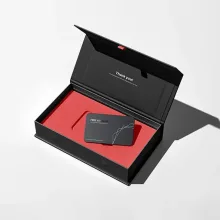
Window display boxes are a useful reference when visibility is part of the retail presentation. Compare window boxes for panel and patch planning, and use wallet boxes as a smaller accessory-packaging reference for cards, care pieces, or other items that may travel with the boots. These pages provide format references, not boot dimensions.
What belongs on a boot-box proof?
A dieline is the flat cutting template used to show cut lines, scores, glue tabs, folds, and artwork panels. The proof should show the packed pair in its actual orientation, with the shaft, tissue, accessories, opening direction, and removal path visible.
- Label inside length x width x depth, outside size, shaft clearance, folds, seams, and closure movement.
- Mark any window, logo, foil, spot UV, embossing, or debossing layer separately.
- Check that the upper does not press against a sharp fold, glue seam, or window edge.
- View the carton from the buyer direction and inspect the filled pair before approval.
- Record how many flat cartons nest in the master carton and how packed cartons are arranged for delivery.
How are boot boxes quoted?
Send the packed pair dimensions, shaft height, structure preference, artwork status, window or insert needs, quantity, and delivery destination. Custom Packaging Lane quotes boot boxes to spec from a 100-unit minimum, with pricing from $0.49 per unit at volume, quoted to spec. Production typically takes 8 to 10 business days after proof approval, plus delivery. Free US shipping, free design support, and a free dieline are available. The $19.99 sample kit is credited to the first order. For branded carton planning, use custom boxes with logo.
Frequently Asked Questions
What clearance should boots have inside a carton?
Boot clearance should account for the sole, heel, toe, shaft, tissue, inserts, and the direction of loading. The upper should not press against a fold, seam, or lid. Measure the packed pair rather than adding a generic allowance, then check the complete carton with the selected board and closure.
Does shaft height change the box structure?
Shaft height can change the box depth, opening direction, flap layout, and loading sequence. A tall upper may need a top opening, a deeper cavity, or a rigid lid and base. Measure the highest point of the packed boot and test the pair in the intended storage orientation before fixing the structure.
Is a rigid boot box worth comparing with a folding carton?
A rigid boot box uses a separate lid and base and holds its shape differently from a folding carton. A folding carton can use straight tuck end, reverse tuck end, auto-lock bottom, or crash-lock construction. Compare the opening, storage, product protection, and assembly path with the actual pair inside.
What does PET window film do in a boot box?
PET window film creates a clear panel that lets a buyer see the boot without opening the carton. Film around 0.2 to 0.3 mm is a common packaging reference. The patch uses artwork area and must be checked against scores, glue zones, seams, folds, and the surface protection the boot needs.
Which files should I send with boot-box artwork?
Send the product dimensions, packed orientation, structure preference, logo or artwork, window position, insert details, quantity, and destination. Mark bleed, fold scores, glue tabs, and panels that must remain visible. Low-resolution art, RGB files, small type near scores, and missing bleed should be resolved before the proof is approved.