




























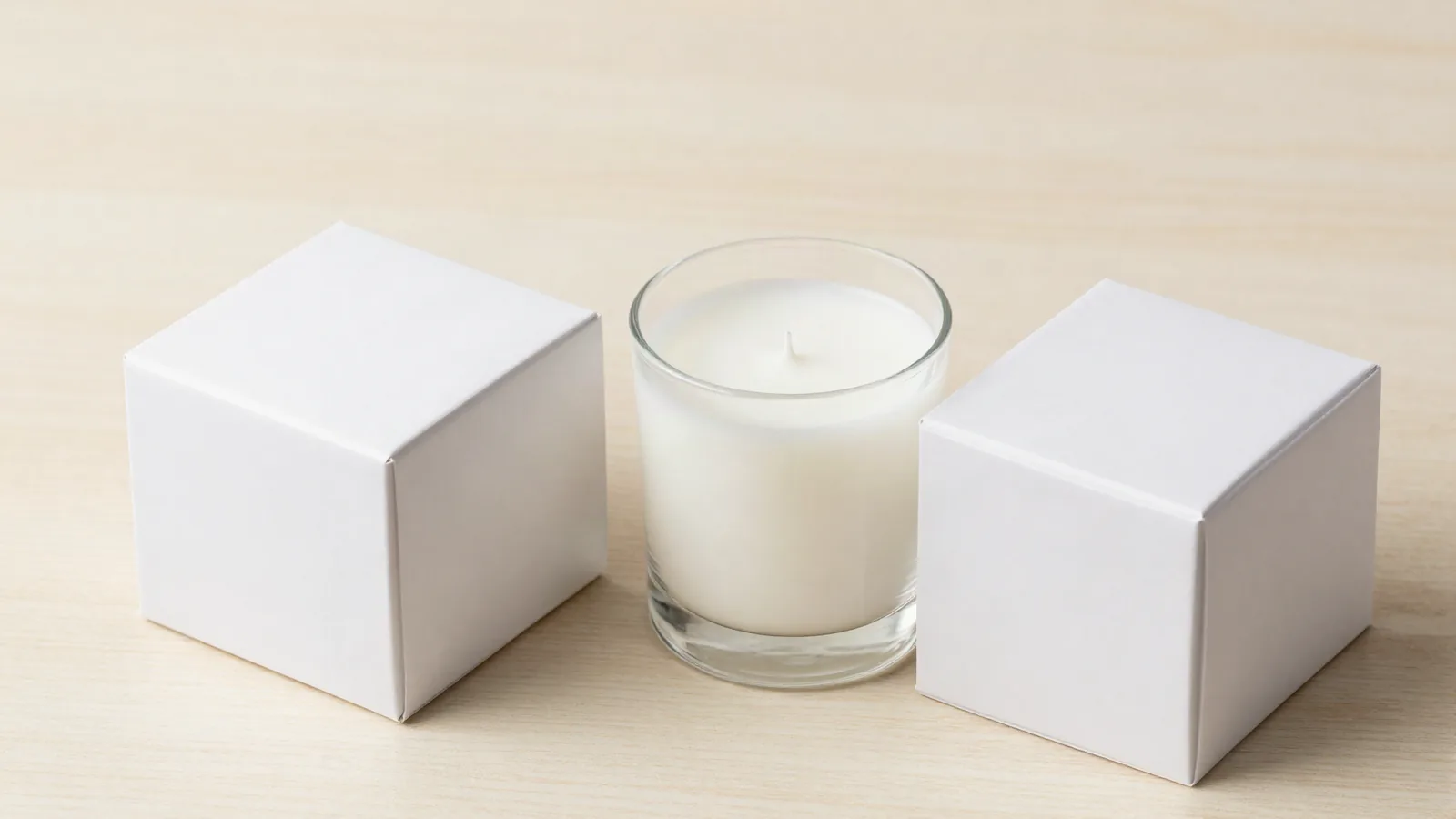




















































A candle box and paper bag set has two connected jobs. The box holds the candle, controls the opening, and carries the printed surface. The paper bag carries the finished box after the sale. A dieline is the flat cutting template that shows panels, scores, folds, glue areas, and cut lines before the box is made. Start with the actual candle vessel, its lid or closure, and the handoff you expect at the counter or gift table.
How do the box and bag divide the work?
The folding carton or rigid box controls fit and opening; the paper bag controls carrying, gusset space, handles, and the outside handoff. A box that fits the candle can still be a poor match if the bag opening catches its corners or the base sags under the packed load. Decide whether the set holds one boxed candle, a candle with a care card, or a grouped gift set. Then check the finished box inside the bag, not an empty drawing beside it.
Which structure should I compare for a candle set?
A reverse tuck end changes the panel order, while a two-piece rigid box separates the lid from the base. Use the table to set the first structure conversation.
| Structure | Typical job | Fit question |
|---|---|---|
| Straight tuck end carton | Shelf presentation with integrated flaps | Will the vessel stay in position without an insert? |
| Reverse tuck end carton | Folding carton with an alternate panel order | Which face should carry the main artwork? |
| Two-piece rigid box | Separate lid and base for a gift opening | Can the bag accept the box without crushing its corners? |
| Retail paper bag | Carry format for one box or a grouped purchase | What opening, gusset, handle, and packed load must it accept? |
Which materials fit the box and bag pairing?
Folding cartons usually start with SBS, C1S, or C2S paperboard, three stock designations used for printed carton faces. A general industry reference places these boards in the 12 to 24 pt range. Kraft board commonly falls in the 18 to 24 pt range and gives the set a different surface direction. A rigid box uses chipboard, a dense board core, in the 1.5 to 3 mm range, with 100 to 157 gsm art paper wrapped around it. Specify the paper bag by its paper grade, gusset, handle attachment, and packed load, then keep the color and surface relationship deliberate across both pieces.
How do I size the box and bag together?
Inside length x width x depth starts with the vessel closed, then includes the insert, care card, tissue, or protective wrap. A gusset is a folded side or bottom panel that creates extra room in a paper bag. About 1/16 in, or 1.5 mm, is a common planning tolerance, but the right clearance depends on the vessel shape and closure. Measure the finished box before setting the bag opening and base. Check handle attachment and the packed load with the actual box inside.
Which print and finish choices can cross both pieces?
Offset CMYK suits detailed carton artwork, while digital printing can suit a short-run concept check. Matte or gloss lamination changes sheen. Lamination is a film or coating bonded over the printed surface, so it should be shown on the proof instead of added as an afterthought. Soft-touch changes the feel. Spot UV, foil stamping, embossing, and debossing can set apart a mark or message on a lid or front panel. Check ink coverage, bleed, and type near every score. Place handles, folds, seams, gussets, and glue tabs on the artwork map before the digital proof is approved.
Which CPL products should I compare first?
Four catalog pages make the set easier to scope. Small candle boxes give a compact carton reference. Tealight candle boxes fit a smaller-unit discussion. Reverse tuck candle boxes show the relevant folding structure, and retail paper bags cover the carry component. Use those pages to choose a direction, then size the box and bag around the actual vessel.
What should I send in the quote brief?
The first line should state the vessel, finished box, bag opening, and intended handoff. Include a digital proof request. A digital proof is the screen check that catches artwork placement before anything prints.
- Provide the candle vessel, lid, insert, care card, tissue, and finished product dimensions.
- State whether the bag carries one box, several boxes, or a gift set.
- Choose a folding carton, rigid box, sleeve, or opening direction.
- Mark print coverage, finish zones, handles, gussets, seams, folds, and glue areas.
- Share the delivery destination and whether the set is handed over or shipped.
Custom Packaging Lane quotes this set to spec from a 100-unit minimum. Pricing is from $0.49 per unit at volume, quoted to spec. The quote follows the selected box, bag, materials, print, finish, quantity, tooling, and shipping zone. Production is typically 8 to 10 business days after proof approval, plus delivery. Free US shipping, free design support, and a free dieline are available during setup. Order the $19.99 sample kit, credited to the first order. For broader small-business planning, see custom packaging for small business.
Frequently Asked Questions
How should I measure the candle before requesting packaging?
Measure the finished vessel with its lid or closure in place. Add the insert, care card, tissue, or protective wrap that must travel inside the box. State the product orientation and whether the paper bag carries one boxed candle or a grouped set. Use inside length, width, and depth for the product-fit discussion.
What is the practical difference between straight tuck and reverse tuck?
A straight tuck end keeps the tuck flaps on one panel order, while a reverse tuck end changes which panels open from the front and back. That change affects the main artwork face, seam placement, and opening direction. Choose after checking the vessel fit, insert, closure, and the way the box sits inside the paper bag.
How should the paper bag fit the finished box?
The paper bag opening should clear the finished box, and the bag base should carry the packed load without forcing the box corners into the sides. Specify the gusset, handle attachment, handle length, and whether one box or several boxes travel together. Check the bag with the closed, finished box inside it.
Can the box and paper bag use different finishes?
Yes. A box may use matte or gloss lamination, soft-touch, spot UV, foil stamping, embossing, or debossing, while the paper bag uses a simpler printed surface. Keep the logo position, color direction, contrast, and important text consistent. Map every effect away from folds, seams, handles, gussets, and glue areas.
What belongs in a custom candle set brief?
A useful brief names the vessel, lid, insert, box structure, bag opening, gusset, handles, packed load, artwork status, print coverage, finish areas, quantity, and delivery destination. State whether the set is for a counter handoff, gifting, or shipment. Those details give the dieline and proof a real packout to check.












