




























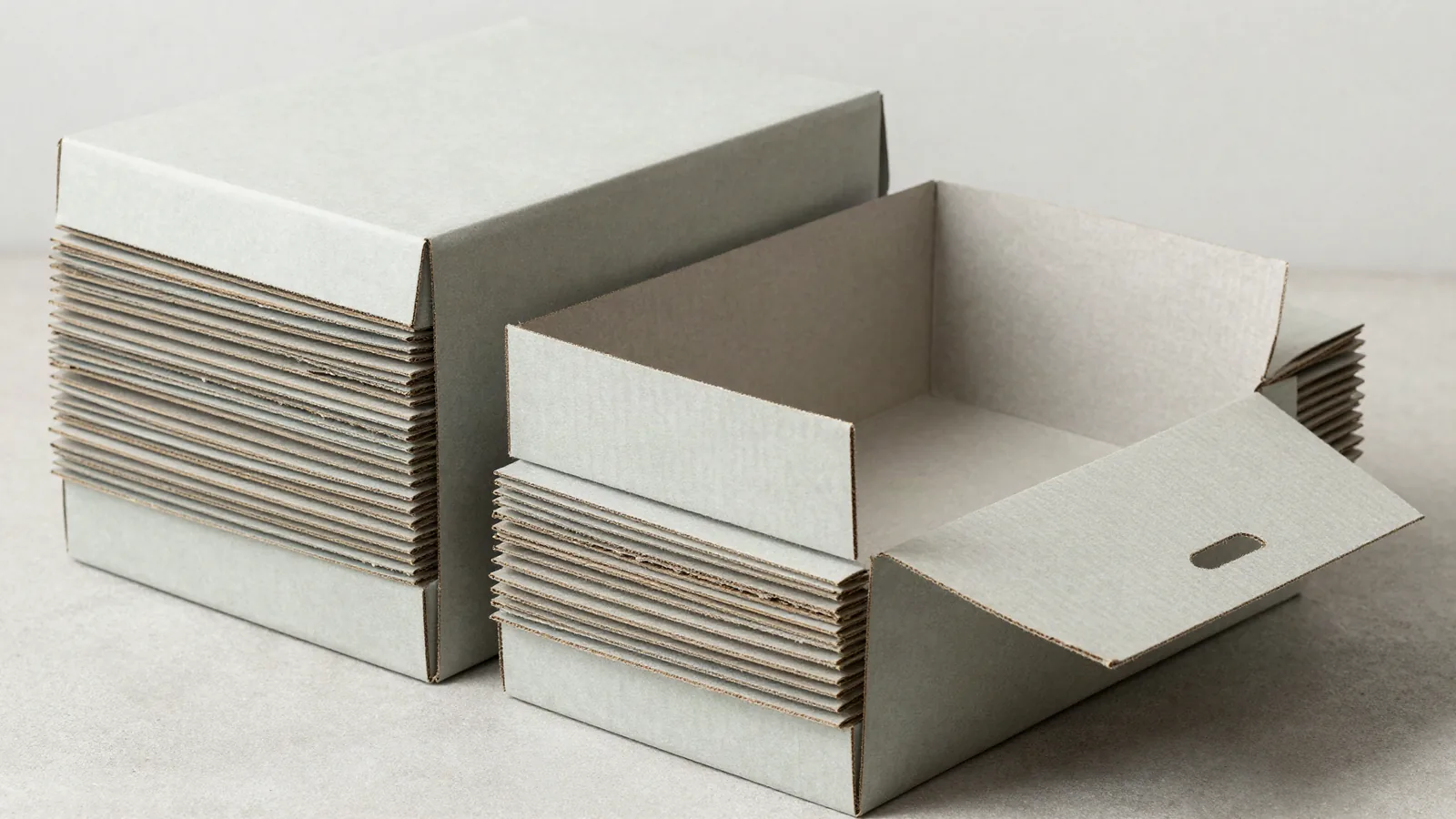




















































A clothing mailer is an outer package planned around a folded garment and the way that garment moves through packing, delivery, and return handling. Decide whether the job is shipping-first or presentation-first. Start with the packed bundle, inner wrap, cards, accessories, and any return material that must travel with it.
What does the pack station need to know first?
The packed bundle sets the usable interior, not an empty sample. Record the garment fold, compressed thickness, inner wrap, accessory locations, insert position, and the direction the product enters the mailer. Mark where the packer applies a label or closes the flap. A repeat shipment needs the same sequence each time, even when the garment or card changes by cycle.
Which workflow checkpoints belong in the brief?
Five checkpoints connect the packing routine to the printed package.
| Workflow checkpoint | What to record | Why it belongs |
|---|---|---|
| Bundle preparation | Fold method, inner wrap, cards, and accessories | Defines the usable interior and packing sequence |
| Opening path | Pull tab, flap direction, and reclosure need | Shows how the recipient and packer handle the mailer |
| Shipping board | Corrugated flute or folding-carton direction | Connects the outer structure to parcel handling |
| Artwork zones | Logo panel, label area, scores, and glue zones | Keeps branding clear of working parts |
| Return handling | Extra space, closure behavior, and insert removal | Prevents a dispatch package from becoming awkward on return |
Which closure works when a garment may come back?
A return-ready package needs a closure the recipient can understand and handle again. A roll end tuck top mailer is commonly associated with FEFCO 0427, a standard code for a style with an integrated opening and closing sequence. A straight tuck end or reverse tuck end can suit a folding-carton presentation. An auto-lock bottom or crash-lock structure can simplify setup when the bottom must hold its shape. Choose after recording how the package is opened, folded, sealed, and handled again.
Which board references fit parcel handling?
Corrugated E, B, and C flutes are common shipping references, while folding-carton and rigid stocks create different surfaces and structures. Corrugated board uses flutes, the arched paper layers that create thickness and cushioning. A common shipping reference is 32 ECT, where ECT means edge crush test, a board-strength measurement. Printed cartons commonly use SBS, C1S, or C2S paperboard in the 12 to 24 pt range. Kraft board commonly falls in the 18 to 24 pt range. A rigid presentation can use 1.5 to 3 mm chipboard wrapped in 100 to 157 gsm art paper.
What should the clothing mailer proof show?
The digital proof must show score lines, glue tabs, label areas, the closure, and the artwork panels in their working positions. A dieline is the flat cutting template that shows where the board will cut, fold, and glue. Offset CMYK suits detailed paperboard artwork. Flexo printing is commonly considered for corrugated surfaces, while digital printing can suit a short run or an artwork test. Matte or gloss lamination, soft-touch, spot UV, foil stamping, embossing, and debossing should be marked by panel. Keep effects away from folds, seams, and closures.
How do clothing mailer dimensions affect shipping weight?
Outside size can affect carrier billing even when the garment is light. State length x width x depth and identify whether the measurements are inside measurements. About 1/16 in, or 1.5 mm, is a common planning tolerance, but useful clearance depends on the garment fold, wrap, insert, and closure. For US ground shipping, dimensional weight commonly uses L x W x H / 139. Compare the outside size with the actual packed bundle before proof approval.
Which CPL products can anchor the mailer brief?
Use clothing subscription boxes when the same packing routine repeats. Compare clothing gift boxes when presentation is part of the handoff, and compare clothing boxes when the garment needs a broader carton reference. These catalog pages frame the choice. The packed bundle, closure, board direction, and shipping route still set the project specification.
What should I send for a clothing mailer quote?
The useful starting point is the packed garment, opening path, and return requirement. State whether the mailer is for subscription fulfillment, gifts, or direct shipping.
- Send the garment type, fold method, inner wrap, accessory list, and bundle dimensions.
- State the opening preference, return requirement, board direction, and closure.
- Mark print coverage, logo panel, label area, scores, glue zones, and finish areas.
- Provide artwork status, quantity, delivery destination, and any outer-package need.
- Describe the packing sequence the proof must show at the bench.
Custom Packaging Lane quotes clothing mailers to spec from a 100-unit minimum. Pricing is from $0.49 per unit at volume, quoted to spec. The quote follows board caliper, print coverage, finishing, quantity breaks, tooling, shipping zone, and structure. Production is typically 8 to 10 business days after proof approval, plus delivery. Free US shipping, free design support, and a free dieline are available during preparation. Order the $19.99 sample kit, credited to the first order. For broader planning, see custom packaging for small business.
Frequently Asked Questions
What is the difference between a clothing mailer and a clothing box?
A clothing mailer is planned around an integrated opening, closure, and parcel handoff. A clothing box may put more space into retail or gift presentation. Some structures can cover both jobs. Compare the packed garment, inner wrap, board or corrugated direction, label area, opening path, and return handling before choosing.
How should a subscription shipment change the mailer brief?
A subscription brief should record the repeat contents, garment fold, inner wrap, cards, accessories, closure sequence, label location, and any material that travels back during a return. The proof should show the same pack order that the station will use for each cycle, even when artwork or garment details change.
What makes a clothing mailer ready for returns?
A return-ready mailer explains how the recipient opens it, whether the original closure can be used again, and whether the garment needs extra refolding space. Note the insert, card, label, and inner wrap positions. Test the package after dispatch and again after the garment is placed back inside.
Why does FEFCO 0427 appear in clothing mailer discussions?
FEFCO 0427 is a standard code commonly associated with a roll end tuck top mailer. The style uses an integrated opening and closing sequence, so the packer and recipient handle the same structure. Confirm the garment bundle, closure, board direction, label area, and return path before choosing the code as the format reference.
How should I compare paperboard and corrugated mailers?
Paperboard gives a printed carton surface, while corrugated E, B, or C flutes create a thicker shipping structure. A 32 ECT reference describes edge crush performance. Compare the packed garment, outside package, closure, label area, print process, and whether a second carrier package is needed.












