




























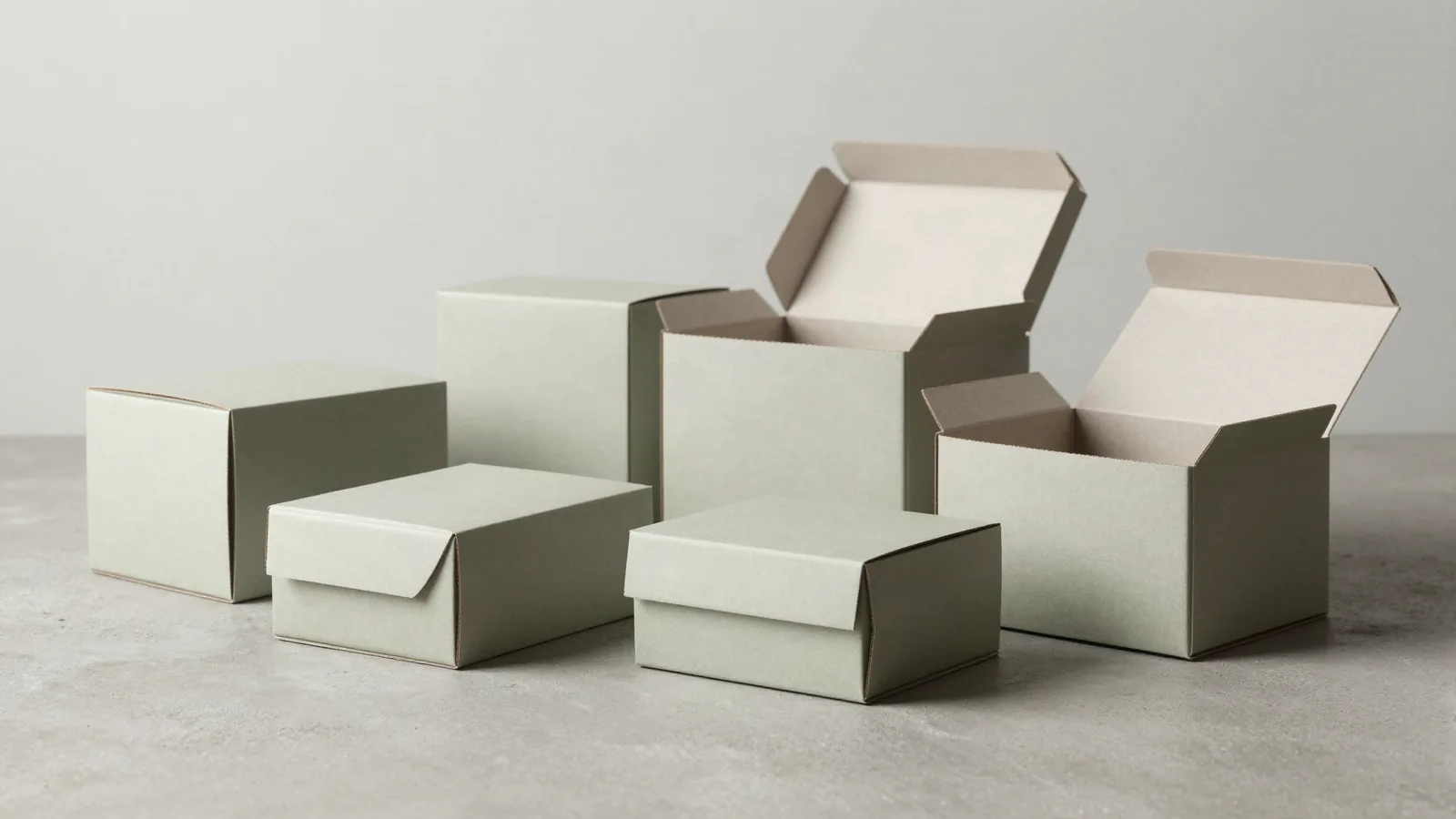




















































The choice gets easier when the box is defined by its job. Decide whether the package must present, protect, ship, dispense, stack, or support repeated access. Then record the packed product dimensions, inside clearance, opening sequence, closure, and surfaces that need print. A visual reference can start the conversation, but the loaded product decides the box.
How do I choose a custom box format?
The first choice is the job the box must perform: presentation, protection, shipping, dispensing, stacking, or repeated access. A bottle may need neck support. A vial may need grouped cavities. A mailer has to close cleanly after packing and fit its parcel path. Write length x width x depth and use inside measurements for the product fit.
Which structures should I compare?
A straight tuck end carton, a mailer, and a rigid drawer can all look different because they solve different handling problems.
| Structure | Typical use focus | Check before approval |
|---|---|---|
| Straight tuck end | Accessible folding carton | Tuck direction and repeated opening |
| Reverse tuck end | Folding carton with opposing tucks | Panel sequence and closure overlap |
| Auto-lock or crash-lock bottom | Faster setup and stronger base | Base engagement under product weight |
| Mailer | Parcel-oriented presentation | Roll end, tuck top, and shipping fit |
| Two-piece rigid or drawer | Structured presentation | Lid movement, friction, and storage volume |
For bottle-led work, compare custom woozy bottle boxes. For small cylindrical products, use custom vial boxes as a fit reference. When parcel presentation matters, custom tuck top mailer boxes show why closure, stacking, and outside dimensions belong in one check.
What dimensions and clearance should go into the dieline?
A dieline is the flat cutting template that marks cut lines, scores, folds, glue tabs, and panels. About 1/16 inch, or 1.5 mm, is a common planning tolerance, but the product, insert, label, and wrap decide the final clearance. Measure the loaded product, not an idealized product listing. A box that is slightly tight can stress folds or slow packing. An insert that is too loose lets the product shift.
Which board and flute fit the job?
Paperboard, rigid board, and corrugated board solve different physical problems. SBS, C1S, and C2S paperboard commonly fall in the 12 to 24 pt range. Kraft board commonly falls in the 18 to 24 pt range. Rigid boxes commonly use 1.5 to 3 mm chipboard wrapped in 100 to 157 gsm art paper. Corrugated formats commonly use E, B, or C flutes, with 32 ECT as a common strength reference. Weight, dimensions, stacking, fold pattern, and transit exposure guide the selection.
How do print and finish choices change the box?
Offset CMYK is common for detailed paperboard artwork, flexo is common for corrugated surfaces, and digital printing is often considered for short runs. Matte or gloss lamination changes reflection and color perception. Soft-touch changes the tactile impression. Spot UV, foil stamping, embossing, and debossing create focused detail, but they need room around folds, seams, and small type. Window patching adds a clear product area and another boundary for artwork. If any surface will touch food, ask us about food-contact options.
What physical checks catch problems before production?
A loaded physical check catches fit and closure problems that a flat file cannot show. Test the actual product, insert, label, accessory, and wrap in the box.
- Measure the packed product and record inside clearance.
- Test closure engagement with one hand and after repeated openings.
- Inspect folds, corners, seams, glue tabs, and decorated edges.
- Check shelf orientation, stacking, and placement inside the outer carton.
US ground carriers commonly use L x W x H / 139 for dimensional weight. That formula uses the outside packed dimensions, so shipping-oriented box choices need the outer carton and parcel role recorded beside the product box.
How do I move from a box idea to a quote?
A quote request becomes usable when it names the product, packed dimensions, structure, material, artwork status, quantity target, finish, and delivery location. The packaging sample kit gives the buyer a physical way to compare board feel and finishes. For a wider format comparison, use wholesale custom packaging.
Custom Packaging Lane quotes custom boxes from a 100-unit minimum, with pricing from $0.49 per unit at volume, quoted to spec. Production is typically 8 to 10 business days after proof approval, plus delivery. Free US shipping, free design support, and a free dieline are available. The $19.99 sample kit is credited toward the first order. Confirm the exact structure, dimensions, artwork, material, finish, and packout in the approved proof.
Frequently Asked Questions
How do I select a custom box structure?
Select the structure from the product's handling and presentation needs. Straight tuck and reverse tuck cartons suit folding formats, auto-lock or crash-lock bottoms can help with setup, mailers suit parcel presentation, and rigid or drawer formats suit a more structured opening. Test the loaded box so closure force, base support, and packout speed are checked together.
What box dimensions should I provide?
Provide the product's length, width, and depth with every item that will be inside the package. Include inserts, wraps, labels, accessories, and required clearance. State whether the measurements are inside or outside dimensions. Inside measurements are the fit reference, and a common planning tolerance is about 1/16 inch, or 1.5 mm.
Are custom boxes suitable for shipping?
Some custom box structures suit parcel handling, but shipping suitability depends on product weight, board selection, closure, stacking, outer cartons, and void control. Mailer and corrugated formats are common references for shipping-oriented work. Test the loaded package inside its shipping carton and record the outside dimensions used in carrier calculations.
Can I combine printing with special finishes?
Printing can be combined with matte or gloss lamination, soft-touch, spot UV, foil stamping, embossing, debossing, or window patching when the structure supports them. Check glare, texture, registration, folds, and small details. Keep critical artwork away from seams and crease lines, and approve the finished surface under practical viewing light.
What should be checked before approving a custom box proof?
Check fit, clearance, closure, base engagement, fold alignment, artwork cropping, color, finish, edge condition, and the full packout. Use the actual product and accessories. Test shelf orientation, stacking, and shipping-carton placement when relevant, because outside dimensions affect logistics planning.












