




























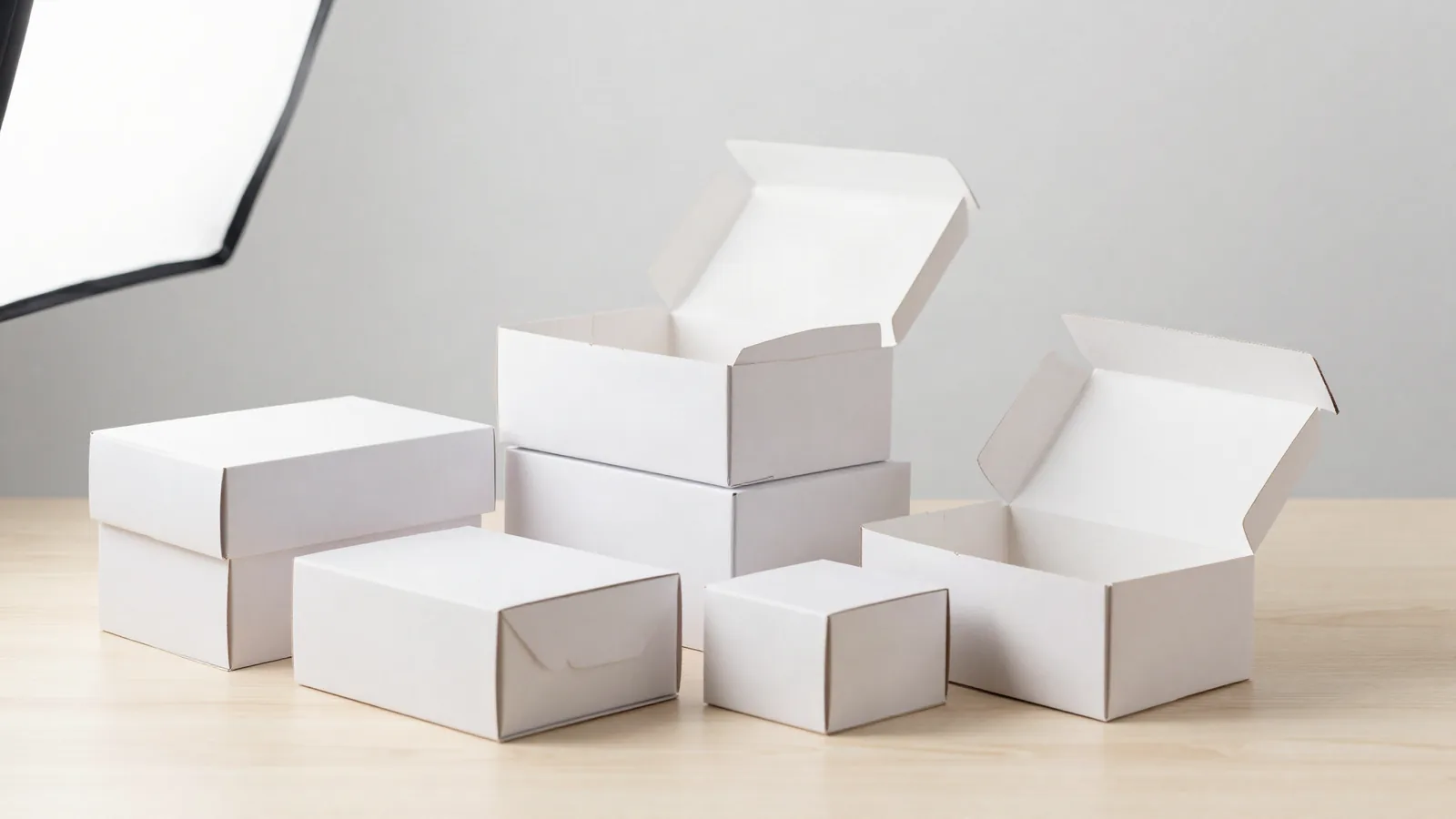




















































Custom boxes now means a complete handoff, not a promise to skip engineering. Put the product, inside measurements, opening, print, finish, and delivery context in one file set. A partial brief can move quickly at first, then stall when the flat template exposes missing dimensions.
What do I need for a custom box quote now?
A finished product or dependable drawing gives the brief its physical starting point. Add the inside space, packed orientation, preferred structure, closure, print coverage, finish, insert, and destination. If the size is unknown, send the component dimensions and desired clearance. Keep approved artwork, working artwork, and missing copy clearly separated.
| Ready-to-quote input | What to provide | Why it matters |
|---|---|---|
| Product fit | Component, inside measurements, clearance, and orientation | Determines internal package space |
| Structure | Carton, mailer, sleeve, rigid box, pouch, or tin direction | Sets opening and construction logic |
| Artwork | Logo, copy, panels, color direction, and image files | Defines printable presentation |
| Finish | Laminate, soft-touch, spot UV, foil, embossing, or debossing | Separates surface effects from base print |
| Delivery | Location, package role, and planned quantity | Scopes the delivered request |
Can I move quickly without skipping the proof?
Speed comes from closing open decisions before the file reaches the proof stage. A dieline is the flat cutting template that shows cuts, folds, glue areas, and open panels. We send a digital proof before printing. Check product fit, panel order, closure, folds, seams, glue zones, image placement, and finish layers. If a barcode is present, inspect its size and quiet zone. The proof catches type too close to a score, an image that is too soft, or artwork that changes when RGB is converted for press.
A proof is the point where the flat dieline, printed face, and assembled box can be compared. Approve it only after the product, structure, artwork, and finish plan describe the same package.
Which material should I choose first?
SBS, C1S, and C2S paperboard give a folding carton a smooth print surface in the 12 to 24 pt range. Kraft board is often discussed around 18 to 24 pt and gives the package a different base color and surface character. Rigid boxes commonly use chipboard around 1.5 to 3 mm wrapped in 100 to 157 gsm art paper. Pt is a board caliper notation, and gsm is a paper-weight measure.
Corrugated E, B, or C flutes create different profiles, stiffness, cushioning, and print surfaces. 32 ECT, or edge crush test, is a common corrugated strength reference. Treat these as typical industry planning references. The product, opening, storage, stacking, print coverage, and shipping role decide the working board.
Which box structure fits the job?
A roll-end tuck-top mailer points to a parcel-led format, and FEFCO 0427 is a common reference for that structure. Straight tuck end and reverse tuck end are folding-carton options with different panel and flap arrangements. Auto-lock and crash-lock bottoms change setup and base support. A two-piece rigid box separates lid and base, while a magnetic flap, drawer, or slide changes the opening motion. Pillow and gable structures create different shapes and loading paths. Choose the structure from the product and handoff, not from the word now.
How should I provide dimensions for a fast quote?
Length x width x depth is the cleanest notation, but the brief must label each value as inside or outside. Add product orientation, clearance, insert thickness, closure space, and any area that must remain open. About 1/16 in, or 1.5 mm, is a common tolerance reference. Confirm the working fit on the chosen board and structure.
US ground carrier planning commonly uses dimensional weight of L x W x H / 139. Keep that carrier calculation separate from product fit. A smaller outside carton can change shipping math, but it cannot solve an insert that is too tight or a product that rattles.
What print and finish choices belong in the first brief?
Offset CMYK, the four-color process, handles detailed paperboard artwork. Digital printing can suit short runs or an early artwork direction, and flexo is commonly associated with corrugated printing. Matte or gloss lamination changes reflection. Soft-touch changes hand feel. Spot UV, foil stamping, embossing, and debossing can mark selected areas. Put each treatment on its own layer and show how it sits around folds, seams, glue areas, openings, windows, and closure panels.
Which product references can help me choose a starting structure?
The catalog pages give the brief a physical reference for opening direction, footprint, or small-part arrangement. Review custom tuck-top mailer boxes for a shipping-led opening. Compare custom votive candle boxes for compact presentation, custom vial boxes for a small component fit, and custom undergarments boxes for a larger apparel-style package.
What should I send before asking for a quote?
A useful handoff is a short file set: product information, dimensions, structure, artwork, finishes, and delivery details.
- Provide the product, component drawing, inside measurements, and packed orientation.
- Choose the carton, mailer, sleeve, rigid, pouch, tin, or bag direction.
- Identify the closure, insert, window, support, seam, and glue requirements.
- Supply the logo, artwork, copy, color direction, print coverage, and finish layers.
- State the delivery location, package role, and planned quantity.
- Mark open decisions so they can be resolved before proof approval.
Custom Packaging Lane quotes custom boxes now to spec from a 100-unit minimum, with pricing from $0.49 per unit at volume, quoted to spec. Production is typically 8 to 10 business days after proof approval, plus delivery. Free US shipping, free design support, and a free dieline are available. The $19.99 sample kit is credited to the first order. Use custom packaging solutions for a broader format review, then send the finished brief for a quote.
Frequently Asked Questions
What file set makes a custom box quote usable?
A usable custom box quote file set includes the product or a dependable drawing, inside measurements, packed orientation, structure, closure, artwork status, print coverage, finish, insert needs, quantity, and destination. Keep approved files separate from working edits. That separation gives the dieline and proof a clear source of truth.
Does a packaging proof check more than artwork?
A packaging proof checks fit, panel order, folds, seams, glue zones, closure, image placement, and finish layers as well as artwork. Read it against the actual product and intended opening motion. A proof can expose a type block near a score, an RGB color shift, or an image that loses clarity in print.
Which structure suits a parcel-led custom box?
A roll-end tuck-top mailer is a parcel-led structure, and FEFCO 0427 is a common reference for that format. Straight tuck end, reverse tuck end, auto-lock, and crash-lock solve different carton jobs. Compare outside size, inside clearance, closure behavior, packed product movement, and the board before choosing.
What is the correct way to write carton dimensions?
Carton dimensions should be written as length x width x depth and labeled as inside or outside measurements. Add orientation, clearance, insert thickness, and closure space. About 1/16 in, or 1.5 mm, is a common planning tolerance. For carrier planning, US ground dimensional weight commonly uses L x W x H / 139.
Can one box brief include several print finishes?
One box brief can include several print finishes when each effect is assigned to a named panel or layer. Matte or gloss lamination changes reflection, soft-touch changes feel, and spot UV, foil stamping, embossing, or debossing affect selected areas. Keep effects away from folds, seams, glue zones, closures, and small type.












