




























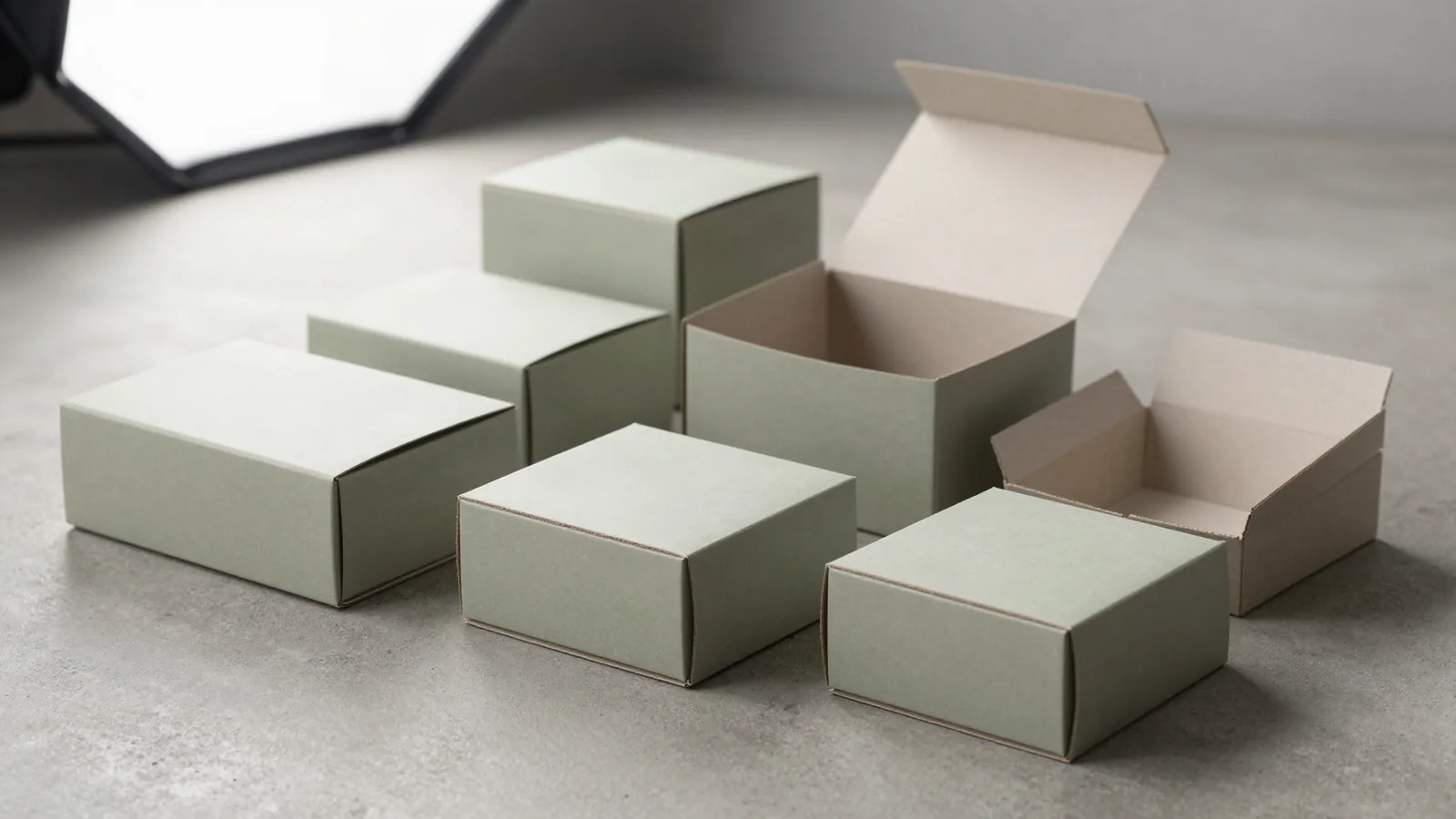




















































What should custom e-commerce boxes in the USA solve?
The box has to fit the packed product and work at the packing bench. Start with inside length x width x depth, packed weight, fragile areas, surface sensitivity, acceptable void space, and the order in which the team loads the box. About 1/16 in, or 1.5 mm, is a common tolerance reference for structural conversations. A dieline is the flat cutting template for the print, score, and cut. Record outside dimensions separately because the carrier sees the closed box, not the empty cavity.
Fulfillment details belong in the same brief. A fast tuck closure suits a simple pack, while several components may need a divider or insert. Reserve a readable label zone and keep brand graphics away from folds, seams, score lines, glue areas, and likely abrasion points. A package that closes well on a sample still needs to work with the actual product and packing sequence.
Which box structure fits direct-to-consumer orders?
A roll end tuck top mailer is a common starting point when the outer box needs a defined opening and a ship-ready closure.
| Structure | Fulfillment direction | Decision to make |
|---|---|---|
| Roll end tuck top mailer | Shipping-oriented closure and repeatable opening | Does the pack need easy opening and reclosure? |
| Folding shipping box | Flat storage and quick setup | How much bench assembly is acceptable? |
| Insert-supported carton | Multiple parts or movement-sensitive products | What must stay separated or centered? |
| Two-piece rigid box | Gift or presentation-led opening | Is fixed presentation worth less-flat storage? |
Roll end tuck top mailers are commonly discussed with the FEFCO 0427 reference, a standard structure reference for that format. Straight tuck end and reverse tuck end cartons use a folding-carton opening. Auto-lock bottom and crash-lock structures change bottom assembly and setup speed. A sleeve adds a printed layer around another carton. Choose the closure after checking packing time, storage, reclosure, product access, and the space at the packing station.
How do flute and board choices affect online orders?
E, B, and C are corrugated flute profiles, and their thickness changes print surface, cushioning, stacking behavior, and outside size. E flute is commonly discussed when a finer profile and smoother print surface matter. B and C flute discussions usually focus more on cushioning, stacking, and shipping support. A 32 ECT figure is a standard edge-crush-test reference used to frame corrugated strength, not a universal requirement.
Paperboard cartons commonly use SBS, C1S, or C2S around 12 to 24 pt. SBS is solid bleached sulfate paperboard, C1S is coated on one side, and C2S is coated on two sides. Kraft board is commonly around 18 to 24 pt. Presentation-led rigid boxes use chipboard commonly around 1.5 to 3 mm wrapped in 100 to 157 gsm art paper. Rigid construction holds shape through board and wrap, while a folding carton depends on scores and folds.
Which print and finish choices survive fulfillment handling?
Offset CMYK is commonly used for detailed graphics on folding cartons. Digital printing is often considered for shorter runs or artwork revisions. Flexographic printing is commonly used for corrugated packaging. Matte or gloss lamination changes sheen, soft-touch changes surface feel, spot UV adds a local gloss, and foil stamping, embossing, and debossing alter selected areas.
Keep finish masks away from scores, glue tabs, closure stress points, label zones, and barcode quiet zones. A barcode that scans on a flat file can become difficult to read after the panel bends or receives heavy glare. RGB artwork can shift when converted for press, and type too close to a score can break across the fold. The digital proof is the place to catch those file problems.
How do inserts change the package fit?
An insert is an internal structure that separates components, centers the product, limits movement, or guides the opening sequence. Specify the insert material, contact points, retention method, packing order, and finger access. A cavity cut to the exact product size can jam during loading, while an oversized cavity lets the product rattle. Test the insert inside the assembled outer box.
Carrier calculations use the closed outside size. For US ground dimensional weight, a common reference is length x width x height divided by 139. Dimensional weight estimates billed space from the outside size, so the formula is worth checking when a small exterior change still leaves the product fitted. Keep labels, barcodes, return instructions, and opening guidance readable after the box is folded, packed, and closed.
Which real product formats can I compare?
Review for a product-specific shipper direction. Compare when a compact folding-carton format is closer to the brief. For cylindrical products, custom woozy bottle boxes frame fit and insert questions. For a presentation-led format, see custom votive candle boxes.
What should a US e-commerce quote include?
Send the product dimensions and packed weight, packed configuration, insert or divider needs, closure preference, artwork, quantity, and delivery ZIP code. Custom Packaging Lane provides free design support and a free dieline. The quote is from a 100-unit minimum, with pricing from $0.49 per unit at volume, quoted to spec. Production is typically 8 to 10 business days after proof approval, plus delivery. Free US shipping applies.
Use the custom packaging solutions hub for broader format planning. Order the $19.99 sample kit, credited to the first order, when you need to check packed fit, closure movement, label placement, and the opening sequence before approving the package.
Frequently Asked Questions
What does custom e-commerce packaging need to account for?
Custom e-commerce packaging needs the packed product dimensions, weight, fragile areas, acceptable void space, packing sequence, storage method, shipping route, label zone, and opening path. Start with inside length x width x depth, then record the closed outside size. Decide whether the order needs a mailer, folding shipper, insert, divider, sleeve, or rigid box, and test that choice with the actual pack.
Why is a roll end tuck top mailer used for parcel orders?
A roll end tuck top mailer is commonly considered for parcel orders because it combines a defined opening with a shipping-oriented closure. Folding shipping boxes support flat storage and setup at a packing bench. The choice follows product fit, packing speed, reclosure, stacking, storage, and protection needs. A packed sample should confirm the closure before the dieline is fixed.
What does 32 ECT tell a shipper buyer?
A 32 ECT figure is a standard edge-crush-test reference used to frame corrugated strength. E, B, and C are flute profiles with different thicknesses and tradeoffs in print surface, cushioning, stacking, and outside size. E flute is commonly discussed for a finer profile, while B and C flute discussions focus more on cushioning and shipping support. Choose from the product, dimensions, handling, and packing conditions.
Can an e-commerce box include an insert?
An e-commerce box can include an insert that centers a product, separates components, limits movement, or guides removal. Specify the material, contact points, retention method, packing order, and finger access. Check the insert inside the assembled box because a cavity can hold the product and still interfere with a flap, lid panel, seam, label, or closure.
How should artwork be prepared for an online-order box?
Artwork for an online-order box should show panel order, folds, scores, glue areas, closure stress points, label zones, barcode quiet zones, and any finish masks. Offset CMYK, digital, and flexographic printing are common directions for different boards and run conditions. Check RGB conversions, bleed, type near scores, and barcode readability on the digital proof before the package prints.












