




























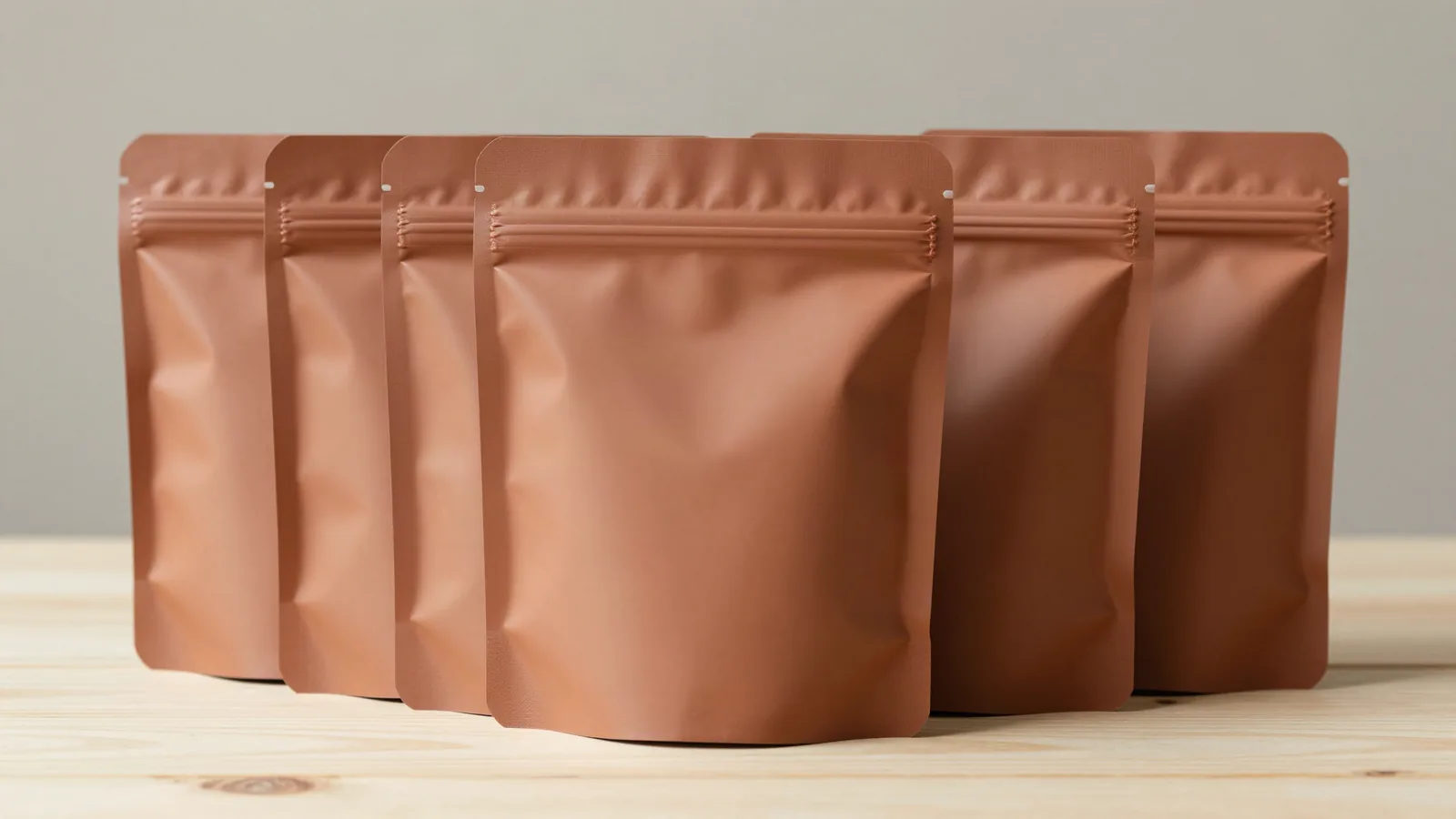




















































A custom foil pouch is a flexible package built from a barrier laminate, printed outside surface, seals, and an opening or closure. The pouch format follows the product form, filling method, display position, and storage behavior. Start with target fill, pouch width, gusset depth, closure preference, tear feature, and the space needed for artwork. Relevant catalog references include custom stand-up pouches, zipper pouches, and .
Which laminate layers belong in a foil pouch?
A common foil laminate uses PET, AL, and PE layers. PET is the printed outer support layer, aluminum is the barrier layer, and PE faces inward as the heat-seal layer. Aluminum helps block light, moisture, and odor transfer. PE provides the surface that seals. The exact construction follows the product, seal method, filling equipment, and handling requirements, so a metallic appearance alone is not a material specification.
| Specification area | Common industry reference | What to check |
|---|---|---|
| Laminate | PET / AL / PE layers | Print surface, barrier layer, and sealant layer |
| Format | Stand-up, zipper, or specialty pouch | Whether the pouch sits, hangs, or stays flat |
| Closure | Zipper or heat-sealed opening | Whether the product needs repeated access |
| Width | Stand-up pouches commonly 3 to 7.5 in wide | Fill volume, gusset geometry, and shelf space |
The 3 to 7.5 in width range is a general packaging reference. Usable capacity also depends on gusset depth, seal zones, fill weight, product shape, and the front panel left clear for artwork.
How do stand-up and zipper formats change the package?
A bottom gusset gives a stand-up pouch a base that lets it present upright on a shelf or counter. A zipper adds repeated opening and closing, but it also takes space at the top and needs a clear seal zone. A flat pouch uses less display depth. A specialty pouch can put more emphasis on portability or a particular use. Choose from the actual customer opening and storage behavior.
Kraft stand-up pouches show how the outer visual direction can change while the stand-up structure remains familiar. Herbal tea pouches are another catalog reference for pouch presentation. For a broader comparison, use custom packaging solutions after the format and laminate are defined.
Should the pouch use a zipper or a heat seal?
Repeated access points toward a zipper. A heat-sealed opening suits a package intended to be sealed through filling and opened later, when resealing is not part of the use. The closure changes the top seal, artwork clearances, tear feature, and usable fill area. Check the real opening motion with a sample because a closure that looks correct on the dieline can be awkward at the counter.
What pouch dimensions should I plan?
Stand-up pouch widths are commonly 3 to 7.5 in, but width alone does not set capacity. Gusset depth adds standing volume, while top and bottom seals reduce the usable area. Provide the target fill, product shape, pouch orientation, and shelf space. Record the finished outside size and the clear print panel separately so the front artwork does not run into a seal.
For irregular products, list the widest point, the fill level, and any headspace needed for the closure. Do not use the empty pouch as the fit reference. The filled package is the object that has to stand, close, and present correctly.
What print and finish choices work on foil pouches?
Artwork needs clear zones for the zipper, top and bottom seals, gussets, tear features, and folds. Digital printing can suit a short run or version test when the selected process supports it. Flexographic printing is commonly used for flexible packaging production. Matte or gloss treatments change surface reflection, and a metallic foil layer can shift how colors read. Check contrast, logo scale, front and back panel alignment, and barcode space on the proof.
Keep fine type away from the seal edge. A full-bleed file needs the printer's bleed requirement on the dieline, and RGB art can shift when converted for press. The proof is where the usable panel, closure, and finish zones should be read together.
How are custom foil pouches quoted?
Material yield and converting work drive the quote. Provide laminate construction, film specification, pouch dimensions, gusset depth, print coverage, finish, closure hardware, tear features, quantity, destination, and filling method. Quantity breaks and tooling can also affect the quoted scope. The front-panel design alone is not enough to define a pouch.
Custom Packaging Lane quotes to spec from a 100-unit minimum, with pricing from $0.49 per unit at volume, quoted to spec. Production is typically 8 to 10 business days after proof approval, plus delivery. Free US shipping, free design support, and a free dieline are available. Order the $19.99 sample kit, credited to the first order, to compare pouch structures and finishes before artwork approval.
Frequently Asked Questions
What does aluminum do in a foil pouch laminate?
In a PET, aluminum, and PE laminate, aluminum is the barrier layer that helps block light, moisture, and odor transfer. PET supports the printed outer surface, while PE faces inward and supports heat sealing. The final layer structure still depends on the product, filling method, seal conditions, and handling requirements.
What pouch width is common for stand-up formats?
Stand-up pouches commonly measure about 3 to 7.5 inches wide, but that range is only a starting reference. Gusset depth, seal zones, fill volume, product shape, and front-panel artwork change the usable capacity. Provide the filled product and target fill so width, height, gusset, and print area can be checked together.
How do zipper and heat-seal openings differ?
Choose a zipper when the customer needs repeated opening and closing. Choose a heat-sealed opening when the pouch is sealed through filling and is meant to be opened later without resealing. The choice changes the top seal, tear feature, artwork clearances, and usable fill area, so check the opening motion with a sample.
What artwork details matter on a foil pouch?
Keep essential copy away from the zipper, top and bottom seals, tear features, gussets, and folds. Check color contrast on the metallic foil layer, then confirm the front panel, back-panel information, barcode space, logo scale, and finish zones on a proof. The dieline should show the usable print area and every seal clearly.
What should I decide before ordering custom foil pouches?
Before ordering custom foil pouches, decide the PET, aluminum, and PE laminate structure, pouch dimensions, gusset depth, closure, tear feature, filling method, print process, finish, and artwork panel. Those choices determine barrier behavior, opening behavior, material yield, and converting work. A sample is useful when comparing structures before the final proof.












