




























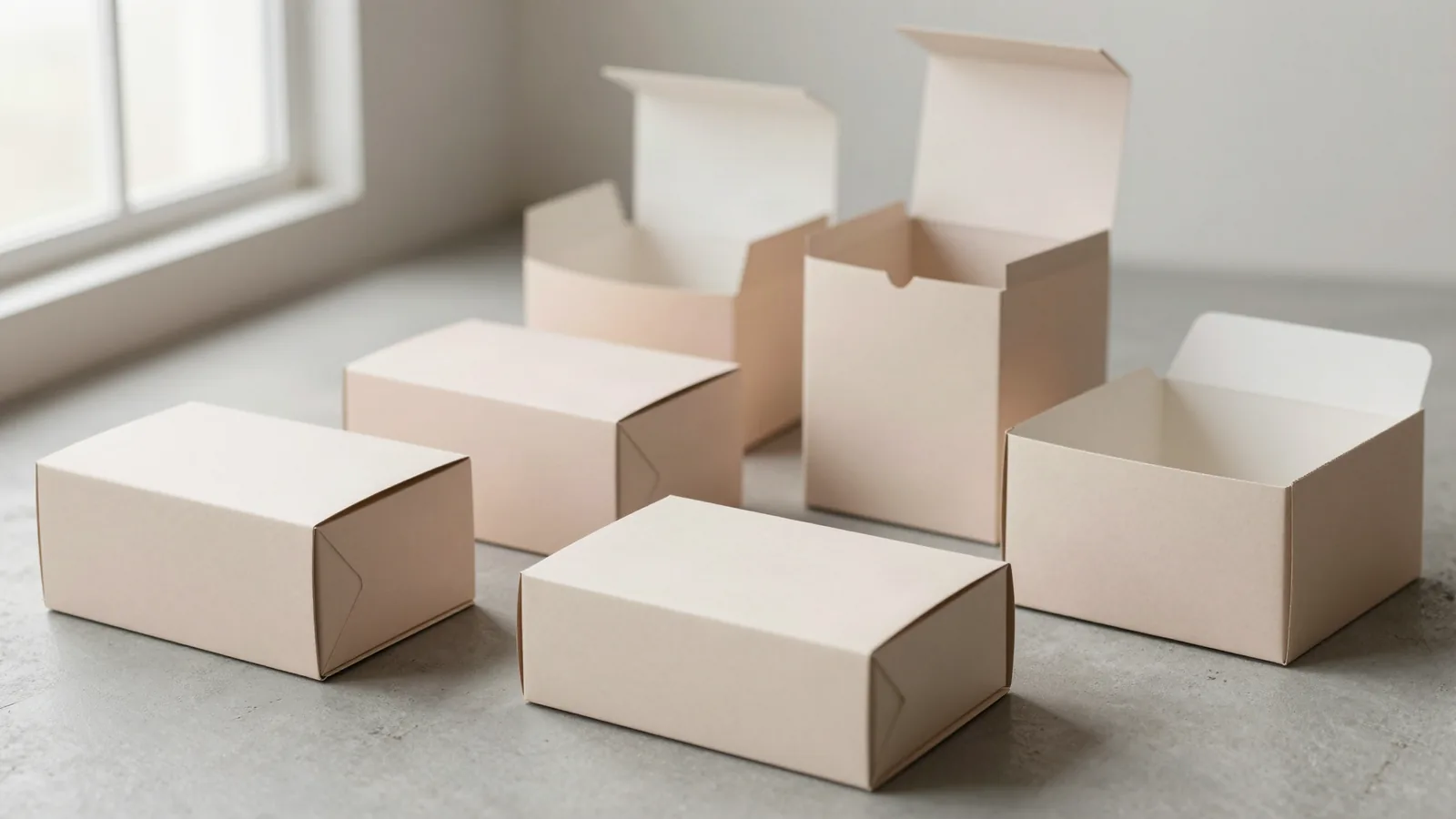




















































What should custom package boxes solve?
The box has to fit the product, survive its handling path, and open the way the buyer expects. Start with the packed item, how it is loaded, whether it is stored or carried, whether it sits on a shelf or enters parcel delivery, and what the customer sees first. A folding carton, shipping mailer, sleeve, insert, or rigid box solves a different problem. Write those decisions into the brief before choosing board or finish.
SBS means solid bleached sulfate paperboard, while C1S means coating on one side and C2S means coating on both sides. Folding-carton references commonly sit at 12 to 24 pt. Kraft board commonly falls around 18 to 24 pt. Corrugated board uses flute profiles such as E, B, and C, with 32 ECT as a common strength reference. Rigid boxes commonly use 1.5 to 3 mm chipboard wrapped in 100 to 157 gsm art paper. These are typical industry ranges, not fixed order specifications.
Which box structure fits the way the product is packed?
A straight tuck end closes from one direction, while a reverse tuck end places the tucks on opposite ends of the carton. Auto-lock and crash-lock bottoms change how the base folds and how much hand assembly it needs. A mailer keeps the closure in the folded board. A sleeve slides over an inner pack.
| Structure | Common use | What to check |
|---|---|---|
| Straight or reverse tuck end | Retail folding cartons | Tuck direction, panel order, and opening cue |
| Auto-lock bottom | Hand packing where base setup matters | Locking action and support under the product |
| Crash-lock bottom | Pre-glued quick-setup formats | Folded base strength and assembly sequence |
| Mailer, FEFCO 0427-style | Products needing an integrated closure | Roll end tuck top, clearance, and corner protection |
| Sleeve | Branding around an inner pack or tray | Inside clearance and sliding friction |
FEFCO 0427 is a mailer-style reference with a roll end tuck top and folded panels. Test the actual board, product weight, and closure together because a flat layout can look right and bind after scoring. A sleeve needs enough clearance to slide over the inner package without becoming loose during handling.
How should box dimensions and protection be checked?
Inside measurements give the clearest fit reference for a box. Write them as length x width x depth. About 1/16 in (1.5 mm) is a common packaging tolerance reference, but the finished fit also depends on board thickness, folds, glue, product variation, and protective material. Measure the product, cap, base, protrusions, and insert, then test the assembled box for insertion force, movement, closure alignment, and edge crush points.
For a shipping box, reduce empty space where the product and protection permit it. US ground dimensional weight commonly uses L x W x H / 139, so outside dimensions belong in the shipping review even when inside dimensions control the fit. PET window film around 0.2 to 0.3 mm is a common reference. Keep window patching away from creases and glue areas, then check whether the product stays where the window shows it.
Which print and finish choices fit the board?
Offset CMYK suits detailed paperboard artwork. Flexo is commonly used for graphics on corrugated board, while digital printing can suit short-run development. Matte and gloss lamination change reflection and scuff behavior. Soft-touch changes the hand feel. Spot UV creates localized gloss contrast. Foil stamping, embossing, and debossing add physical detail, but keep those effects away from critical scores, glue areas, and very small type.
Catalog formats make the choice easier to picture. Compare custom tuck top mailer boxes for an integrated shipper closure, custom veterinary medicine boxes for compact carton planning, and custom woozy bottle boxes for bottle geometry. The custom packaging solutions hub gives the broader structural route without changing the question this page answers.
What belongs in a custom package box quote?
A useful quote starts with the product's physical measurements and the way the finished box will be packed, stored, and shipped. Include weight, orientation, closure preference, insert or window needs, artwork status, barcode placement, laminate direction, and anything that must stay fixed. A barcode too close to a score, RGB artwork converted for press, missing bleed, or type set over a glue flap is cheaper to fix before the proof.
- State inside or outside dimensions and the packed product position.
- Identify the board family, flute reference, or rigid construction for comparison.
- Mark print coverage, finish areas, folds, scores, and glue tabs.
- Ask for an assembled sample when fit, protection, or opening needs a physical check.
Custom Packaging Lane quotes custom package boxes to spec from a 100-unit minimum, with pricing from $0.49 per unit at volume. Production is typically 8 to 10 business days after proof approval, plus delivery. Free US shipping and free design support with a free dieline are available. The $19.99 sample kit can be credited to the first order.
Frequently Asked Questions
What is the difference between a folding carton and a corrugated box?
A folding carton uses paperboard such as SBS, C1S, or C2S for printed panels and scored folds. Corrugated packaging adds a fluted layer and is commonly reviewed for shipping handling. E, B, and C flutes have different thickness and stacking behavior, while 32 ECT is a common board-strength reference. Test the finished pack with the actual product and protection.
What dimensions should I give for a custom package box?
Custom package box dimensions should be labeled as inside or outside and written as length x width x depth. Inside measurements describe the space the product needs. About 1/16 in, or 1.5 mm, is a common tolerance reference. Measure the product, insert, cap, and protrusions, then confirm closure and movement with an assembled sample.
What does FEFCO 0427 mean for a mailer box?
FEFCO 0427 is a mailer-style structure reference with a roll end tuck top and folded panels. It can combine an integrated closure with a presentation-led opening. The finished design still needs checks for clearance, score placement, corner protection, locking behavior, and pack-out speed because the reference does not determine the product's dimensions.
Can custom package boxes use specialty finishes?
Custom package boxes can use matte or gloss lamination, soft-touch, spot UV, foil stamping, embossing, or debossing. Each changes the surface or adds a physical effect. Keep finish areas clear of critical folds, glue zones, and small type, then review the proof and assembled package for contrast, legibility, and placement.
What should a box quote request include?
A custom package box quote request should include product dimensions, weight, orientation, structure, board or flute preference, insert or window needs, artwork status, print coverage, finish areas, and packing method. Label measurements clearly. Those details let the dieline and proof address the real fit and handling conditions instead of a flat drawing alone.












