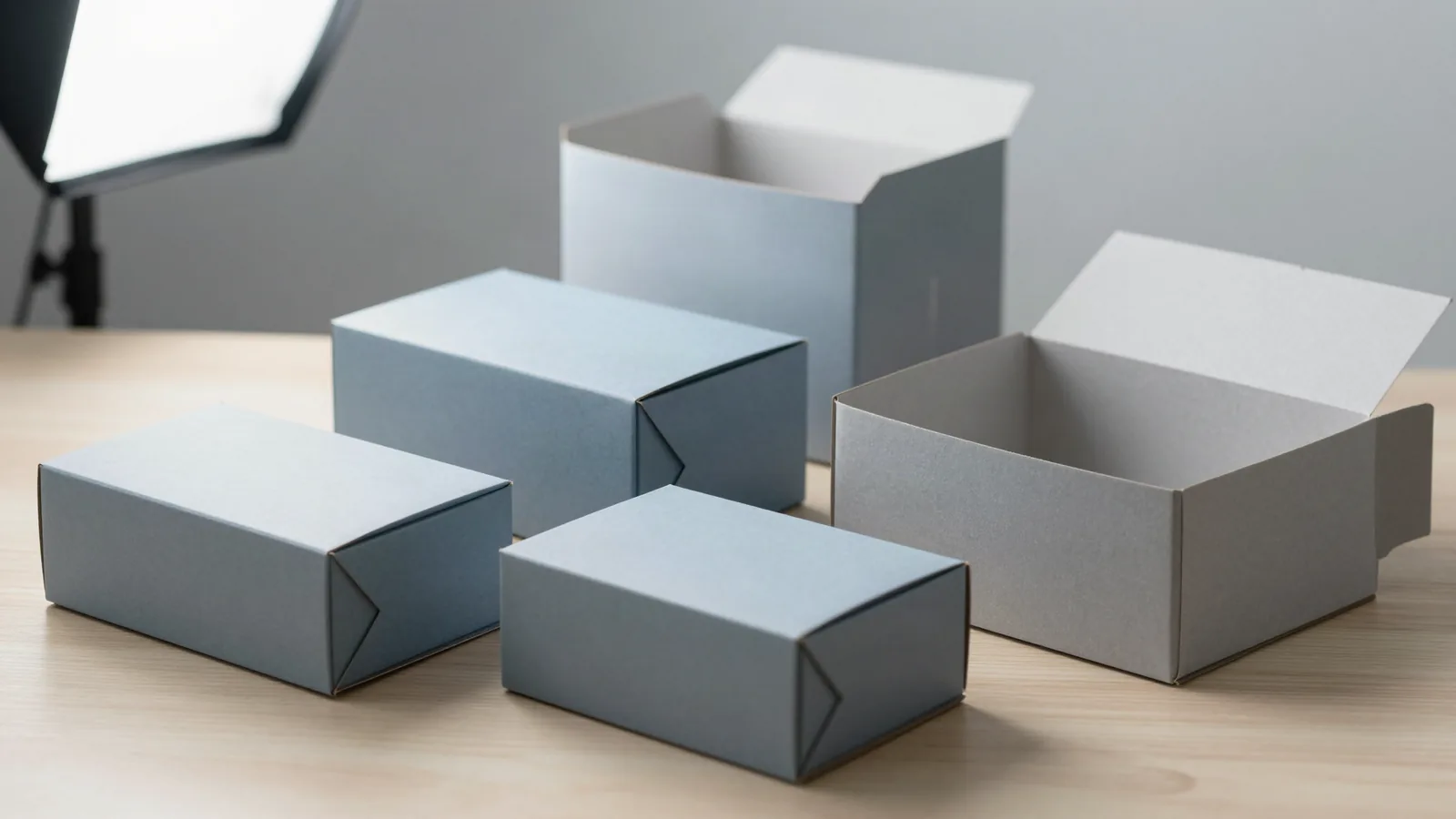





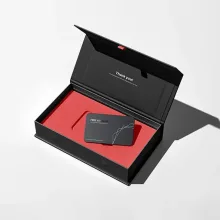











































Custom container packaging is the physical format that holds, presents, or protects a product. The term can describe a folding carton, tin, rigid box, window carton, corrugated shipper, sleeve, or coordinated inner-and-outer format. The useful starting point is the product path: how the item is filled, closed, displayed, shipped, opened, and stored.
Different products need different containment decisions. Custom tin packaging frames a metal container. Custom stevia packaging can be planned around a compact folding format. For a long or narrow item, custom screw packaging may need a fitted interior and an opening that keeps the product oriented.
What does custom container packaging include?
The package type follows the fill and access path. A folding carton uses scored panels, a tin uses formed metal, a rigid box uses wrapped board, and a corrugated shipper uses fluted board. A window carton adds a cut opening and a clear panel. Each format changes the closure, interior clearance, surface, and way the finished package is handled.
Start by describing the product's packed shape, not just the product category. State whether the container will sit on a shelf, travel in a parcel, enter an outer carton, or need an insert to hold its position. That information narrows the construction discussion before artwork begins.
Which material makes sense for the container?
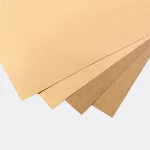
Folding cartons commonly use SBS, C1S, or C2S paperboard in the 12 to 24 pt range. Kraft board commonly falls in the 18 to 24 pt range when a natural surface is part of the visual direction. Rigid packaging commonly uses 1.5 to 3 mm chipboard wrapped in 100 to 157 gsm art paper. Corrugated packaging commonly uses E, B, or C flutes, with 32 ECT as a common strength convention. A PET window is commonly around 0.2 to 0.3 mm.
| Container format | Common material reference | What the buyer should check |
|---|---|---|
| Folding carton | SBS, C1S, or C2S, 12 to 24 pt | Print area, folding stiffness, and closure |
| Kraft carton or mailer | Kraft board, 18 to 24 pt | Paper tone, surface, and board feel |
| Rigid box | 1.5 to 3 mm chipboard with 100 to 157 gsm art paper | Lid, base, drawer, wrap, and opening |
| Corrugated shipper | E, B, or C flute, with 32 ECT commonly referenced | Product weight, outer size, and stacking |
| Window container | Paperboard with a PET window, commonly 0.2 to 0.3 mm | Visibility, board around the opening, and folds |
Metal, paperboard, rigid board, and corrugated formats behave differently in production and use. The filled product, closure, moisture exposure, display setting, and shipping route should guide the choice. Ask us about food-contact options for your product when the package may touch food directly or indirectly.
Which structure is easiest to fill and close?
A straight tuck end puts the opening on a tuck flap, while a reverse tuck end changes the flap direction. Auto-lock bottom and crash-lock construction change how the base sets up. A sleeve adds a layer around an inner container. Gable, pillow, and two-piece rigid constructions create different filling and opening sequences.
A window patch needs a clean boundary and enough board around the opening to preserve stiffness. Glue tabs, scores, and seams also need room. Custom scissor packaging can frame a narrow or sharp product that needs controlled access. Custom printed macaron packaging boxes can frame an organized interior where movement affects presentation.
How should I specify printing, windows, and finishes?
Offset CMYK is commonly selected for detailed folding-carton artwork. Digital printing is commonly considered for shorter runs or changing graphics, while flexo is common on corrugated board. RGB artwork can shift when converted for press, and low-resolution art can look soft. Keep bleed outside the cut line and keep required type, barcodes, folds, seams, and glue areas visible on the proof.
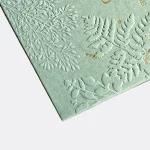
Matte or gloss lamination changes surface appearance and scuff behavior. Soft-touch changes hand feel. Spot UV, foil stamping, embossing, and debossing create selected areas of contrast or relief. Mark the treatment zones against the panels and folds so the finish does not land across a score or closure.
How should I size a container around the product?
Write dimensions as length x width x depth and clarify that the figures are inside measurements when they describe the packout. A common tolerance convention is about 1/16 in, or 1.5 mm. Build functional clearance for the product, insert, protective wrap, and closure rather than treating nominal dimensions as the usable cavity.
An insert cut to the exact product size can hold the item tightly. An undersized insert lets the item rattle. A physical sample or clear drawing also shows whether the product needs a divider, fitted cavity, window, or access notch. Those choices belong in the container specification before the dieline is prepared.
Which catalog formats are useful comparisons?
Use the catalog to compare physical problems, not to copy a finished size. Custom tin packaging shows a metal direction, but the link has already been used as a starting reference for the container brief. Compare custom stevia packaging for a compact retail format, custom screw packaging for an organized narrow product, and the scissor and macaron pages for access and interior movement. The quote still follows the actual product dimensions.
What should I send for a container quote?
- Packed product length, width, depth, weight, orientation, and any protective wrap or primary package.
- Preferred container format, closure, insert, divider, window, opening sequence, and outer carton plan.
- Material direction, board or flute reference, print coverage, artwork status, and finish preference.
- Display setting, handling details, moisture exposure, storage needs, and product clearance.
- Photos, a physical reference, or a dependable drawing when the product has unusual contours.
Custom Packaging Lane supports a 100-unit minimum, with pricing from $0.49 per unit at volume, quoted to spec. Production is typically 8 to 10 business days after proof approval, plus delivery. Free US shipping and free design support are available, and the free dieline is prepared before print approval. The $19.99 sample kit is credited to the first order. See the custom packaging solutions hub to compare construction choices.
Frequently Asked Questions
What is the difference between a container and a shipper?
A container holds or presents the product, while a shipper is built around parcel handling and transit protection. A folding carton, tin, rigid box, or window carton may need an outer corrugated package for travel. The quote should state whether the requested format ships alone, sits inside another carton, or performs both jobs.
How much board should surround a PET window?
A PET window should leave enough surrounding paperboard to preserve stiffness and avoid critical folds, glue areas, and handling points. The exact opening depends on the container structure, panel size, and product visibility requirement. Mark the window boundary on the dieline so the surrounding board and the finished opening can be checked before printing.
Can a container use both an insert and a window?
A container can use both when the product needs internal control and shelf visibility. The insert holds orientation and limits movement, while the window exposes a selected area. Plan the insert cavity, window opening, glue zones, folds, and clearance together because each feature uses space inside the same package.
Which printing method fits corrugated board?
Flexo is commonly associated with corrugated board, while offset CMYK is commonly selected for detailed folding-carton artwork. Digital printing is commonly considered for shorter runs or changing graphics. The chosen method should match the board, artwork coverage, image detail, color direction, and the panels that need print.
What should a container drawing show?
A container drawing should show length x width x depth, inside versus outside measurements, product orientation, closure, scores, cuts, glue areas, insert space, window boundaries, and finish zones. Add photos or a physical reference when the product has unusual contours. Those details let the dieline follow the actual fill and opening sequence.