




























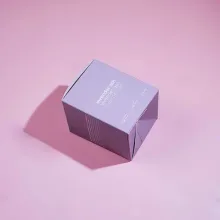
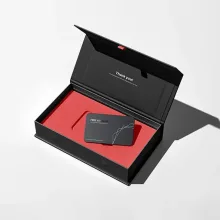
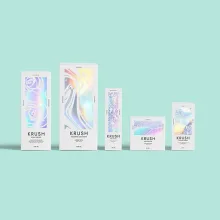
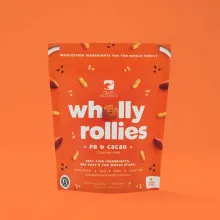
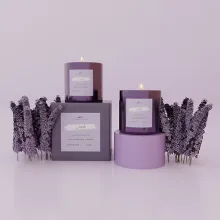
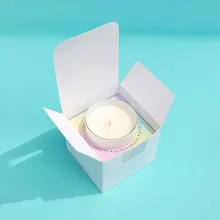



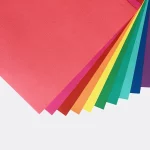

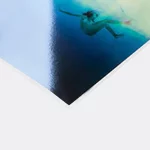
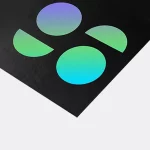
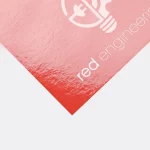




























In a packaging request, helographic usually means a holographic-style effect. It is a reflective surface that can look rainbow, metallic, or light-shifting as the viewing angle changes. The effect may come from holographic film or laminate, foil stamping, reflective substrate, or a combination of print and finish. Confirm the reference before finalizing the dieline. A dieline is the flat cutting template used to print, cut, score, and fold the box.
What do buyers mean by helographic boxes?
Most requests mean a broad reflective panel or a small accent. Holographic film or laminate changes how color and type read across a larger area. Foil stamping keeps the effect in a selected mark or pattern. A reflective substrate changes the base surface before printing.
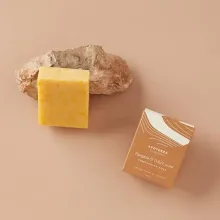
A window can split reflection from the printed panel. Compare window display boxes with window boxes when the product faces forward. Window soap boxes are another front-panel reference. Decide the panel, window, and reflective layer as one drawing.
Which board keeps a reflective box readable and stable?
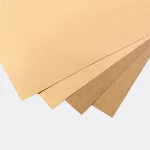
SBS, C1S, and C2S paperboard are commonly referenced from 12 to 24 pt for folding cartons. Kraft board is commonly referenced from 18 to 24 pt. A rigid box commonly uses 1.5 to 3 mm chipboard wrapped in 100 to 157 gsm art paper. Corrugated E, B, and C flutes are common for outer protection, with 32 ECT as a shipper reference. The finish cannot rescue a board choice that folds poorly, crushes at the closure, or leaves the product moving inside.
Which finish creates the reflective effect?
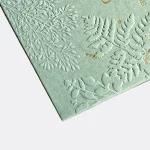
Holographic film or laminate creates a broad light-shifting surface. Foil stamping creates a metallic accent. Spot UV creates gloss contrast. Embossing raises a detail, and debossing presses it into the board. Window patching creates product visibility, with PET window film commonly referenced from 0.2 to 0.3 mm.
| Effect approach | Visual result | Production check |
|---|---|---|
| Holographic film or laminate | Broad reflective or light-shifting surface | Full panel or selected area |
| Foil stamping | Metallic or reflective accent | Clean artwork zone and tooling layout |
| Spot UV | Gloss contrast over a selected region | Logo, pattern, or reading hierarchy |
| Embossing or debossing | Raised or recessed tactile detail | Detail scale, folds, and board behavior |
| Window patching | Clear view of the product | PET film from 0.2 to 0.3 mm |
Film and foil are not interchangeable. A full reflective field can compete with small text, while a foil accent leaves more quiet space for product information. If the box needs a product view, a window may do more work than reflection across every panel. Check lighting and first-read copy on a sample.
How should holographic artwork be prepared?
Map the base board, printed color, reflective layer, and finish layer. Offset CMYK is commonly used for detailed folding-carton artwork. Digital printing is commonly considered for short runs or changing graphics. Flexo is associated with corrugated packaging. Matte or gloss lamination changes glare. Soft-touch creates a different hand feel beside a glossy or metallic region.
Keep product information, instructions, barcodes, and required copy in a controlled, high-contrast area. RGB art can shift when converted for press. Small type set across a score can break when the box folds, and missing bleed can expose an unprinted edge. Spot UV, foil stamping, embossing, and debossing should follow the artwork hierarchy. Ask us about food-contact options if the package may touch food.
Which box structure fits the product inside?
A straight tuck end or reverse tuck end carton gives a broad printed panel. An auto-lock bottom or crash-lock base changes assembly. A sleeve wraps another box or tray. A pillow box creates a curved profile. A mailer combines shipper and presentation. A two-piece rigid construction separates lid and base. Choose the cavity and closure first, then place the treatment around folds, glue flaps, windows, and opening points.
For compact products, and wallet boxes show how a small cavity keeps the product aligned and leaves room for a front panel. For display-led work, wedding card boxes frame larger openings and display construction. The product fit controls the box. The reflective effect comes after that decision.
Can a reflective box include a clear window?
A reflective box can combine a holographic treatment with a clear window when the product needs to be seen. PET window film is commonly referenced from 0.2 to 0.3 mm. Keep the cutout away from scores and glue areas, with enough board for filling and handling. Check the window view and product orientation on the sample.
What belongs in a helographic box quote request?
State the intended effect in plain language: holographic film, foil accent, reflective pattern, spot UV, or another reference. Add the product dimensions, structure, board preference, print coverage, finish areas, window requirement, quantity, and whether the box ships alone or inside another carton. Box dimensions are normally written as length x width x depth with inside measurements. About 1/16 in, or 1.5 mm, is a common tolerance reference for verification.
Custom Packaging Lane quotes helographic boxes from a 100-unit minimum, with pricing from $0.49 per unit at volume, quoted to spec. Production is typically 8 to 10 business days after proof approval, plus delivery. The quote includes free US shipping, free design support, and a free dieline. Use the custom boxes with logo hub, then order the $19.99 sample kit, credited to the first order, to compare the effect under display lighting.
Frequently Asked Questions
Is helographic the same as holographic packaging?
Helographic is usually a spelling variation for holographic packaging, but the requested effect still needs a plain-language description. A buyer may mean a rainbow-reflective film, metallic foil, glossy contrast, reflective substrate, or another light-shifting treatment. Share a visual reference so the board, print layers, and finish can be planned around the actual result.
How can a holographic box keep product information readable?
A holographic box keeps product information readable when the reflective treatment stays out of the main copy and barcode area or has enough contrast beneath it. Film creates a broad effect, while foil and spot UV can stay localized. Check small type, instructions, and barcodes on a physical sample under the lighting used for display.
Which structure suits a reflective retail box?
A straight tuck end or reverse tuck end carton gives broad printed panels. A sleeve can wrap an inner box, a two-piece rigid format separates the lid and base, and a mailer can combine shipment with presentation. Choose the product cavity, closure, folds, and glue flaps before selecting the reflective finish.
Can helographic boxes include a clear window?
Helographic boxes can include a clear window when the product needs to be visible through the reflective package. PET window film is commonly referenced from 0.2 to 0.3 mm. Keep the cutout clear of scores and glue areas, leave board around the opening, and check the product view and print contrast on a physical sample.
What should I describe in a helographic box quote request?
A helographic box quote request should describe the visual effect, product dimensions, box structure, board, print coverage, finish areas, window need, quantity, and shipping context. State whether helographic means holographic film, foil stamping, spot UV, reflective substrate, or another treatment. Inside length, width, and depth help the packaging plan start from the real cavity.