




























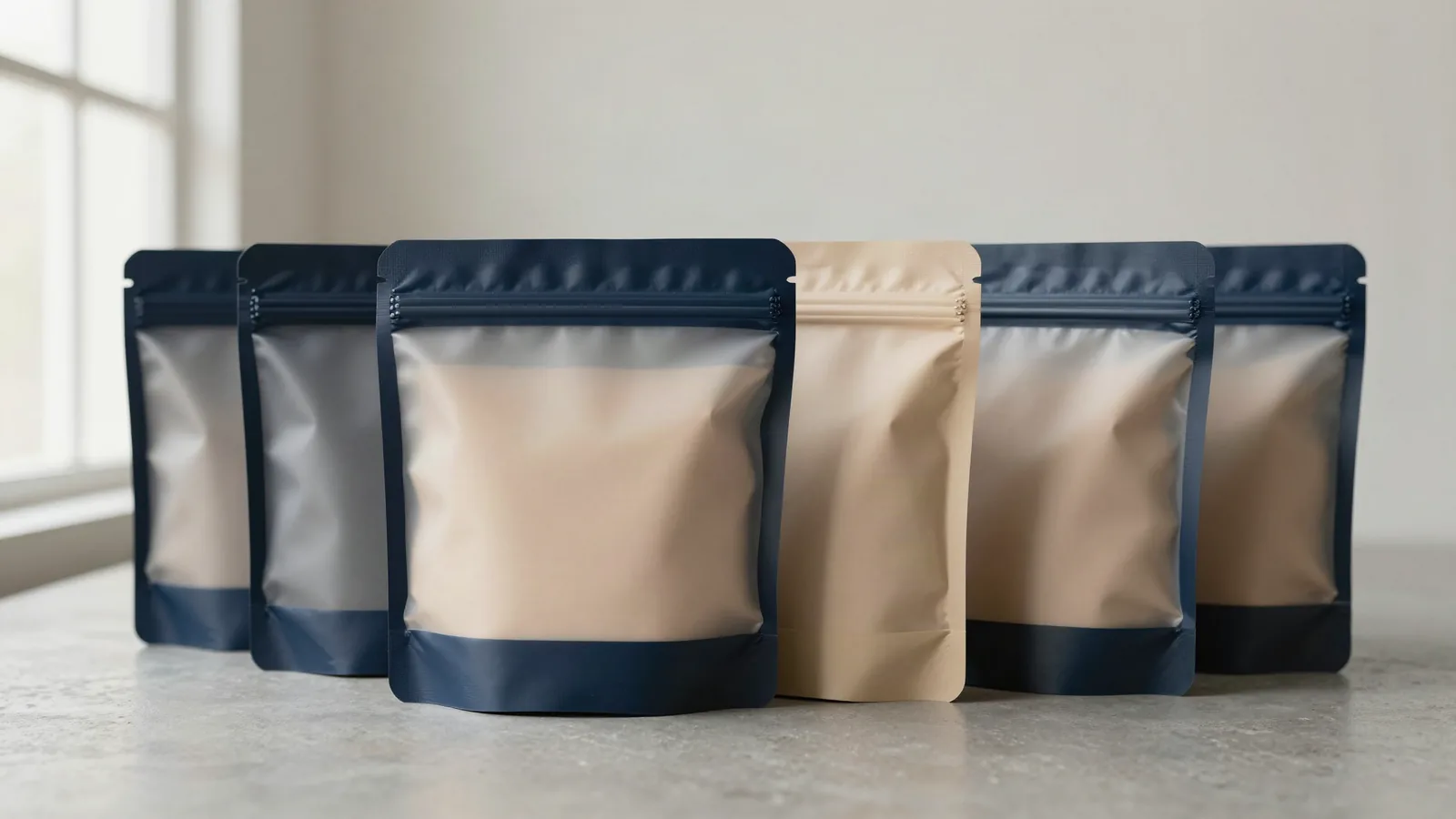




















































An aluminum pouch is a flexible package built from a laminate, seal, and opening system. The aluminum layer is only one part of the specification. Flat, stand-up, zipper, and spout formats each change the filled shape, access, seal area, and artwork map, so the pouch brief should start with the product and how it will be used.
For a repeatable pouch program, see wholesale custom packaging. Compare an aluminum foil spout pouch for controlled dispensing, a kraft paper zipper pouch for a kraft-look outer layer, a granola pouch for a snack-style silhouette, and aluminum packaging bags for a flat bag direction.
What does aluminum pouch construction include?
The usual foil stack has three functional layers: PET carries print and handling, AL limits light transmission, and PE forms the sealant surface. The exact layer order matters because the print side, fill-facing side, seal behavior, and opening all depend on the construction selected for the application.
| Format or layer | Common role | Decision for the brief |
|---|---|---|
| PET / AL / PE laminate | Print support, light barrier, sealant layer | Identify the print side and the side facing the fill. |
| Stand-up pouch | Base gusset and upright display | Filled width and height set the early size direction. |
| Zipper pouch | Repeated access and closure | Place the zipper below the top seal and above the fill zone. |
| Spout pouch | Controlled dispensing | Set the opening and cap position around the fill behavior. |
Stand-up pouches are commonly 3 to 7.5 inches wide, but that is an early planning range, not a finished size. Filled height, gusset, seal area, closure, and display orientation can change the dieline. A flat bag may use a different seal and tear arrangement. Measure the filled pack, not only an empty film silhouette.
Which pouch opening suits the way customers use it?
Repeated access calls for a zipper, while controlled pouring or dispensing points to a spout when the fill and closure geometry support it. A flat bag suits a compact pack-out where a gusset is unnecessary. The tear notch, seal line, zipper or spout location, and material above the fill all need to appear on the dieline.
How do print and finish choices change the result?
Short runs and several artwork versions usually point toward digital printing. Matte or gloss lamination changes reflection, while soft-touch changes hand feel. Foil stamping, embossing, debossing, and focused spot treatments each need a defined panel area. Reflective foil can change how printed colors appear, so the proof should be read at actual panel orientation.
Mark the front, back, seal area, zipper, spout, cap, tear notch, and no-print zones. Keep the artwork aligned to the finished pouch, not to a generic rectangle. Check bleed, barcode placement, and type near the seal or opening. A digital proof catches orientation and conversion problems before the run.
What should food or personal-care brands ask about the fill?
The fill, storage conditions, and intended contact surface determine the questions that matter. Ask us about food-contact options for your product, then identify the fill, temperature, storage conditions, seal, ink, adhesive, and intended contact surface. Personal-care projects also need the product viscosity, dispensing behavior, closure use, and exposure to oils or moisture.
The foil layer does not answer every question about a finished pouch. Laminate direction, sealant, adhesive, ink, opening, and storage conditions all belong in the technical brief.
Which inputs help a pouch proof move cleanly?
The dieline starts with the filled profile, not the empty film. Add the target format, shelf or transit orientation, laminate direction, front and back artwork, opaque areas, color coverage, seal, zipper, spout, cap, tear notch, gusset, finishes, quantity, delivery destination, and any food-contact question.
- Send a filled product profile and the intended pouch orientation.
- Mark seal lines, zipper or spout placement, tear notch, gusset, and no-print areas.
- Separate artwork coverage from finish zones and closure hardware.
- Identify the fill conditions that could affect the laminate or seal.
For a quoted CPL project, the minimum is 100 units, pricing is from $0.49 per unit at volume, quoted to spec, and production is typically 8 to 10 business days after proof approval, plus delivery. Free US shipping and free design support include a free dieline. The $19.99 sample kit can be credited to the first order.
Frequently Asked Questions
What layers are common in an aluminum pouch?
An aluminum pouch commonly uses PET, AL, and PE layers. PET supports print and handling, AL limits light transmission, and PE provides the sealant surface. The exact construction depends on the fill, seal method, opening, and storage conditions, so the brief should identify the print side, fill-facing side, and intended use before artwork is finalized.
Is a zipper or spout better?
A zipper suits products that need repeated access and a resealable top. A spout suits controlled pouring or dispensing when the fill and opening geometry support it. Neither opening is universally better. Compare fill behavior, closure position, user grip, shelf orientation, and whether the pack needs a flat or stand-up format.
How wide are stand-up pouches?
Stand-up pouches are commonly 3 to 7.5 inches wide, but that is an early planning range rather than a finished size. Filled height, gusset, seal area, zipper or spout placement, and display orientation can change the width. Confirm the filled pouch dimensions before selecting the final dieline.
Can a foil pouch have a soft-touch finish?
A foil pouch can be reviewed for soft-touch, matte, or gloss effects, subject to the film and print process. Finish changes reflection, hand feel, and color appearance. Check a proof or material sample for contrast, scuff visibility, and the difference between the reflective foil layer and the printed surface.
What should food brands ask before choosing film?
Food brands should ask Custom Packaging Lane about food-contact options for the product, then provide the fill, temperature, storage conditions, seal, ink, adhesive, and intended contact surface. An aluminum layer describes one part of the laminate and does not answer every finished-package question. Keep technical fit separate from branding and finish selection.












