




























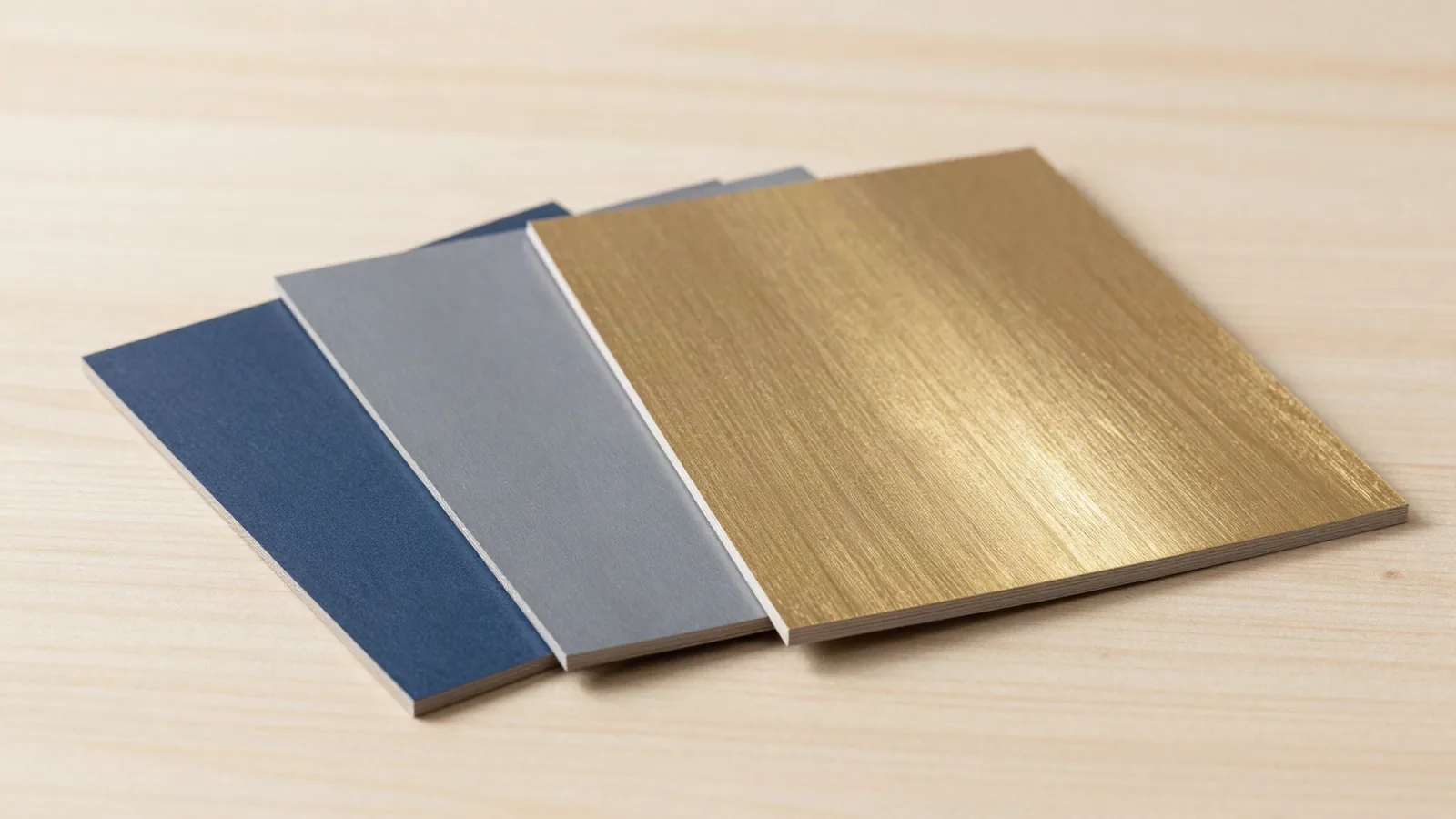




















































The phrase boxes with olographic effect usually means boxes with a holographic foil effect. Holographic foil is a reflective finish applied to a printed box surface, not a separate box material. A fine pattern in the foil shifts the reflected color as the viewing angle changes. The final look depends on the base board, artwork, foil coverage, and panel facing the customer. Put those choices in one specification.
How does holographic foil change a box panel?
Holographic foil makes a box panel read differently as light and viewing angle change. Full coverage creates a broad reflective field. A selected logo, border, or pattern keeps the effect in one area and leaves room for copy. The finish is strongest where the eye meets the panel first, so choose that panel before drawing the artwork.
| Finish placement | Visual result | Question to settle |
|---|---|---|
| Full lid panel | Reflective field across the opening panel | Is the lid the first panel seen? |
| Logo or product name | Focused foil accent | Which mark needs the reflective cue? |
| Border or repeated pattern | Reflective edge around printed copy | How much clear space stays inside the border? |
| Sleeve exterior | Foil on the removable outer layer | Does the sleeve carry the brand message? |
| Inner panel | Finish inside the opening sequence | Should the effect appear after the lid opens? |
A quiet panel is useful when the package carries instructions, ingredients, or a barcode. Keep the reflective treatment away from copy that must be read quickly unless the proof shows enough contrast. The same finish can look bright under a showroom light and subdued under a desk light, so review the proof in both conditions.
What should the holographic artwork proof show?
The proof should show the foil area, printed areas, scores, glue tabs, and visible panels on the same layout. A dieline is the flat cutting template used to print and cut the box. Mark the foil as its own layer, keep type away from score lines, and leave bleed beyond cut edges. Low-resolution art can look soft. RGB art can shift when converted for press. A digital proof before printing is where those problems get caught.
Send product dimensions before the dieline is drawn. If a lid, sleeve, or insert is cut to the exact product size, a small error can make assembly difficult. Free design support includes drawing the dieline, but the approved proof is the record that starts production. The clock starts at proof approval, not when the inquiry arrives.
Which rigid box structures suit a holographic finish?
Rigid boxes with sleeve and tray or magnetic closure suit a finish that needs a clear outer panel. A rigid box uses a stiff board core wrapped with printed paper, so the outer wrap carries the artwork and finish while the core gives the box its shape. Rigid boxes with sleeve and tray put the foil on the sleeve or lid. Rigid boxes with magnetic closure keep the finish on the lid and front panel, where the opening action exposes it.
Where should a quiet panel remain?
Keep a quiet panel where the buyer needs to inspect product information or scan a barcode. Quiet does not mean blank; it can use ordinary print on a non-holographic field. That separation prevents a reflective pattern from competing with small type, legal copy, or an insert that carries product details. Plan the inside and outside together when the box opens in stages.
How can one finish plan fit more than one box?
Use one rule for foil coverage and information hierarchy, then redraw the placement for each structure. Jewelry boxes with lid and tray can carry the effect on the lid while the tray stays quiet. Custom rigid boxes with inserts can reserve the reflective treatment for the outer panel and keep the insert focused on product placement. Consistency comes from the finish rule, not from forcing every box to use the same panel.
What should the holographic box quote include?
A useful quote lists the structure, board, dimensions, foil placement, printed panels, artwork, quantity, and delivery location. The MOQ is 100 units. Pricing is from $0.49 per unit at volume, quoted to spec. Production is typically 8 to 10 business days after proof approval, plus delivery. Free US shipping and free design support are available. Order the $19.99 sample kit to inspect the finish before approval. The sample kit is credited toward the first order. For a logo-led brief, start with custom boxes with logo.
Frequently Asked Questions
What are boxes with a holographic effect?
Boxes with a holographic effect use holographic foil on a selected box surface. Holographic foil is a reflective finish, not the board itself, and its colors shift as the viewing angle changes. The finished look depends on the box structure, base board, artwork, foil coverage, and visible panel.
Is holographic foil the same as the box material?
No. Holographic foil is a finish applied to an underlying box construction. The box may use a rigid structure, sleeve, lid, tray, or insert, while the foil covers a chosen panel or detail. Request the structure and finish as separate fields so the proof shows both clearly.
Can holographic foil go on rigid boxes?
Holographic foil can be specified for rigid formats such as sleeve and tray boxes, magnetic closure boxes, lid and tray boxes, and insert based boxes. The visible panel, artwork contrast, coverage, and opening sequence should be reviewed together so the reflective finish supports the structure.
How do you keep text readable on holographic packaging?
Keep important text on a defined printed area and mark the foil area separately in the artwork proof. Review the design under more than one lighting condition because reflection changes perceived contrast. A focused finish area leaves product information easier to inspect than a reflective pattern placed across every panel.
What is the MOQ for holographic foil boxes?
The MOQ for holographic foil boxes is 100 units. Pricing is from $0.49 per unit at volume, quoted to spec. Production is typically 8 to 10 business days after proof approval, plus delivery. Free US shipping is available, and a $19.99 sample kit can be credited toward the first order.












