












































































An RSC box is a corrugated container with a regular slotted closure pattern. RSC stands for regular slotted container. The name describes the panel and flap arrangement, not one universal size, board grade, flute, print treatment, or interior support. A useful quote turns that style label into a measured packout and a proof that shows how the carton closes.
What does regular slotted container mean?
Regular slotted container means a corrugated box with regular body panels and end flaps that meet across the openings. The construction gives the buyer a familiar closure pattern, but the term does not settle the finished dimensions or material callout.
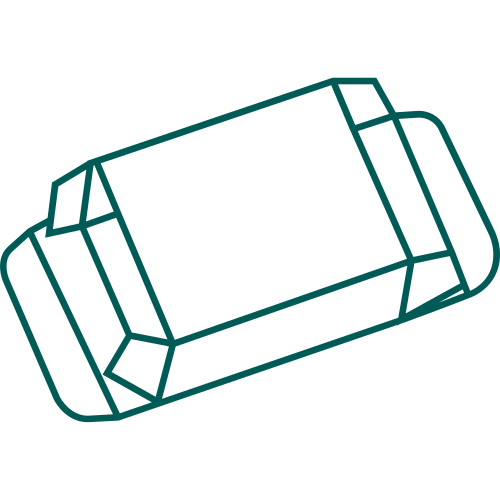
On an RSC blank, the body panels form the walls, score lines establish the folds, and the end flaps close the top and bottom. A manufacturer joint joins the body into the finished loop. Tape, adhesive, or another selected closure method belongs in the project record because RSC alone does not choose it.
How do the flaps close an RSC box?
The regular flaps fold inward across the opening, with the meeting points and overlap set by the box dimensions and closure plan. The proof should show the fold order, joint position, artwork clearance, and any insert that changes how the product sits.
That sequence matters at packout. A label near a score can wrinkle or disappear under a flap, while a product that sits too close to the top can press against the closure. Review the assembled carton, not only the flat sheet.
What measurements belong on an RSC quote?
Measure the product in the condition in which it will be packed. Include an insert, divider, sleeve, wrap, accessory, or void-fill allowance if it occupies interior space. Keep inside dimensions separate from the outside footprint, because fit and storage answer different questions.
| Specification field | Value to provide | Quote or proof check |
|---|---|---|
| Interior dimensions | Length x width x depth around the packed product | Confirm the assembled interior matches the packout |
| Exterior dimensions | Outside length x width x depth after assembly | Check storage and handling footprint |
| Board grade | Selected corrugated board direction | Record the material callout |
| Flute type | A, B, C, or E industry profile | Connect the profile to the approved build |
| End flaps | Regular flap sequence and overlap | Check closing, seams, and artwork clearance |
How do A, B, C, and E flutes differ?
A flute is the corrugated wave between the outer liner sheets. A flute has a taller profile and more cushioning, B flute has a lower profile and a tighter footprint, C flute sits between those common choices, and E flute has a fine surface that suits smaller cartons and detailed print. These are typical industry descriptions, not a substitute for the board callout on the order.
The product weight, footprint, stacking position, closure, print surface, and handling route all belong in the material discussion. If the request does not name a grade or flute, provide those operating details and ask CPL to identify the selected board direction in the specification.
Is an RSC box different from a mailer or rigid box?
Yes. The styles use different structures and answer different packout problems.
| Box style | Structural format | Buyer question |
|---|---|---|
| RSC corrugated box | Regular end flaps on a corrugated blank | What board, flute, fit, and closure suit the handling route? |
| Mailer box | Hinged lid with tuck or locking panels | How should the opening present the product? |
| Rigid set-up box | Chipboard wrapped in printed paper | How should a fixed shape hold the product? |
| Folding carton | Scored paperboard panels and tabs | How should the blank fold around the product? |
An RSC box is usually the clearest starting point when regular flaps and corrugated handling matter. A mailer, rigid box, or folding carton needs its own dieline and closure discussion.
Which CPL catalog products can frame an RSC brief?
Use wine box packaging to frame a product-led fit and closure discussion. Shoe box packaging can organize a larger footprint conversation. Custom DNA test kit boxes provide a compact kit reference, while custom foam box inserts can support a separate interior positioning discussion. These pages are catalog references, not a claim that each uses RSC construction.
What should be checked on the RSC proof?
A digital proof is the approval file that shows the printed panels and the proposed construction before production starts. Check the inside and outside dimensions, board direction, flute type, print surface, finish, end-flap sequence, joint position, scores, seams, and product placement.
- Confirm the measurement convention: inside or outside.
- Check that inserts, dividers, labels, and accessories fit the assembled carton.
- Keep small type away from scores, seams, and flap overlaps.
- Review low-resolution art, RGB conversion, and missing bleed before approval.
- Record the quantity, destination, artwork version, and approval date.
What order terms apply to an RSC project?
CPL uses a 100-unit MOQ. Pricing is from $0.49 per unit at volume, quoted to spec. Production is typically 8 to 10 business days after proof approval, plus delivery. Free US shipping and free design support are available.
A $19.99 sample kit can help compare board and surface direction before the final proof. For a broader purchasing brief, see wholesale custom packaging and attach the packed dimensions, handling route, and selected RSC details.
Frequently Asked Questions
What does RSC stand for on a box specification?
RSC stands for regular slotted container. It identifies a corrugated construction with regular body panels and end flaps that close the openings. The term is a starting style label, not a complete specification. The final carton still needs dimensions, board grade, flute, artwork, joint, closure details, and interior support.
Does the RSC label choose the board or flute?
The RSC label does not choose a board grade or flute. A buyer still needs to name the corrugated board direction, flute profile, packed dimensions, print surface, seam, and closure method. Custom Packaging Lane can attach those fields to the quote and digital proof for the specific carton.
Which flute profile should an RSC box use?
A flute has a taller profile and more cushioning, B flute has a lower profile and tighter footprint, C flute sits between those common choices, and E flute has a finer print surface. The right choice depends on the packed product, footprint, board direction, closure, and handling route.
Can an RSC box be used beyond shipping?
An RSC box can be discussed for shipping, storage, retail transfer, or a branded handoff when the product and handling route support it. State how the carton will be packed, closed, moved, stored, and opened. Those details show whether the regular slotted construction fits the complete request.
What production window applies to an RSC box?
Production for an RSC box is typically 8 to 10 business days after proof approval, plus delivery. The MOQ is 100 units, and pricing is from $0.49 per unit at volume, quoted to spec. Free US shipping and free design support are available.