






































































An RSC style box is an industry-standard label for a corrugated regular slotted container. RSC names the panel, score, and flap arrangement on the blank. It does not establish the finished dimensions, board selection, print coverage, seam location, closure method, or interior support. Reading the blank correctly is the first step toward a useful construction record.
How do you read an RSC style box blank?
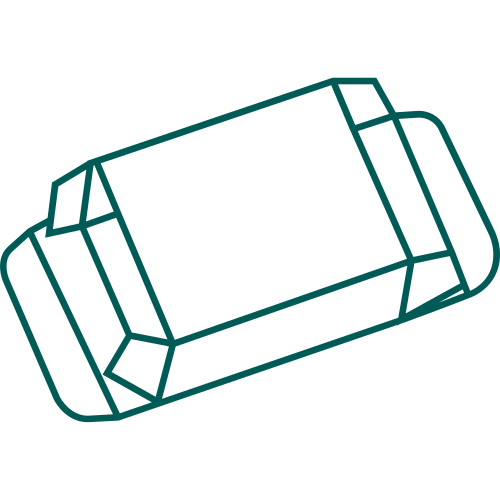
Start with the flat blank, then follow the scores around the body panels until the sheet becomes a carton. A blank is the flat cutting and printing template for the assembled box. The panel order, score locations, end flaps, and manufacturer joint show how the carton will take shape.
What does RSC tell you, and what does it leave open?
RSC tells you that the carton follows a regular slotted construction, but it leaves the project-specific material, size, artwork, and closure fields open.
| Field | What RSC identifies | What the project must add |
|---|---|---|
| Flap pattern | Regular end flaps | Meeting points and closing order |
| Dimensions | No fixed finished size | Packed inside and outside measurements |
| Material | Corrugated box family | Board direction and flute profile |
| Artwork | No fixed print layout | Front, side, rear, top, bottom, and seam panels |
| Interior | No fixed support plan | Insert, divider, pad, sleeve, or void-fill allowance |
Keeping these fields separate prevents a short style label from becoming an incomplete purchasing request.
How do body panels and scores form the carton?
Body panels become the carton walls, score lines guide the folds, end flaps close the openings, and the manufacturer joint joins the body panels. Each part has an artwork consequence as well as a construction job.
| Blank area | Physical job | Artwork check |
|---|---|---|
| Body panels | Form the carton walls | Confirm panel order and product-facing side |
| Score lines | Set the fold path | Keep logos and small type clear of the fold |
| End flaps | Close the top and bottom | Check meeting points and overlap |
| Manufacturer joint | Joins the body into a loop | Check joint position and print continuity |
The proof should show both the flat arrangement and the assembled carton. A logo that looks centered on the sheet can shift after the blank folds, and copy near a flap can disappear under the closure.
How should dimensions be set for an RSC style box?
Set dimensions against the product in its packed condition. Measure the product with its wrap, label, pad, divider, insert, or accessory inside the carton, then state whether the measurements are inside or outside. The inside footprint controls fit. The outside footprint controls storage and handling space.
Do not let a product category stand in for measurements. A shoe, bottle, or kit can occupy different space once an insert or protective layer is added. Send the packed dimensions and the intended orientation so the blank can be drawn around the actual load.
How should artwork follow the folded carton?
Map artwork to the assembled carton, not only to the flat file. Mark the front-facing panel, side panels, rear panel, top, bottom, seam, scores, and flap areas. Keep essential copy away from a score or joint unless the design intentionally crosses it.
Low-resolution art can break down at print size. RGB art can shift when converted for press. Missing bleed can expose an unprinted edge. Check those files before proof approval, then inspect the closed carton to see where the logo and product information actually land.
How should the closing sequence be documented?
Write down which flaps close first, where the opening begins, and whether the final closure uses tape, adhesive, or another selected method. Those details are separate from the RSC label, even though they change how the regular slotted carton is packed and opened.
If the carton is packed by hand, describe the order staff follow. If it moves into delivery, record the storage and handoff conditions without attaching a performance promise that the project does not support.
Which catalog references help while the RSC blank is being planned?
Wine box packaging can frame a bottle-led fit discussion. Shoe box packaging gives a different product envelope and printed-panel reference. Custom foam box inserts can support an interior positioning discussion, while book-style rigid boxes provide a contrasting fixed-shape reference. These links organize questions without claiming that every page uses RSC construction.
What commercial terms belong beside the style label?
For a custom RSC style project, the MOQ is 100 units. Pricing is from $0.49 per unit at volume, quoted to spec. Production is typically 8 to 10 business days after proof approval, plus delivery.
Free US shipping and free design support are available. The $19.99 sample kit can help compare general board feel, print surface, and closure handling before the exact carton proof is approved. Use custom packaging design support when the panel plan and artwork need to be coordinated.
Frequently Asked Questions
What does an RSC style box include?
An RSC style box includes a corrugated blank with regular body panels, score lines, end flaps, and a manufacturer joint. The RSC label does not set the finished size, board direction, flute, artwork, closure method, or interior support. Those fields must be added to the project record and checked on the proof.
Is the RSC label enough to order a box?
The RSC label is not enough to order a complete box. A usable request also names the packed product, inside and outside dimensions, board direction, flute profile, print panels, seam, closure sequence, and any insert or divider. Custom Packaging Lane uses those fields to frame the structure-specific quote and proof.
Can artwork cross a score on an RSC style box?
Artwork can cross a score only when the fold effect is intentional and the proof shows the result. Keep small type and important product information clear of scores, seams, and flap overlaps. Check the flat blank and the closed carton because folding can change the visual position of a logo.
What does the manufacturer joint do on an RSC box?
The manufacturer joint joins the body panels into the finished carton loop. Its position affects panel order, print continuity, and the way the blank is assembled. The RSC label does not place the joint, so the project proof should show the joint location and keep important artwork clear of it.
What terms apply to a custom RSC style box?
A custom RSC style box has a 100-unit MOQ. Pricing is from $0.49 per unit at volume, quoted to spec. Production is typically 8 to 10 business days after proof approval, plus delivery. Free US shipping and free design support are available, and the sample kit is $19.99.