















































































What should a tampon box do for the product?
Product count and wrapper format decide the carton cavity before artwork starts. A folding carton is a printed paperboard box that ships flat, folds at scores, and closes with tabs. The search phrase tampons box points to practical questions about count, opening, discretion, and storage. State individual wrappers, applicator or non-applicator format, count per carton, and whether the box sits at retail, travels in a parcel, or goes inside a kit.
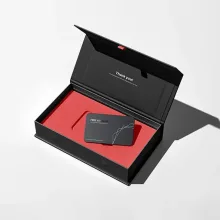
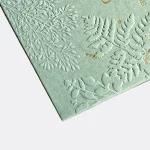
Use custom tampon boxes as the direct product reference. Custom DNA test kit boxes show how inserts can organize several components, while an embossed tin box gives a separate reference for a tactile surface. The tampon carton still needs its own filled fit check.
Which carton structure fits the count?
The closure has to close around the filled count, not an empty sample. SBS, C1S, and C2S are common paperboard references for folding cartons in the 12 to 24 pt range. Kraft board commonly falls in the 18 to 24 pt range when the natural paper surface is part of the brief.
| Structure | Packaging role | What to check |
|---|---|---|
| Straight tuck end | Front-facing folding carton with a familiar opening | Tuck friction, panel order, and repeated opening |
| Reverse tuck end | Carton with the opposite tuck direction | Top and bottom orientation during packing |
| Auto-lock bottom | Folding carton with a formed base | Base stability and packing sequence |
| Crash-lock | Carton with a firm folded base | Locking order and closure alignment |
A sleeve, pillow carton, or two-piece rigid format changes the opening and assembly. Test the closure with the actual filled count, since wrappers can make a carton bow or resist closing even when the empty sample looks right.
Does a tampon box need an insert?
An insert earns its space when wrappers need consistent spacing or the carton also holds a card, disposal pouch, or educational piece. A paperboard insert is a cut-and-scored divider that gives each item a defined place. If the carton travels inside a secondary shipper, E-flute is a thinner corrugated profile with a relatively fine print surface. B-flute and C-flute have deeper profiles and more stacking depth. A common 32 ECT convention is a board-strength reference, not a fit instruction. Match the outer format to the filled carton and its distribution path.
How do print and finish choices change the carton?
Offset CMYK suits detailed full-color graphics on folding-carton panels. Digital printing can suit a short run or changing artwork, while flexo is commonly associated with corrugated packaging. Matte or gloss lamination changes reflection. Soft-touch changes hand feel. Spot UV, foil stamping, embossing, and debossing need a marked artwork layer so decoration stays clear of creases, glue flaps, and tuck tabs.
If a window is part of the structure, PET window material commonly falls around 0.2 to 0.3 mm. A window can show the product or insert, but a solid front panel may keep the presentation more discreet. RGB artwork can shift when converted for press, and type set too close to a score can break at the fold. Leave bleed in the file and check the digital proof before anything prints. If another component in the project may touch food, ask us about food-contact options for that component.
What measurements should the carton brief use?
Inside length x width x depth should sit beside the outside dimensions, with both measurement types labelled. Measure the wrapped product, count orientation, internal clearance, and insert before the drawing is made. About 1/16 in, or 1.5 mm, is a common packaging tolerance reference. Leave enough room for removal without tearing the carton, but avoid loose space that lets the count shift during handling. A filled fit check settles the question faster than an empty carton.
How can the carton stay discreet without losing information?
A restrained front panel can keep the package private while side and back panels carry longer copy. Use controlled color, limited imagery, and a clear information order rather than crowding every panel. The carton opening matters too: a solid panel gives a different experience from a window, and the tuck direction changes which face appears first. Check the closed carton, the open carton, and the packed units before approving artwork.
Which CPL products can I use as references?
The closest catalog match is custom tampon boxes. Use the custom DNA test kit box reference when an insert must separate several pieces, and compare an embossed tin box when the surface treatment matters. These references frame structure and presentation. The filled tampon count still determines the final cavity.
What should I send with a tampon box request?
A short pack-out sketch resolves questions that prose leaves open.
- Give wrapper dimensions, product format, count per carton, orientation, and removal order.
- State the opening preference, board direction, insert requirement, and whether the box ships inside another pack.
- Mark panels, folds, glue flaps, tuck tabs, windows, safe areas, and finish layers.
- Identify the information that must remain readable when the carton is closed.
- Include a filled reference or clear arrangement drawing for the dieline handoff.
How do I move from carton brief to proof?
Proof approval should follow a filled fit and opening check, not come before it. Send the product count, wrapper format, inside measurements, artwork status, and closure choice through custom packaging design. Custom Packaging Lane is a US-based packaging supplier. Quotes are built to spec from a 100-unit minimum, with pricing from $0.49 per unit at volume, quoted to spec. Production is typically 8 to 10 business days after proof approval, plus delivery. Free US shipping and free design support are available, with a free dieline for the carton. The $19.99 sample kit is credited toward the first order.
Frequently Asked Questions
How many units should one tampon carton hold?
The carton count should come from the individual wrapper size, product format, orientation, and removal path. A carton for applicator units may need a different cavity from a carton for non-applicator units, even when the outside panel looks similar. Give the packed count and a simple arrangement sketch before the dieline is drawn.
When is a divider or insert worth adding?
A paperboard insert is useful when wrapped units need fixed spacing or when the carton also holds a card, pouch, or educational piece. It can keep the pack-out orderly during handling, but it adds material and a packing step. Compare those changes against the removal path and the stability the filled carton needs.
Is kraft board suitable for a personal-care carton?
Kraft board is a common folding-carton reference around 18 to 24 pt when its paper surface suits the package direction. SBS, C1S, and C2S paperboard are also common references in the 12 to 24 pt range. Choose the board with the closure, print surface, folds, product weight, and shipping arrangement in view.
Can the front of a tampon carton stay discreet?
A discreet tampon carton can use a restrained front panel, limited imagery, controlled color, and a clear information order. A solid panel gives more privacy than a window, while side and back panels can carry longer copy. Check the closed carton and the open carton so the design works at both points.
What happens if the tampon carton goes inside a shipper?
A secondary shipper changes the board and pack-out discussion. E-flute is a thinner corrugated profile, while B-flute and C-flute have deeper profiles. A common 32 ECT convention gives a board-strength reference. Check the filled carton inside the outer pack, including closure alignment, movement, and available space.