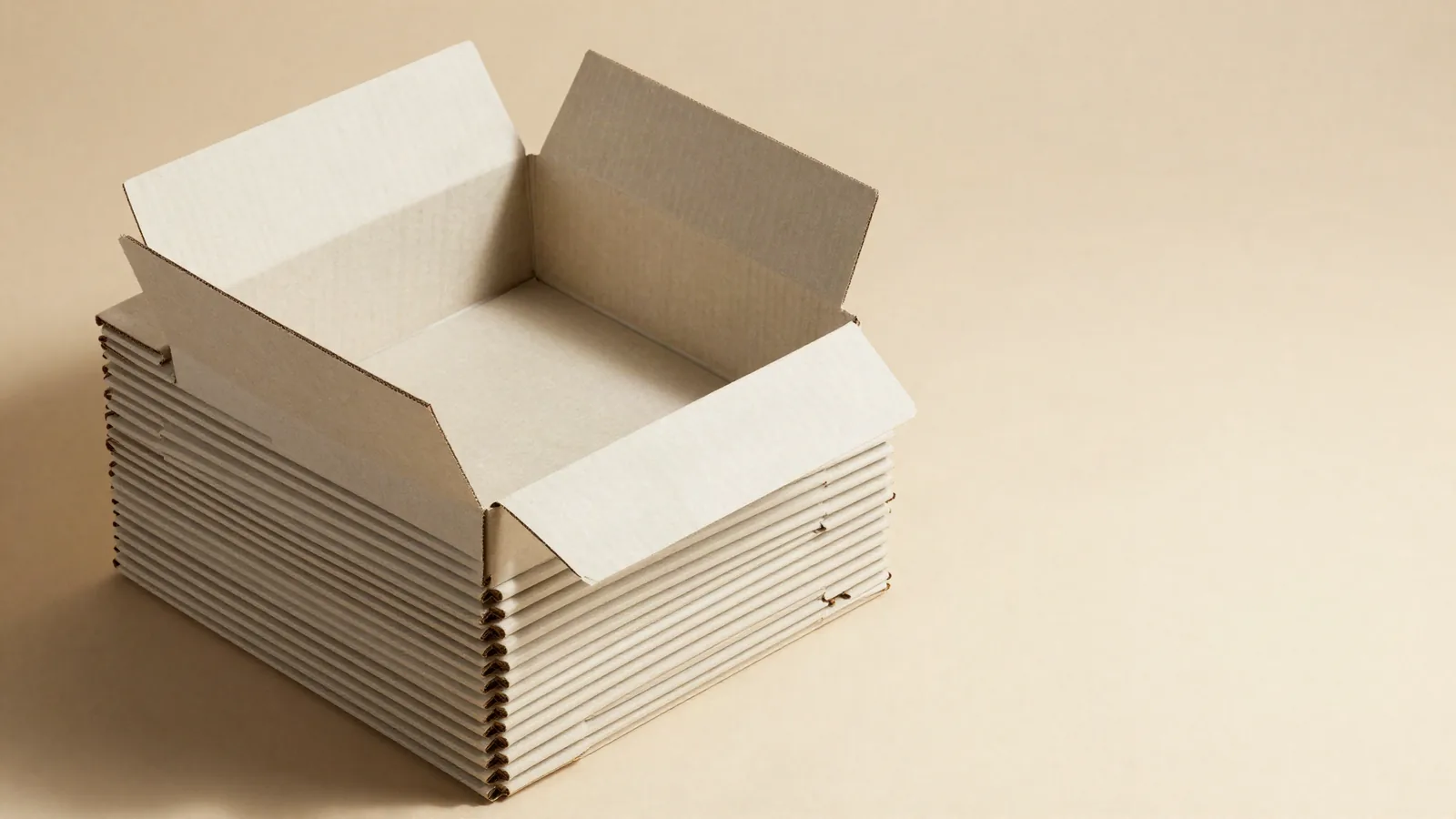

















































Corrugated cardboard thickness is easier to specify when the request names the wall and the flute. A liner is the flat paper sheet on the outside of the board. A fluted medium is the paper formed into arches between liners. A flute profile is the size and shape of that wave. A thickness chart should keep those fields beside the finished box style, because the board is scored, folded, glued, and compressed before it becomes a package.
What does corrugated cardboard thickness measure?
Corrugated cardboard thickness is the board caliper, measured across the assembled liners and fluted medium before conversion into a box. The finished wall can change when scores are pressed, panels are folded, and adhesive joins the parts. Ask for the wall construction and flute profile together, then confirm whether the quoted measurement refers to flat board or the assembled box.
What belongs in a corrugated cardboard thickness chart?
A useful corrugated cardboard thickness chart separates wall construction, flute profile, and the finished box style.
| Construction field | CPL reference | What it identifies |
|---|---|---|
| Single wall | Typically 2 to 7 mm | One fluted layer between two liners |
| Double wall | Typically 5 to 12 mm | Two fluted layers with three liners |
| Triple wall | Up to 15 mm or more | Three fluted layers with four liners |
| Flute profile | A, B, C, D, E, or F | The named corrugated profile inside the board |
These are planning references, not a substitute for the finished construction record. Liners, adhesive, compression, scores, folds, and conversion all affect the board after the sheet leaves the corrugator. Keep the wall label and flute label together when the request moves from design to quote.
How do single wall and double wall cardboard compare?
Single wall cardboard has one fluted layer between two liners, while double wall cardboard has two fluted layers and three liners. Single wall keeps the construction thinner. Double wall adds another flute and liner, which increases board thickness and can add stacking stiffness. The right choice still depends on the product, packed weight, box footprint, closure, and handling path.
For a mailer or retail box, the outer dimensions and opening also affect the result. A thicker board does not fix a loose product, a weak closure, or an insert that leaves too much room around the item. Put the wall construction beside the assembled dimensions so the box gets reviewed as a package, not as a material label.
What do corrugated flute sizes mean?
A flute profile is the wave-shaped paper layer inside the board, and its letter identifies the profile's typical height.
| Flute | Approximate profile | Inch reference | Practical material note |
|---|---|---|---|
| A flute | 5 mm | 1/4 inch | Taller profile with more interior air space |
| B flute | 3 mm | 1/8 inch or 0.125 inch | Lower profile for a more compact board |
| C flute | 4 mm | 11/64 inch | General shipping profile reference |
| D flute | 2 mm | 0.085 inch | Thinner profile planning |
| E flute | 1.5 mm | 1/16 inch or 0.0625 inch | Finer printed surface with less wall height |
| F flute | 0.6 mm | 1/32 inch | Very thin profile planning |
Flute sizes are reference values. A mill can produce a finished caliper that shifts with liner paper, adhesive, compression, and conversion. The profile letter should never stand alone in a quote request.
Which flute should a corrugated shipping box use?
Choose a flute after the product dimensions, packed weight, box style, stacking conditions, and print surface are recorded. A taller profile can leave more air space around a product. A lower profile can keep the finished package thinner and give the outer face a finer print surface. E flute is commonly chosen when printed detail and a lower wall matter; A or C flute may fit a shipping discussion where cushioning and board height matter. Confirm the final wall and flute combination on the proof.
Which CPL products should use this thickness guide?
Use the catalog format to make the thickness discussion concrete. Custom corrugated mailer boxes are the direct place to compare a printed shipping style. Kraft cardboard boxes cover a paper-led box format. Custom cardboard boxes with inserts add interior positioning, and custom cardboard boxes with lid and tray shift the discussion toward presentation and closure. The product style does not replace the wall and flute record.
What should a corrugated quote request include?
A corrugated quote request should state the product dimensions, packed weight, box style, wall construction, flute profile, closure, artwork, print surface, insert, quantity, and destination. The MOQ is 100 units. Pricing may be from $0.49 per unit at volume, quoted to spec. Production is typically 8 to 10 business days after proof approval, plus delivery. Free US shipping and free design support are available.
The $19.99 sample kit gives the buyer a way to compare board feel and surface before proof approval. Use custom packaging solutions when the quote needs a broader package brief. Send the wall and flute fields with the product dimensions.
Why can two boards with the same flute label have different thickness?
Moisture content, liner weight, adhesive pickup, and compression during converting can change the measured wall even when the named flute is identical. Caliper is the distance between the two outside faces of corrugated board. To compare samples, let them share the same room conditions, place the gauge on flat unscored areas, and record several readings without squeezing the arches. Avoid folds, crushed corners, and the glued or stitched manufacturer's joint.
| Check | Property recorded | Unit | Sample location |
|---|---|---|---|
| Board caliper | Total wall thickness | mm or in | Flat, unscored panel |
| Edge Crush Test | Edgewise compression resistance | lb/in | Prepared board edge |
| Flat crush test | Resistance to flute crushing | kPa or psi | Face of unconverted board |
| Packed trial | Fit, closure, and product restraint | Pass or fail | Assembled box with contents |
Use samples with the same conditioning history. A caliper reading belongs on the material record, but it cannot predict every load the assembled package will face.
Does a higher caliper automatically improve box strength?
No. Edge compression also depends on the facing papers, corrugated medium, adhesive, panel span, joint design, moisture, and load direction. For single-wall shipping work, 32 ECT is frequently used as a specification reference; that value does not select the right construction by itself.
A tall case with broad unsupported panels can fail differently from a compact carton made from the same board. Product weight distribution, empty space, inserts, and closure design influence stacking. Record caliper and ECT in separate specification fields, then run a packed trial with the intended contents and packing method.
Why can printing make one corrugated wall look uneven?
Large solid areas can expose washboarding, with light and dark bands following the flute peaks beneath the printed face, even when the measured thickness is consistent. Direct flexographic printing may reveal more surface texture, while a separately printed sheet laminated to corrugated can present fine graphics on a smoother face. Digital printing can suit short custom runs or several artwork versions.
During a press check, inspect registration, solid-color density, small reversed type, and color movement across panel scores. The digital proof confirms artwork position, but a converted sample is needed to reveal crushed flutes, cracked folds, or a seam that pulls the carton out of square.
Where does corrugated board lose caliper during box conversion?
Pressed folds, die-cut openings, and glued seams are the main points where the original wall can compress. In a FEFCO 0427 roll end tuck front mailer, several close scores form the rolled sidewalls and front lock. A regular slotted shipping case uses larger flap folds and a side seam, so the same board can behave differently after assembly.
Corrugated box dimensions are commonly stated as inside length x width x depth. When outside size matters, add the measured wall caliper through the relevant panels rather than reusing the inside values. Check panel span, score depth, insert pressure, closure force, and packed weight together. A thicker sheet cannot correct an insert that squeezes a wall or a lock that requires excessive force.
How should incoming corrugated boxes be checked for caliper consistency?
Take readings from flat panels on several finished boxes, keep the gauge force consistent, and separate results by panel location. A group of readings shows whether variation is isolated to a score or spread across the sheet. If low caliper clusters beside a die cut, inspect score pressure and blank stacking. If it appears across every panel, compare the unconverted board record and conditioning history.
For structural context, custom corrugated mailer boxes show closely spaced roll-end scores, while corrugated boxes show broader panels and shipping seams. Related formats appear in the custom mailer box range. For a physical reference, see the sample kit.
Frequently Asked Questions
What should a corrugated cardboard thickness chart include?
A corrugated cardboard thickness chart should separate wall construction from flute profile. Single wall is typically 2 to 7 mm, double wall is typically 5 to 12 mm, and triple wall is up to 15 mm or more. The same chart can list A through F flute references, but the final box still needs a complete construction record.
What is the practical difference between single wall and double wall cardboard?
Single wall cardboard has one fluted layer between two liners. Double wall cardboard has two fluted layers and three liners. Double wall is thicker and can add stacking stiffness, while single wall keeps the construction thinner. Product dimensions, packed weight, closure, and handling conditions still belong in the box specification.
What are the main corrugated flute sizes?
The main corrugated flute references are A at 5 mm, B at 3 mm, C at 4 mm, D at 2 mm, E at 1.5 mm, and F at 0.6 mm. Inch references appear beside those values. Use each flute letter with the wall construction, then confirm the assembled package before approval.
What information should I send when asking about corrugated shipping box thickness?
A corrugated shipping box thickness request should include the product dimensions, packed weight, box style, wall construction, flute profile, closure, artwork, insert needs, quantity, and destination. Those details connect the material choice to the finished box. Ask for a proof that shows the assembled dimensions before production starts.
What order terms apply to custom corrugated boxes?
Custom corrugated box projects use a 100-unit MOQ, and pricing may be from $0.49 per unit at volume, quoted to spec. Production is typically 8 to 10 business days after proof approval, plus delivery. Free US shipping and free design support are available, with a $19.99 sample kit for early material comparison.