





































































A standard cardboard box size is meaningful only when length, width, and height are labeled as interior or exterior. Buyers searching for size cardboard boxes, a size cardboard box, or a cardboard box size chart may be comparing a product carton, gift box, shipping carton, or presentation package. Those formats do not share one measurement rule.
CPL's 562-product catalog provides the size and dimension records used for its production references. Read each record against the same fields: product space, finished footprint, closure, board, and internal support. A row with three unlabeled numbers is incomplete because it does not tell the buyer whether the product will fit or how large the closed box will be.
What do standard cardboard box dimensions mean?
Standard cardboard box dimensions describe length, width, and height, but the measurement basis must be stated before the numbers can guide an order. Interior dimensions describe usable product space. Exterior dimensions describe the closed package footprint.
Start with the packed product. Record the longest side, the side-to-side space, the vertical room under the lid or closure, and any insert, divider, wrap, or card that remains inside. Then check the outside footprint for storage, shelf placement, shipping cartons, and pallet layout.
Which fields belong in a cardboard box size chart?
A useful cardboard box size chart keeps each measurement and structural question in its own field.
| Chart field | What the buyer should confirm |
|---|---|
| Interior length | The longest product dimension that must sit inside the box |
| Interior width | The side-to-side space needed for the product, wrap, divider, or insert |
| Interior height | The vertical room under the lid, tuck panel, sleeve, or closure |
| Exterior footprint | The finished space the closed package occupies on a shelf, pallet, or shipping surface |
| Closure style | The way the box opens and closes, including panels that affect usable space |
| Product support | The insert, divider, wrap, or other component that keeps the product positioned |
How does board thickness change the finished size?
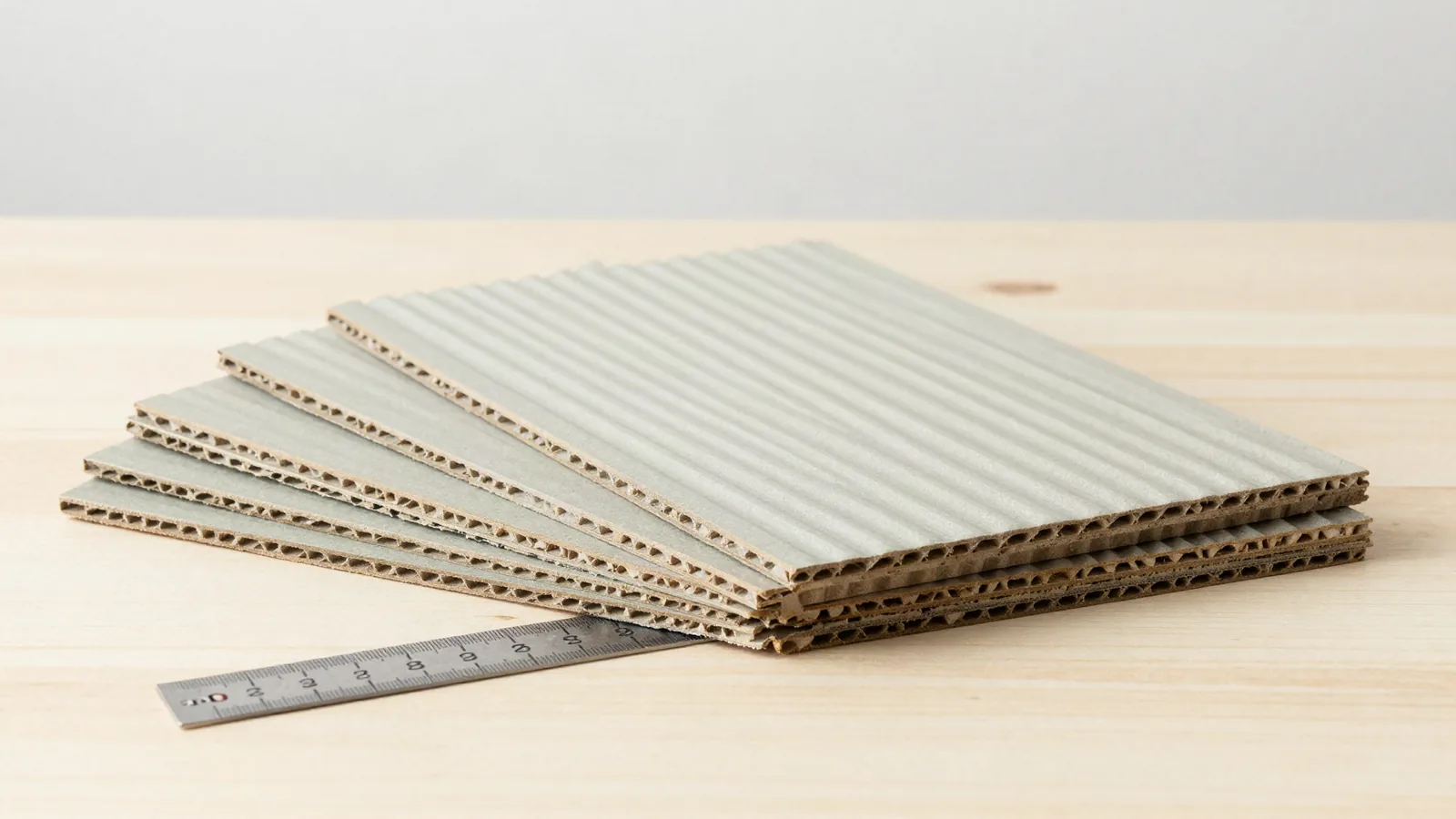
Board thickness changes the inside cavity, outside footprint, fold behavior, and stacking performance. If the brief calls for corrugated board, these typical industry caliper references help frame the conversation. Actual mill specifications can differ.
| Corrugated flute | Typical industry caliper | Common packaging effect |
|---|---|---|
| E-flute | About 1/16 in, 1.5 mm | Finer print surface and a thinner profile |
| B-flute | About 1/8 in, 3.2 mm | More cushioning and stacking support than E-flute |
| C-flute | About 3/16 in, 4.8 mm | Thicker wall and more room for shipping protection |
Paperboard cartons use a different construction from corrugated boxes, so the board choice belongs in the dieline brief. A dieline is the flat cutting template that shows panels, scores, cut lines, glue tabs, and bleed. It is where the product fit and board choice meet.
Which cardboard package fits the product?
Choose the package family after deciding how the product will be handled and displayed. For a kraft-led direction, review kraft cardboard boxes. A footwear project can use shoe box packaging as a format reference.
Small presentation items may fit the proportions of custom cardboard jewelry boxes, while a gift-led opening can start with custom cardboard gift boxes. If the product needs controlled positioning, include custom foam box inserts in the brief. Each family still needs to be measured against the packed item.
How do interior and exterior measurements affect the order?
Interior measurements answer whether the product fits. Exterior measurements answer whether the closed package fits the storage, display, and distribution plan. Keep both values on the quote, but do not blend them into one unlabeled size.
- Fit depends on interior length, width, height, and controlled clearance.
- Presentation depends on the opening direction, lid or sleeve behavior, and product position.
- Storage depends on the exterior footprint and the way closed boxes stack.
- Product stability depends on the insert, divider, wrap, or other internal support.
Check scores and glue tabs before artwork is final. Type set too close to a score can fold into the crease. Low-resolution art can look soft on a large panel, and RGB color can shift when the file is converted for press. The digital proof is the place to catch those problems.
What goes into a custom cardboard box quote?
CPL's MOQ is 100 units. Pricing is from $0.49 per unit at volume, quoted to spec. Production is typically 8 to 10 business days after proof approval, plus delivery. Free US shipping and free design support are available.
Send the product dimensions, inside or outside measurement basis, board direction, closure, insert, finish, artwork status, quantity, and destination. Ask how many closed boxes nest in a master carton and how the cartons stack on a pallet. The $19.99 sample kit can be credited toward the first order. Use custom packaging solutions to organize the project before requesting the proof.
Frequently Asked Questions
What are common cardboard box dimensions?
Common cardboard box dimensions are usually written as length, width, and height, but the useful answer depends on whether those numbers describe the inside or outside. A product carton, gift box, and shipping carton can use different structures. A meaningful chart labels the measurement basis, closure, board, and internal support.
How do I measure a product for a cardboard box?
Measure the packed product at its longest, widest, and tallest points, including any wrap, card, divider, or insert that stays inside. Record interior clearance separately from the outside footprint. Also note the opening direction, closure panels, storage space, and shipping context before the dieline is drawn.
Does cardboard thickness change the outside size?
Cardboard thickness changes the relationship between the inside cavity and outside footprint. Typical corrugated references include about 1/16 inch for E-flute, 1/8 inch for B-flute, and 3/16 inch for C-flute. The selected board, folds, scores, and closure should appear together in the final dieline.
Can CPL make a cardboard box to a product's measurements?
CPL can plan a custom cardboard box around the product dimensions, structure, closure, board, insert, artwork, and finish. Free design support helps organize the brief before proof approval. The final size should be checked on the selected construction, because interior fit and exterior footprint are separate measurements.
What is the cardboard box minimum order?
The cardboard box minimum order is 100 units. Pricing is from $0.49 per unit at volume, quoted to spec. Production is typically 8 to 10 business days after proof approval, plus delivery. Free US shipping and free design support are available, and the $19.99 sample kit can be credited toward the first order.