




























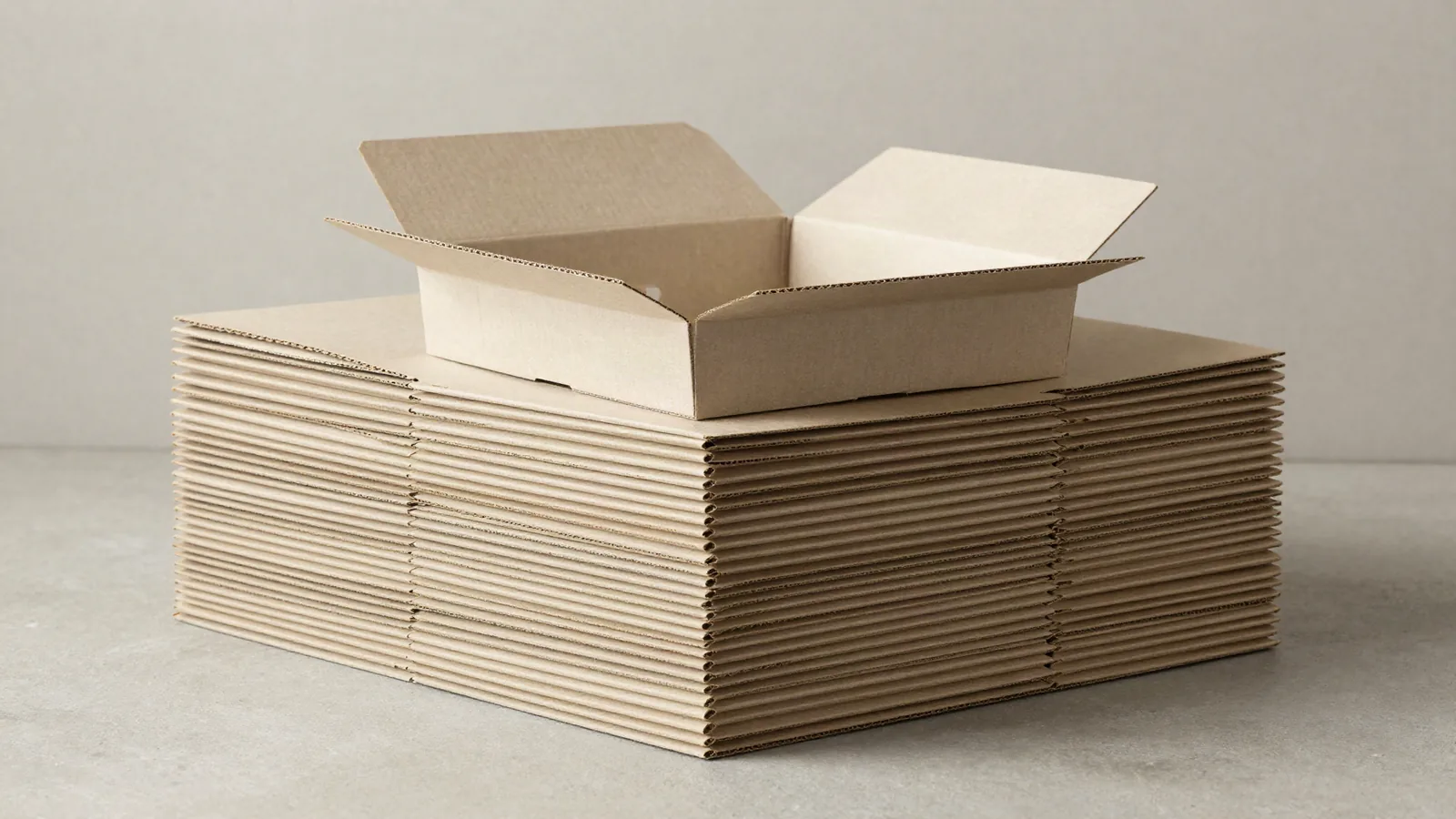




















































A corrugated box size starts with the packed product's inside length, width, and height. Outside dimensions come later, after board thickness, flute, folds, closure, and print structure are set. CPL's catalog uses custom corrugated dimensions, so the useful chart is a quote record built around the product rather than a copied list of stock measurements.
What should a corrugated box sizes chart show?
A useful corrugated box sizes chart shows inside dimensions, outside dimensions, flute profile, board request, closure, and the product packed inside. Inside length, width, and height describe usable space. Outside dimensions matter for storage and freight. Keep those fields separate when comparing standard corrugated box dimensions.
A corrugated flute is the arched paper layer between liners that adds thickness and stacking support. A dieline is the flat cutting and scoring template used to turn the sheet into a box. Flute choice changes caliper, print surface, fold behavior, and the space available inside the finished box.
| CPL catalog direction | What it is suited to compare | Fields to confirm |
|---|---|---|
| Custom corrugated mailer boxes | Products shipped through a carrier network | Inside dimensions, closure, flute, board request |
| Corrugated boxes | General product and shipping structures | Fit, print coverage, board grade, handling context |
| Cake corrugated boxes | Shaped products with a defined footprint | Footprint, height, clearance, opening, support |
| Custom shipping structure | A shipment planned around the packed product | Filled weight, carrier use, stacking, proof dimensions |
The table separates what is visible in the product catalog from what still belongs in the quote. If a supplier gives you a size without stating whether it is inside or outside, ask before comparing quotes. A number without its measurement convention is not a reliable size comparison.
What does ECT board grade mean for box sizing?
ECT means edge crush test, a public corrugated-board test used to discuss the board's resistance to crushing at the edge. ECT is not a box dimension. Length, width, and height answer whether the product fits, while ECT and flute answer part of the board-performance question.
CPL's product records do not assign one fixed ECT value to every corrugated box. Put the requested ECT grade, flute profile, dimensions, filled weight, and handling context in the same request. A taller box, heavier product, or stacked shipment can lead to a different board discussion from a display-oriented carton.
How do I choose a corrugated shipping box size?
Measure the packed product first, including the space needed for an insert, divider, cushion, or void fill. Then decide whether the box ships by itself, fits inside an outer carton, or presents the product at retail. A mailer and a standard shipper can use corrugated board while serving different jobs.
Write down inside dimensions and outside footprint as two separate values. Request the flute and ECT fields with the size, closure, and shipment conditions. This keeps a dimension comparison from turning into a board-grade guess.
When a product has a tapered shape or a fragile corner, measure the widest packed point rather than the smallest face. If the box includes an insert, size the product and insert together. A tight insert cut to the wrong product profile can hold the wrong place or leave the product rattling in transit.
Which flute and board details should be in the quote?
Ask for the flute profile, board grade or ECT request, liner direction, filled weight, stacking position, and closure. Caliper means board thickness. Typical industry calipers are about 1.2 to 2.0 mm for E-flute and about 3.0 to 3.5 mm for B-flute, with mill variation. E-flute is commonly thinner and gives a finer print surface, while B-flute is commonly thicker.
Print and finish also change the job. CPL's corrugated catalog describes CMYK and PMS directions, along with matte, gloss, aqueous, spot UV, foil, embossing, and debossing. PMS is a spot-color reference system. A carrier-facing mailer may need a readable surface that handles routine contact, while a product-facing carton may put more emphasis on print and finish.
How should inside and outside corrugated dimensions be recorded?
Record the inside length, width, and height first, then list the outside dimensions after the board and structure are selected. This separates usable product space from the footprint that affects storage, master cartons, pallet layout, and freight.
- Label every dimension as inside or outside.
- State the order of the dimensions.
- List the flute and board request beside the size.
- Include the packed product and any insert.
- Note the closure and shipping orientation.
What print and proof details should I check?
Check the proof against the assembled box, not only the flat art file. Look for type crossing a score, bleed missing at a cut edge, RGB artwork that shifts during press conversion, and print coverage that sits on a glue tab. The proof is the point to correct those file issues before the production run begins.
What quantity and timing apply to corrugated boxes?
The MOQ is 100 units, and pricing is from $0.49 per unit at volume, quoted to spec. Production is typically 8 to 10 business days after proof approval, plus delivery. Free US shipping and free design support are available. The $19.99 sample kit can help compare stock feel and finish direction before proof approval.
For a broader product-family conversation, visit custom packaging solutions. Send the packed product dimensions, inside and outside size targets, board request, flute question, print direction, quantity, and destination so the quote answers the actual shipping-box problem.
Frequently Asked Questions
What are standard corrugated box dimensions?
Standard corrugated box dimensions are not one universal set because the correct size depends on the packed product, clearance, closure, board thickness, and shipping use. CPL catalog records describe custom dimensions. Provide inside length, width, and height first, then confirm outside dimensions after the flute, folds, and board structure are selected.
What is ECT board grade sizing?
ECT board grade sizing refers to edge crush test, a public corrugated-board test used to discuss edge-crush performance. ECT is separate from box length, width, and height. A corrugated quote should state the product fit, flute profile, requested ECT grade, filled weight, and handling context together.
Is ECT the same as corrugated box size?
ECT is not the same as corrugated box size. Box size describes the space available for the packed product, while ECT describes one board-performance test field. Keep dimensions, flute, board grade, closure, filled weight, and shipment conditions together when comparing corrugated shipping box options.
Can CPL make a custom corrugated mailer box?
CPL's catalog includes custom corrugated mailer boxes for products that move through a carrier network. A useful request includes the packed product, inside dimensions, opening and closure, flute profile, board request, print direction, and shipping context. The final structure is set through the approved proof, not a generic stock size.
What quantity and timing apply to custom corrugated boxes?
Custom corrugated boxes have a 100-unit MOQ and pricing from $0.49 per unit at volume, quoted to spec. Production is typically 8 to 10 business days after proof approval, plus delivery. Free US shipping and free design support are available, and the sample kit costs $19.99.












