Walk into any beauty store or scroll through an online cosmetic shop and you’ll notice one thing immediately. Many products look similar, but only a few actually stand out. Most of the time, it’s not the formula doing that. It’s the packaging.
Cosmetic packaging ideas are not just about making a product look good. They shape how a customer understands the product, how quickly they trust it, and whether they pick it up or scroll past it. Good packaging removes confusion. It makes the product feel complete. These cosmetic packaging ideas are commonly used by brands looking to improve product presentation, strengthen brand identity, and increase conversion across retail and e commerce channels.
At the same time, not every idea works in real conditions. Some designs look impressive in mockups but fail when stacked on shelves or shipped in bulk. The ideas that actually work are the ones that balance design with structure and usability.
In this guide, you’ll see how different cosmetic packaging ideas are used in real situations, what makes them effective, and how brands apply them based on product type and positioning. Brands that want to turn these ideas into production-ready packaging often rely on custom cosmetic boxes to align structure with branding.
What Makes a Cosmetic Packaging Idea Actually Work
If you look at brands that perform well consistently, their packaging usually follows a few simple rules. Nothing feels random.
First, the product is easy to understand. You don’t have to rotate the box or read everything to figure out what it is. The layout guides your eye naturally.
Second, the packaging feels stable. When you hold it, it doesn’t feel loose or poorly fitted. That physical experience matters more than most people think.
Third, everything looks connected. The colors, fonts, and spacing feel like they belong to the same brand. Even if you see the product for the first time, it feels familiar.
These are small things individually, but together they decide whether packaging works or not.
Creative Cosmetic Packaging Ideas That Actually Get Attention
A lot of brands think creativity means adding more design elements. In reality, the opposite often works better.
You’ll notice many newer skincare and beauty brands are moving toward simpler layouts. They leave space around the logo. They reduce unnecessary text. This makes the packaging easier to scan, especially when placed next to competitors.
Another approach you’ll see is layered packaging. For example, an outer sleeve that slides off, followed by a clean inner box. It’s not complicated, but it changes how the product is experienced. That small interaction makes the packaging feel more intentional.
Typography is also doing more work now than before. Some brands rely almost entirely on font choice and spacing to define their look. No heavy graphics, just strong alignment and structure.
These kinds of creative packaging ideas for cosmetics don’t rely on decoration. They rely on control.
Cosmetic Packaging Design Ideas Based on Product Type
This is where many brands go wrong. They use the same packaging logic for every product, even when the products behave differently.
Lipstick Packaging Ideas
Lipsticks are small, but they are often displayed in rows. That means even small inconsistencies become visible.
You’ll see many brands use slim, vertical boxes with sharp edges. This helps them stay aligned when stacked together. If one box bends or shifts, it affects the whole display.
Another thing you’ll notice is restraint in design. Instead of filling the box with graphics, brands focus on spacing and proportion. It makes the product easier to recognize from a distance.
Many brands refine these details by working through different versions of lipstick packaging boxes until the sizing and alignment feel right in real display conditions.
Nail Polish Packaging Ideas
Nail polish is where packaging becomes more about protection than appearance.
Glass bottles are sensitive. Even a small amount of movement inside the box can lead to damage during shipping. That’s why most effective designs here focus on what’s inside the box rather than outside.
You’ll often find inserts, tighter dimensions, and slightly thicker board. These are not design choices in the visual sense, but they make a big difference in performance.
Brands usually move toward nail polish packaging boxes that reduce empty space and hold the bottle firmly in place. It’s a simple idea, but it solves a real problem.
Eyelash Packaging Ideas
Eyelash packaging works differently. Here, customers often want to see the product before buying.
That’s why window cutouts are so common. They allow the product to be visible without opening the packaging. This reduces hesitation and builds confidence.
At the same time, the packaging needs to stay compact and easy to handle. Oversized or complicated structures usually don’t perform well in this category.
Most brands experimenting in this space look at different versions of eyelash packaging boxes to balance visibility and structure without making the packaging fragile.
Hair Extension Packaging Ideas
Hair extension packaging brings a different challenge. The product itself changes the rules.
Because of the length, standard box formats don’t always work. You’ll often see vertical packaging with hanging options, especially in retail stores.
These boxes are designed so the product can be displayed without losing its shape. Window panels are also common, allowing customers to see the texture and color before opening.
Brands handling these products usually develop custom formats of hair extension packaging boxes to manage both size and presentation in a practical way.
Cosmetic Gift Packaging Ideas That Feel Complete
Gift packaging is less about the product alone and more about the experience around it.
You’ll notice that brands often switch to rigid boxes for gift sets. The reason is simple. They feel more solid and structured, which makes the product seem more valuable.
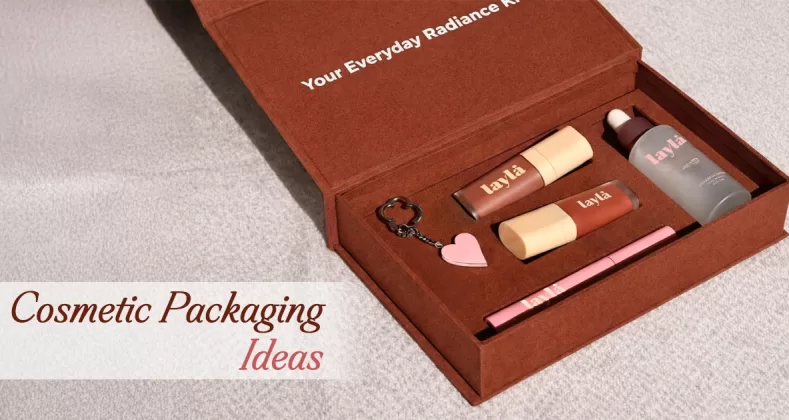
Magnetic closures, inserts, and grouped products are also common. Instead of selling one item, brands package multiple items together in a way that feels intentional.
The best cosmetic gift packaging ideas don’t rely on decoration. They rely on how the packaging opens, how it holds the product, and how it feels when handled.
Luxury Cosmetic Packaging Ideas That Actually Feel Premium
Luxury packaging is often misunderstood because many brands assume it comes from adding more elements. In practice, premium cosmetic packaging works in the opposite way. It removes unnecessary design and focuses on precision.
If you observe established premium brands, their packaging rarely feels loud. Instead of using multiple colors or heavy graphics, they rely on controlled color palettes. Black, white, muted tones, or soft neutrals are commonly used because they create a stable visual base. This allows smaller details, such as the logo or product name, to stand out more clearly.
Finishing also follows the same principle. Foil stamping, embossing, or debossing is applied in a very selective way. Instead of covering large areas, these finishes are used to highlight one key element. This creates contrast without overwhelming the design.
Material choice plays a major role in how premium packaging is perceived. Rigid structures are widely used because they maintain their shape and add weight. When a customer picks up the box, that physical firmness immediately signals quality. This is something that printing alone cannot achieve.
Another detail that separates luxury packaging is spacing. Premium designs often leave intentional empty space around content. This improves readability and creates a sense of control. When packaging feels balanced, it looks more refined even with minimal elements.
Luxury cosmetic packaging ideas work when everything feels deliberate. Nothing looks added for decoration alone. Every element supports the overall presentation.
Skincare Packaging Ideas That Build Trust
Skincare packaging follows a different logic compared to makeup products because customer expectations are different. Instead of being driven by visual appeal alone, skincare packaging is closely linked to trust and clarity.
Customers usually want to understand what the product does without spending time figuring it out. This is why most skincare packaging avoids clutter. The layout is structured, with clear sections for product name, benefits, and usage details. Information is not hidden within design, it is presented in a way that is easy to scan.
Color selection also reflects this approach. Soft tones such as white, beige, pastel shades, or muted greens are commonly used. These colors create a calm and stable appearance, which aligns with how customers perceive skincare products. Bright or overly contrasting colors are used less frequently because they can create confusion in this category.
Typography is another important factor. Fonts are usually simple, readable, and consistent across product lines. When packaging uses overly decorative fonts, it reduces clarity and makes the product harder to trust.
Material choice also supports the positioning. Many skincare brands prefer recyclable or eco-friendly materials because they align with customer expectations. However, the material still needs to maintain structure and protect the product effectively.
What stands out in skincare packaging is not creativity in the traditional sense, but how clearly everything is presented. The most effective skincare packaging ideas focus on making the product feel reliable, understandable, and consistent across every interaction.
Unique Cosmetic Packaging Ideas That People Remember
Not every brand needs bold or complex packaging to stand out. In many cases, small structural or experiential changes create a stronger impression than heavy design.
One of the most effective ways to create uniqueness is through structure. A slight variation in box shape, opening style, or folding mechanism can make a product feel different without increasing production complexity. Customers may not immediately notice the change, but they remember the experience.
Inner packaging is another area where brands are experimenting. Instead of leaving the inside plain, many brands add printed patterns, messages, or subtle design elements. This creates a moment of surprise when the box is opened. It does not change the outer appearance, but it improves the overall experience.
Limited edition packaging is also widely used to create variation. Brands release seasonal designs or campaign-specific packaging that feels temporary. This encourages customers to purchase before the design disappears. It also keeps the product line visually fresh without changing the core structure.
Texture is another element that contributes to uniqueness. Soft-touch finishes, light embossing, or slight variations in surface feel create a more interactive experience. Customers may not consciously identify these details, but they influence how the packaging is perceived.
Unique cosmetic packaging ideas work best when they remain connected to the brand. When uniqueness is forced or unrelated to the product, it can create confusion instead of differentiation.
How to Choose the Right Cosmetic Packaging Idea
Choosing the right packaging idea is not about selecting the most attractive design. It is about understanding how the packaging will function in real conditions.
The first step is evaluating the product itself. Fragile products such as glass bottles require stronger materials and internal support. Lightweight products allow more flexibility in structure and design. Ignoring this step often leads to packaging that looks good but fails during use.
The second factor is the sales channel. Packaging used in retail environments needs to stand out visually. It must be easy to identify from a distance and clear enough to compare with other products. In contrast, packaging used for e commerce must handle shipping conditions. It should resist pressure, movement, and stacking.
The third factor is brand positioning. A premium product requires packaging that reflects its value. This does not always mean expensive materials, but it does require consistency in design and structure. Similarly, products targeting a broader market need packaging that is clear, efficient, and cost-conscious.
When these factors are considered together, packaging ideas become practical solutions. They are no longer just design concepts but decisions that support product performance and brand growth.
Connecting Ideas with Real Packaging Production
There is often a gap between packaging ideas and actual production. A concept that looks strong in design may not work when translated into physical packaging.
Material limitations are one of the main reasons for this gap. Certain finishes may not work well on specific materials. Colors may appear different depending on the surface. Structural designs may need adjustment to maintain strength during manufacturing.
Printing methods also influence the final result. Details that look sharp on screen may not translate the same way in large-scale production. This is why testing and adjustments are part of the process.
Another factor is cost. Some packaging ideas require additional processes that increase production time and pricing. Without balancing design with cost, packaging can become inefficient.
To understand how materials, structure, and cost decisions work together in real scenarios, you can refer to the cosmetic packaging guide, where these aspects are explained in detail from a production perspective.
Conclusion
Cosmetic packaging ideas are not just about appearance. They influence how products are presented, how they perform, and how customers remember them.
The most effective ideas are often the simplest ones. They focus on clarity, structure, and consistency instead of unnecessary complexity. When packaging is aligned with product requirements and brand positioning, it becomes a strong part of the overall product experience.
Brands that treat packaging as a strategic decision rather than a final step tend to see better long-term results. Not just in sales, but in how customers recognize and return to their products.