




























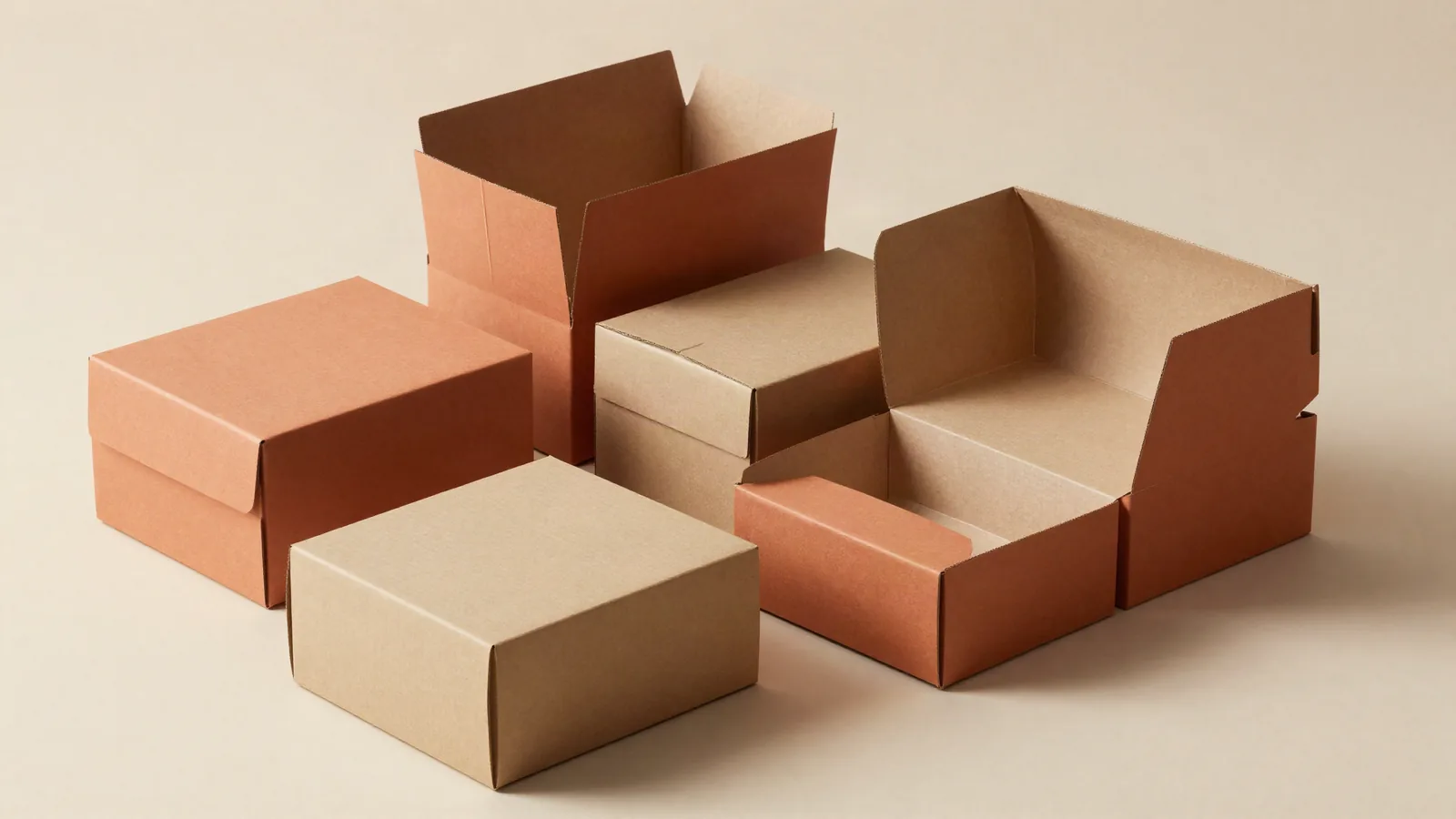




















































A custom boxes pack is a group of packages planned as one system. Begin with the products, their loading order, the way the buyer opens the set, and the panels that need to match. This page stays focused on coordinated box packs, not a general packaging catalog.
What should a custom boxes pack solve?
Several products, their loading order, and the desired reveal should be written before a structure is chosen. A pack may use separate cartons inside a sleeve, a rigid lid and base, or one mailer that carries the set. Note whether the boxes will be displayed, gifted, stored, shipped, or opened repeatedly. Packing labor matters.
Which structures can organize a box set?
Two-piece rigid construction separates a lid from a base, so the components can be checked as separate parts.
| Structure | Physical arrangement | Buyer checkpoint |
|---|---|---|
| Two-piece rigid | Separate lid and base | Lid fit, wall alignment, and stacked footprint |
| Drawer or slide | Inner tray moves through a sleeve | Travel, pull edge, and tray stop |
| Sleeve and tray | Outer wrap holds an inner component | Overlap, clearance, and panel orientation |
| Straight tuck end | Folding carton with tuck flaps | Repeatable panel order and closure |
| Tuck-top mailer | Self-closing outer box | Roll end tuck top, locking points, and packing order |
A drawer or slide opens along a guided path. A sleeve and tray keeps the moving parts separate. A straight tuck end fits a repeatable folding-carton format, while a tuck-top mailer is practical when the set also needs an outer shipping closure. A magnetic flap changes the opening motion. Tuck cartons, mailers, drawers, and two-piece boxes can share artwork rules while keeping their own construction.
How can several boxes look like one pack?
A shared artwork grid carries the family resemblance, even when the outer footprints change. A dieline is the flat cutting template used to place panels, folds, cuts, and glue zones. Keep logo placement, product naming, information hierarchy, barcode zone, and opening cues in predictable positions. Let the dimensions change within their approved dielines instead of squeezing copy into a smaller panel.
Color blocks and secondary graphics can change by product while the core panel order stays fixed. Record the artwork revision with each box size. Keep the front, reverse, side, and bottom panels named in the same order across the set.
What fit checks matter across the set?
Inside measurements expose the real fit; outside dimensions do not show whether a product rattles. Write each box as length x width x depth and use inside measurements during fit planning. A general convention allows about 1/16 in (1.5 mm) tolerance. Test the smallest and largest item, protective wrap, insert, loading sequence, and closure. For a multi-box pack, also check whether the boxes nest, stack, or need a sleeve.
If a set includes a visible product, PET windows, or clear plastic windows, around 0.2 to 0.3 mm are a common reference. Window patching needs clear space around the opening and can affect panel strength. An insert cut to the exact product size may stop movement, but it can make loading difficult if the product has a wrap or label. Check removal before the artwork is locked.
Which materials keep the set consistent?
SBS, C1S, and C2S paperboard give matching printed surfaces across folding formats in the 12 to 24 pt range. Kraft board is often discussed around 18 to 24 pt and gives another surface direction. Rigid boxes commonly use 1.5 to 3 mm chipboard wrapped in 100 to 157 gsm art paper. These are typical industry planning ranges. The product, folds, panel size, stacking, and shipping path decide the working board.
Offset CMYK, the four-color process, is common for detailed folding-carton artwork. Digital printing can suit short-run development or changing versions, and flexo is commonly associated with corrugated printing. If one pack mixes folding cartons and mailers, keep the print method and color expectations visible in the same review.
How should finishes be assigned across the pack?
Matte or gloss lamination sets the surface direction, while spot effects belong on named panels. Matte reduces reflection and gloss increases it. Soft-touch changes hand feel. Spot UV isolates a selected mark, foil stamping adds reflective detail, and embossing or debossing changes surface height. Keep effects away from folds, glue areas, seams, tuck flaps, and small type.
Which catalog formats help frame a coordinated pack?
Tuck-top mailers and undergarment boxes show two different footprints for a shared visual system. Compare custom tuck-top mailer boxes and custom undergarments boxes for outer structure and panel planning. Review custom votive candle boxes for compact presentation and custom vial boxes for small-component arrangement. The custom packaging solutions hub is a broader route when the set includes more than one format.
What belongs in a box-pack brief?
The brief should identify every product, opening motion, artwork rule, and packing check before samples are compared.
- List every product, quantity, orientation, accessory, and desired opening sequence.
- Separate retail presentation from storage and shipping requirements.
- Choose a material and structure for each format, then align the visual system.
- Review assembled samples for fit, nesting, closure, surface feel, and packing speed.
Custom Packaging Lane quotes coordinated custom boxes pack projects to spec from a 100-unit minimum, with pricing from $0.49 per unit at volume, quoted to spec. Production is typically 8 to 10 business days after proof approval, plus delivery. Free US shipping, free design support, and a free dieline are available. The $19.99 sample kit is credited to the first order. Use the sample kit to compare structures and finishes before approving a production proof.
Frequently Asked Questions
Can boxes in one pack have different dimensions?
Boxes in one coordinated pack can use different internal dimensions while sharing logo placement, product naming, color rules, information hierarchy, and opening cues. Write each box as length x width x depth with inside measurements, then test the actual products, wraps, inserts, sleeves, and closures. The visual system should adapt to each dieline.
When does a two-piece rigid box make sense?
A two-piece rigid box suits a set that needs a separate lid and base with a deliberate opening sequence. Rigid chipboard around 1.5 to 3 mm wrapped in 100 to 157 gsm art paper is a common construction reference. Compare lid fit, wall alignment, storage footprint, insert retention, and packing motion with the other structures.
How does a drawer box differ from a tuck-top mailer?
A drawer or slide box moves an inner tray through a sleeve, so the buyer checks travel, pull edge, stop, and clearance. A tuck-top mailer closes with a folded top and can carry the set as an outer package. Compare opening motion, packing order, product protection, and whether the box will be shipped.
What keeps different box sizes visually consistent?
A shared artwork grid keeps different box sizes connected through logo position, product naming, information hierarchy, barcode placement, color blocks, and opening cues. Adapt the graphics to each dieline instead of forcing copy across folds, seams, or glue areas. Matte or gloss lamination can keep surface reflection consistent across the set.
What should I check when opening a coordinated pack sample?
A coordinated pack sample should be checked with the actual products, wraps, inserts, sleeves, and accessories. Compare loading order, fit, closure, nesting, stacking, tray or lid movement, sleeve clearance, removal force, and surface feel. Open the set repeatedly and confirm that the shared artwork remains readable on every box size.












