




























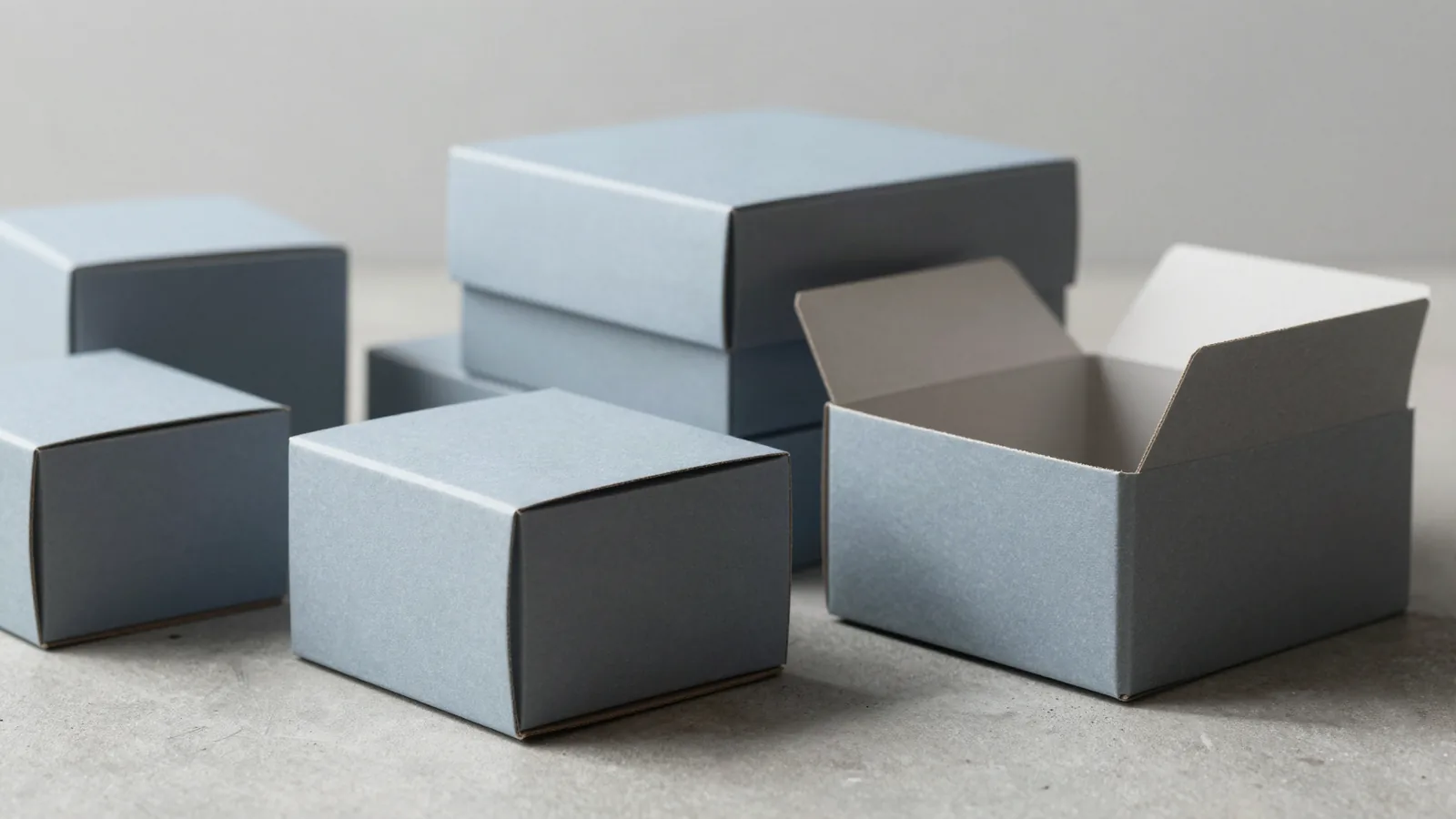




















































Rockford box buyers need a brief built around the packed product, not only the outside appearance. A retail carton, bottle box, corrugated shipper, and mailer solve different problems. Start with inside measurements, product orientation, quantity, material, structure, artwork status, finish, insert needs, and destination. If the package will enter parcel shipping, include the outside carton and packout in the same request.
What should a Rockford box brief contain?
The packed product and shipping path decide the first fields: inside size, orientation, material, structure, artwork, finish, inserts, and destination. A printed carton may sit inside an outer shipper, while a roll-end tuck-top mailer can handle both presentation and shipping. State whether the package needs a window, cavity, divider, sleeve, or open interior. Category names alone create revisions.
Which structure fits a product or shipment?
Straight tuck end, reverse tuck end, and roll-end tuck-top mailer cover different handoffs.
| Package role | Common structure | Primary review point |
|---|---|---|
| Printed shelf carton | Straight tuck end or reverse tuck end | Panel order, fold behavior, and closure |
| Parcel presentation | Roll-end tuck-top mailer | Packout, closing motion, and outside size |
| Supported base | Auto-lock bottom or crash-lock | Setup motion and bottom support |
| Product reveal | Two-piece rigid, drawer, or slide | Lid clearance, tray movement, and opening |
FEFCO 0427 is a common reference for a roll-end tuck-top mailer. Straight tuck end and reverse tuck end suit other folding-carton needs, while auto-lock and crash-lock bases change setup and bottom support. A two-piece rigid box or drawer creates a different reveal from a shipping mailer. Load the product before comparing the opening.
How can I make inside dimensions clear?
Length x width x depth is useful only when each value is marked inside or outside. Inside dimensions control the fit around the product, insert, divider, and closure. About 1/16 in, or 1.5 mm, is a common planning tolerance, subject to the approved specification. Include product orientation and clearance, then check the assembled package because a flat drawing cannot show every loading issue.
Which product references can guide the format?
Review custom veterinary medicine boxes for compact cartons and copy hierarchy. Compare for small-unit arrangement, then review for cavity and insert planning. For parcel presentation, see custom tuck-top mailer boxes.
Which board and flute choices should I compare?
SBS, C1S, and C2S paperboard suit printed folding cartons, while corrugated flute changes thickness, stiffness, cushioning, and print surface. The paperboard reference is around 12 to 24 pt. Kraft board is often discussed around 18 to 24 pt and creates another surface direction. Rigid boxes commonly use 1.5 to 3 mm chipboard wrapped in 100 to 157 gsm art paper. Pt is a board caliper notation, and gsm is a paper-weight measure.
Corrugated E, B, and C flutes offer different profiles and handling behavior. 32 ECT, or edge crush test, is a common corrugated strength reference. These are typical industry planning references, not a fixed quote. Box size, product weight, stacking, and handling still need to be reviewed together.
How should print and finish follow the structure?
Offset CMYK, the four-color process, digital printing, and flexo belong to different substrate conversations. Offset CMYK is common for detailed carton artwork, digital printing can suit short runs or changing versions, and flexo is commonly associated with corrugated print. Matte or gloss lamination changes reflection. Soft-touch changes hand feel. Spot UV, foil stamping, embossing, and debossing can add selected detail. Keep artwork clear of folds, glue zones, locking tabs, seams, and any area where the product blocks the message.
How does parcel size enter the quote?
The outside packed footprint drives carrier math, so the shipper belongs in the same review as the product box. Provide outside carton dimensions, packout, destination, and closure when shipping is part of the job. US ground dimensional weight commonly uses L x W x H / 139. The product box, outer carton, and carrier calculation remain separate parts of the request, even when one package performs more than one role.
What should I send for a Rockford box quote?
A complete handoff names the product, inner fit, outside packout, artwork status, finish, and destination. A dieline is the flat cutting template that maps the structure, folds, cuts, and glue areas. Add the structure, insert, product orientation, and shipping role before it is approved.
- Describe the packed product, inside measurements, loading direction, storage, and delivery path.
- Choose the format and substrate before finalizing the artwork treatment.
- Mark print panels, seals, folds, windows, barcodes, and opening instructions.
- Review the physical sample for color impression, fit, closure, protection, and handling.
Custom Packaging Lane quotes Rockford custom boxes to spec from a 100-unit minimum, with pricing from $0.49 per unit at volume, quoted to spec. Production is typically 8 to 10 business days after proof approval, plus delivery. Free US shipping, free design support, and a free dieline are available. The $19.99 sample kit is credited to the first order. Use the sample kit to compare board, closure, surface, and insert approaches, then use the custom packaging for small business hub to organize the quote request.
Frequently Asked Questions
Which information reduces quote revisions for a Rockford order?
A Rockford custom box request is easier to review when it names the packed product, inside measurements, orientation, structure, material, artwork status, finish, insert, outside packout, delivery path, and destination. Put the product fit and shipping role together. A category label alone does not show the closure, cavity, or outer carton requirements.
What does FEFCO 0427 describe?
FEFCO 0427 describes a roll-end tuck-top mailer with an integrated folded form and tuck closure. It is a common reference for a parcel-led package. Review the packed footprint, outside size, product movement, closure behavior, locking points, and artwork-safe areas with the product loaded.
How do E, B, and C flutes differ?
E, B, and C flutes are corrugated profiles with different thickness, stiffness, cushioning, and print-surface behavior. 32 ECT is a common strength reference. Compare the actual box size, product weight, stacking context, and handling path before selecting a flute. A retail carton and a shipper should not be judged by the same board assumption.
Should dimensions use the inside or outside box?
Box dimensions should be written as length x width x depth and labeled inside or outside. Inside values control product, insert, divider, and closure fit. About 1/16 in, or 1.5 mm, is a common planning tolerance. Outside values matter for parcel planning, including US ground dimensional weight of L x W x H / 139.
What should a parcel-size review include?
A parcel-size review should include the assembled outside length, width, and height, the packed product, protective material, closure, destination, and packout. US ground dimensional weight commonly uses L x W x H / 139. Check those carrier dimensions beside the inside fit, because reducing empty space cannot fix a loose product or a weak closure.












