








































































What size should wristband packaging be?
Size the cavity around the band's packed form, not its fully stretched length. The pack should keep bands organized, visible, and easy to remove without tangling, creasing, or scratching. Record the band material, closure type, folded or rolled diameter, quantity per pack, and whether the package is for retail display, event distribution, a gift set, or shipping. A flat wristband sits on a card in a sleeve. A rolled wristband needs a cavity, insert, or window to keep the coil from springing loose.
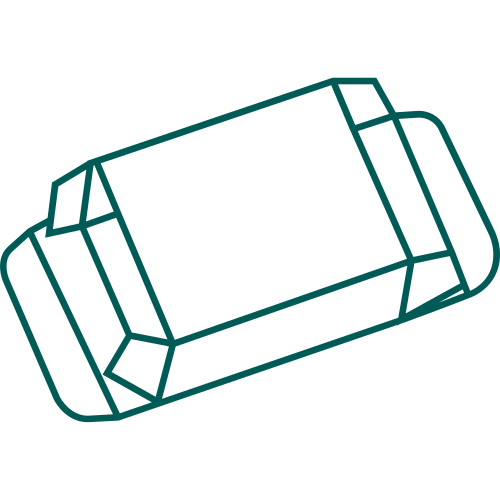
A dieline is the flat cutting template used to print and cut a package. Draw it from the packed band. Record inside length, width, and depth for the product, card, insert, and protective wrap. Box dimensions are conventionally written as length x width x depth. A common planning tolerance is about 1/16 in, or 1.5 mm. Clearance follows elasticity, clasp shape, surface treatment, and packing method. Measure band and insert together before approval.
Which structure keeps a wristband from moving?
Loose coils need a restraint point; flat bands need alignment.
| Structure | Useful direction | Check before proof |
|---|---|---|
| Sleeve | Flat presentation around a band card or small pack | Band stays aligned during handling |
| Straight or reverse tuck carton | Retail-ready individual packaging | Closure protects the band without excess headspace |
| Pillow box | Giftable, lightweight presentation | Curved form holds the band securely |
| Windowed carton or pouch | Product visibility before opening | Window shows the band without weakening the package |
Straight tuck end, reverse tuck end, sleeve, pillow, and mailer formats cover the folding choices. A two-piece rigid structure or drawer puts the outer presentation around the band insert. For parcel handling, an auto-lock bottom or crash-lock construction gives the base more support than a simple tuck carton.
Which board works for a small wristband pack?
SBS paperboard is commonly specified around 12 to 24 pt for cartons. C1S means one coated printable side; C2S means coated surfaces on both sides. Kraft board is commonly around 18 to 24 pt and supports a natural visual direction. Caliper is board thickness, so it changes stiffness, fold feel, and insert pressure.
Rigid chipboard is commonly around 1.5 to 3 mm and can be wrapped in 100 to 157 gsm art paper. It is a built-up board structure, so it holds shape without a fold. The insert then controls the wristband, especially when the band has a clasp or a surface that should not rub against a printed panel.
A PET window is a clear plastic panel that shows the band before opening. PET windows are commonly around 0.2 to 0.3 mm when suitable. Check the window edge, patching method, and surface contact with the band. If a soft or coated band can scuff, separate it with a card or protective layer instead of letting it rub against a rough cut edge.
Use sock packaging and towel packaging for compact textile presentation. Perforated packaging is a reference when tear-open or dispensing is part of handling. Compare wax packaging for another presentation direction. These do not establish wristband dimensions.
How should wristband artwork be prepared?
Scores, glue tabs, and folds need clear space around fine artwork. Map the visible band, front panel, back panel, insert, closure, and window before design. Offset CMYK is commonly used for detailed paperboard graphics. Digital printing fits short runs or variable versions. Compare digital and offset against quantity, versions, setup, and ink coverage.
At proof, look for low-resolution art, RGB art that shifts when converted for press, type set too close to a score, and bleed left off the file. We send a digital proof before anything prints. That is where you catch a small barcode, dark panel coverage, or a logo on a fold.
Matte or gloss lamination changes sheen and surface feel. Soft-touch changes tactile feel. Spot UV, foil stamping, embossing, and debossing can isolate a logo, event name, or pattern. Keep raised or reflective treatments clear of scores, folds, and glue areas.
A sample kit lets you compare board, window, coating, closure, and insert ideas before proof approval.
What belongs in a wristband packaging quote?
A useful quote starts with the packed product and handling route. Send these details:
- Band material, packed dimensions, closure type, and folded or rolled diameter.
- Quantity per pack, card or insert requirements, and protective wrap.
- Preferred structure, window, board, and caliper.
- Artwork count, color direction, and finish.
- Destination, plus event handout or individual shipping.
An event handout puts more weight on removal and presentation. Individual shipping puts more weight on restraint and outer protection. The handling route can change the preferred structure, board caliper, and need for an outer mailer or corrugated shipper.
See custom packaging for small business for broader planning. If the band is bundled with apparel or a gift assortment, compare shoe box packaging or private label packaging as coordinated presentation references.
Custom Packaging Lane is a US-based packaging supplier. Projects start at a 100-unit minimum, with pricing from $0.49 per unit at volume, quoted to spec. Production is typically 8 to 10 business days after proof approval, plus delivery. Free US shipping, free design support, and a free dieline are available. The $19.99 sample kit is credited to the first order. Request a quote with your packed dimensions, structure, artwork, and finish.
Frequently Asked Questions
Should a wristband be packed flat or rolled?
Pack a wristband in the form that keeps it controlled during display or shipment. A flat band often works with a card and sleeve, while a rolled band usually needs a cavity, insert, or window to stop the coil from springing loose. Include the clasp or connector in the packed measurement because projecting parts change the needed clearance.
What does a 1/16 inch packaging tolerance mean?
A 1/16 inch tolerance, also written as 1.5 mm, is a common planning allowance around a package fit. It is not a universal final clearance. Elasticity, clasp shape, surface treatment, and the packing method can change the space a wristband needs, so test the actual band, card, insert, and wrap together before approving the cutting template.
Can a pillow box hold a wristband securely?
A pillow box can hold a wristband when its curved form matches the product and the band has enough restraint inside. A loose coil or projecting clasp can shift in the open space. Add a card, insert, or cavity when needed, then check removal, visibility, and surface contact before choosing the final structure.
What is the difference between C1S and C2S paperboard?
C1S paperboard has one coated printable side, while C2S paperboard has coated surfaces on both sides. C1S can suit artwork that needs one primary print face. C2S gives both sides a coated surface. The choice should follow the printed panels, folding plan, insert pressure, and how much of the inside the buyer will see.
What should I inspect on a wristband packaging proof?
Inspect the score and glue zones first, then check small type, barcode contrast, bleed, color conversion, and the position of the band insert. Low-resolution or RGB artwork can change during press preparation, and type set too close to a score can fold poorly. Confirm that the window edge and any foil, UV, embossing, or debossing stay clear of folds.