












































































A Rockford custom box brief needs the packed product before it needs the city name. Record the inside length x width x depth, the insert or wrap that sits with the product, the opening action, board, print coverage, finish, quantity, and ship-to details. The outer footprint then has something real to work from.
Carrier screening starts with the packed outer carton. The box still has to fit the product without loose space that shifts the item or forces an oversized package.
What should a Rockford buyer specify first?
The product, its packed dimensions, and its route through packing and delivery determine the first useful choices. State whether the package is for retail presentation, gifting, parcel shipment, or a combination. Then include inside measurements, closure, board, print coverage, finish, quantity, destination, and artwork status.
Use custom packaging solutions as the broad path when the format is still open. A city keyword does not replace the production details that determine the dieline.
How do box dimensions affect shipping?
The outside footprint is the first dimensional-weight screen, while inside measurements control product fit. Write dimensions as length x width x depth, label them as inside or outside, and use about 1/16 in, or 1.5 mm, as a common planning tolerance.
| Planning point | Common packaging convention | Why it belongs in the brief |
|---|---|---|
| Folding carton board | SBS, C1S, or C2S paperboard at 12 to 24 pt | Caliper changes the fold, panel feel, and available interior space. |
| Corrugated board | E, B, or C flute with 32 ECT as a common reference | Flute profile and board test help define handling and carton construction. |
| Box notation | Length x width x depth, using inside measurements | The convention keeps the dieline and product fit aligned. |
| US ground dimensional weight | L x W x H divided by 139 | The formula helps screen the outer footprint before carrier pricing is checked. |
US ground dimensional weight is commonly screened with L x W x H divided by 139. Use the packed outer carton for that calculation, then confirm the carrier method that applies to the shipment.
Which structure fits the product?
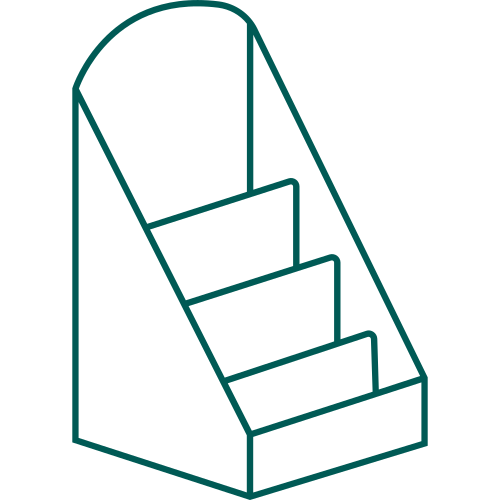
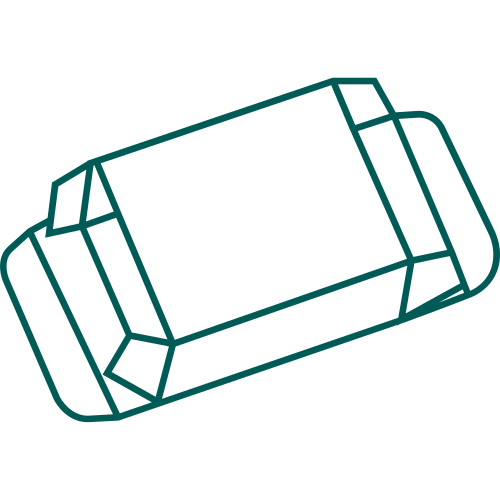
A folding carton gives a printed retail face and a compact closure. Straight tuck end is a common starting structure, while reverse tuck end changes panel orientation. Auto-lock bottom and crash-lock bottom change base assembly. A mailer uses a roll end tuck top when the package needs a connected opening associated with shipping.
Custom shoe box packaging gives a larger footprint reference. Custom foam box inserts address shaped internal positioning. Wine box packaging brings bottle fit and the outer structure into the same brief. Measure the actual packed item before choosing among them.
What print and finish should I put on the dieline?
Offset CMYK is commonly used for detailed folding-carton artwork. Flexo is common for corrugated board, while digital printing is commonly considered for short runs or artwork tests. Name the panels that need coverage, because full-bleed color and a small logo require different artwork files.
Matte or gloss lamination changes surface appearance and glare. Soft-touch changes hand feel. Spot UV, foil stamping, embossing, and debossing add selected visual or tactile detail. Draw every effect on the dieline so its location is clear beside scores, glue areas, and cut edges.
What should I send for a Rockford quote?
- Product measurements taken inside the intended package, including any insert or card.
- Preferred structure, such as straight tuck end, mailer, sleeve, or rigid format.
- Board choice, print method, artwork coverage, and finish notes.
- Quantity, ship-to information, and whether a physical sample is needed before the run.
Send the packed product details first, then review the dieline and digital proof. CPL quotes to spec from a 100-unit minimum, with pricing from $0.49 per unit at volume, quoted to spec. Production typically takes 8 to 10 business days after proof approval, plus delivery. Free US shipping, free design support, and a free dieline are available. The $19.99 sample kit is credited toward the first order.
Frequently Asked Questions
How should I measure a box for a Rockford shipment?
Measure the product with its intended insert, wrap, card, or tray in position. Record inside length x width x depth, then note how the item enters and exits. About 1/16 in, or 1.5 mm, is a common planning tolerance, but the closure and actual product fit still decide the usable clearance.
Which corrugated flute should I choose for a shipment?
E, B, and C flutes are common corrugated choices. E flute gives a smaller profile and finer printed surface, B flute balances thickness and handling differently, and C flute is common for shipping cartons. A 32 ECT board test is a standard reference point, but the box dimensions, product load, and carrier handling still matter.
Can folding cartons work for Rockford retail packaging?
Folding cartons can work for Rockford retail packaging when the product fits a printed paperboard structure. SBS, C1S, and C2S paperboard are commonly discussed in the 12 to 24 pt range. The selected board must suit the footprint, folds, interior clearance, print surface, and any insert or separate packaging component.
How can I screen dimensional-weight exposure?
US ground dimensional weight is commonly screened with L x W x H divided by 139, using the packed outer carton. The formula is a planning screen, not a carrier quote. Check the actual shipment method after the outer dimensions are known, and keep the inside fit controlled so the box does not gain avoidable empty space.
What should I send for a custom box quote?
Send the product name, inside length x width x depth, preferred structure, board direction, print coverage, finish, quantity, artwork status, and Rockford ship-to details. Include any insert, wrap, card, or window in the measurement notes. A clear brief gives the dieline and quote the same set of facts to work from.