




























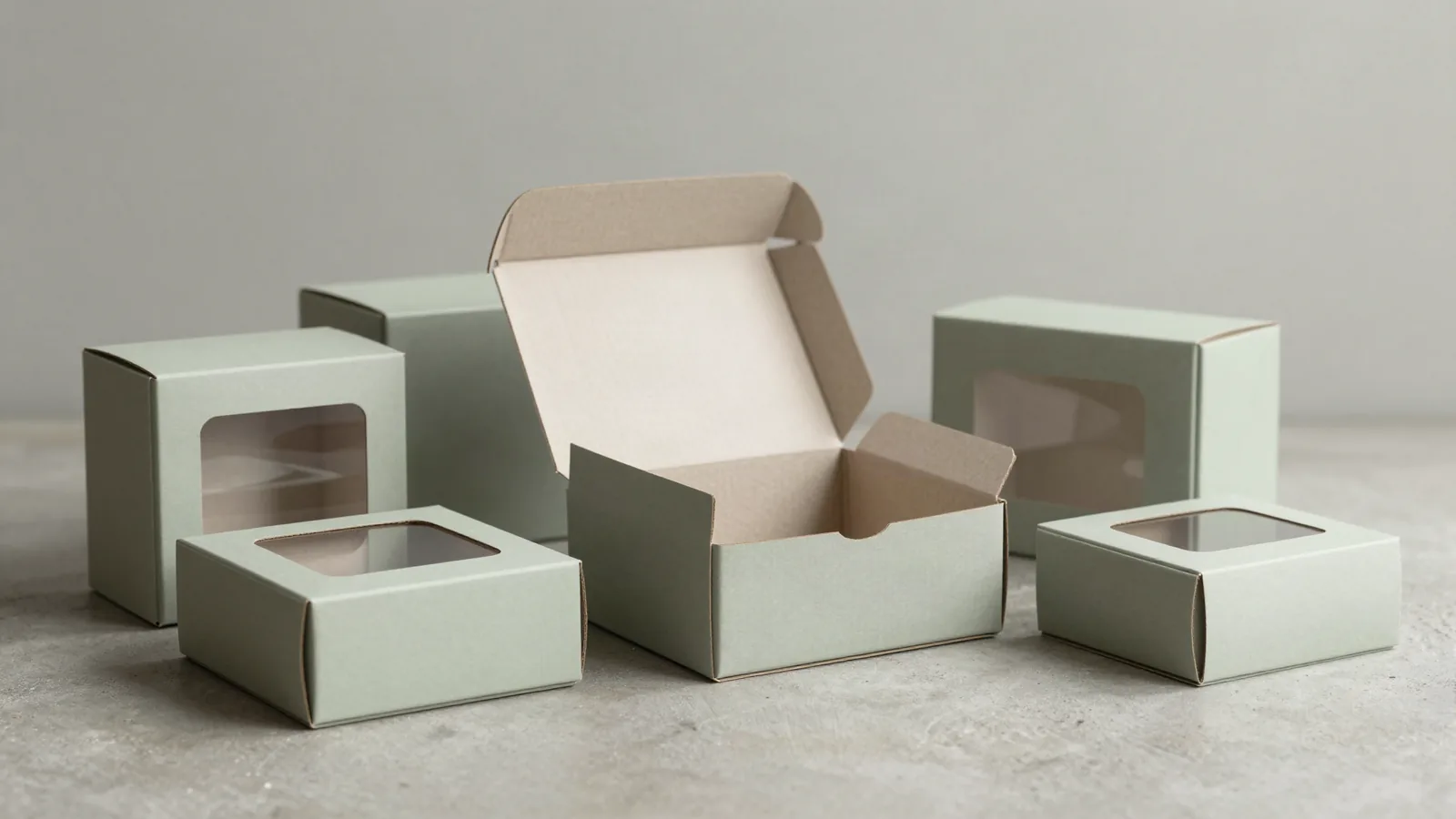




















































A US box brief starts with the packed product, not the logo. Record the product's inside length, width, and depth, then note how it will travel: shelf, parcel carrier, or both. A folding carton, corrugated mailer, rigid box, sleeve, and insert solve different problems. Name the opening, closure, board, print process, finish, insert, window, and ship-to region in the same brief. That gives the dieline a real job to do.
What should a US packaging brief include?
The first useful detail is the product in its shipping position, with the product cavity measured inside the box. A dieline is the flat cutting template used to print, score, fold, and cut the package. Note whether the product needs a cavity, partition, tray, sleeve, window, or insert, then record the number of items packed together. If an insert is cut to the exact product size, check that the product does not rattle after the box closes.
Send the opening direction and closure with the dimensions. Type set too close to a score can fold through a word. Bleed left off the file can expose an unprinted edge after trimming. RGB artwork can shift when it is converted for press, so the proof is where color, copy, and panel placement get checked.
Which box materials work for retail and shipment?
Printed paperboard and corrugated board solve different handling problems. The table compares typical industry references by construction and the checks that should stay in the brief.
| Material or construction | Typical industry reference | What to check |
|---|---|---|
| SBS, C1S, or C2S paperboard | 12 to 24 pt | Fold behavior, print surface, panel stiffness, and finish |
| Kraft board | 18 to 24 pt | Natural surface, ink contrast, and fold behavior |
| Rigid chipboard with art-paper wrap | 1.5 to 3 mm chipboard, 100 to 157 gsm wrap | Wall thickness, lid clearance, edge wrap, and insert fit |
| Corrugated board | E, B, or C flute, with 32 ECT as a common reference | Flute profile, stacking strength, footprint, and closure |
| Mylar or foil laminate | PET, AL, and PE layers | Layer arrangement and whether a flexible format fits |
SBS, C1S, and C2S paperboard give a printable folding surface. Kraft board changes the base color and ink contrast. Rigid chipboard holds shape because it is a separate wall construction wrapped in paper. Corrugated E, B, and C flutes change thickness and stacking behavior, with E-flute normally giving finer print detail than B-flute. Mylar or foil laminate uses PET, AL, and PE layers; the layer order determines the barrier direction. For a consumable, ask about food-contact options for your product.
How do dimensions affect carrier calculations?
The carrier calculation starts with the packed outside footprint. Write the box as length x width x depth, and use inside dimensions for the product cavity. About 1/16 in (1.5 mm) is a common industry tolerance reference, subject to the structure and material. A common US ground dimensional-weight reference is L x W x H / 139. It is a planning formula, not a shipping quote, so check the finished packed dimensions before the run.
| Reference | Use | Practical check |
|---|---|---|
| Inside length x width x depth | Product cavity | Confirm product, insert, and closure fit |
| Outside length x width x depth | Packed footprint | Compare cartons and carrier exposure |
| About 1/16 in (1.5 mm) | Common fit tolerance reference | Check movement and removal on the sample |
| L x W x H / 139 | US ground dimensional-weight reference | Use the packed exterior, not the product size |
Which structures fit different handling paths?
A roll end tuck top mailer, commonly associated with FEFCO 0427, is a parcel-led structure with a built-in opening path. Straight tuck end and reverse tuck end cartons keep the package folded and direct. Auto-lock and crash-lock bases change how the bottom assembles. A sleeve adds an outer printed layer. A drawer or slide, magnetic flap, or two-piece rigid box changes the reveal and the clearance the buyer feels at opening.
Use real product references to pressure-test the brief. Custom tuck top mailer boxes give a parcel closure reference. Custom woozy bottle boxes help check upright clearance and bottle-shaped cavities. Custom votive candle boxes show a compact carton direction, while custom vial boxes give a small-item spacing reference.
How should print and finish be compared?
Offset CMYK is a common choice for detailed paperboard artwork. Digital printing can suit short runs or changing versions, while flexo is more associated with corrugated packaging. Matte or gloss lamination changes glare and rub resistance. Soft-touch changes the hand feel. Spot UV, foil stamping, embossing, and debossing add localized surface effects, but scores, seams, glue tabs, and high-contact edges still need clear type and clean folds.
What should I confirm before requesting a quote?
The quote needs fit, construction, artwork, and destination details before a dieline can be checked.
- Product dimensions, cavity, insert, partition, and items per package.
- Structure, board, flute or laminate layers, closure, and window needs.
- Print process, artwork status, bleed, safe areas, scores, glue tabs, and finish layers.
- Packed outside dimensions and destination ZIP code or shipping region.
- The result that matters most, such as compact fit, shelf display, parcel opening, or carryout.
A sample connects the flat drawing to the assembled box. Check panel alignment, opening force, insert position, product movement, and the packed footprint. When a box goes to several US destinations, document any packing change before the artwork is approved.
Send the finished dimensions, structure, material, print coverage, finish, insert needs, and ship-to ZIP code for a quote. Custom Packaging Lane works from a 100-unit minimum, with pricing from $0.49 per unit at volume, quoted to spec, and production typically 8 to 10 business days after proof approval, plus delivery. Free US shipping, free design support, a free dieline, and a $19.99 sample kit credited to the first order are available. Compare wholesale custom packaging and order the sample kit before finalizing packed dimensions.
Frequently Asked Questions
Which product details control a custom-box dieline?
A custom-box dieline depends on the product's packed length, width, and depth, the inside cavity, quantity per package, structure, board or laminate, print coverage, finish, insert needs, and ship-to ZIP code. State whether the package goes on a shelf, through parcel handling, or through both paths so the proposed structure matches the job.
Should a box quote use inside or outside dimensions?
Product fit uses inside length, width, and depth. Packed footprint uses the outside length, width, and depth. About 1/16 in (1.5 mm) is a common tolerance reference, subject to the structure and material. Keep the convention consistent across the quote, flat template, sample, and artwork so a dimension does not change meaning mid-project.
How does US ground dimensional weight work?
A common US ground dimensional-weight reference is L x W x H / 139. Apply it to the packed outside dimensions during planning, not to the product cavity. The calculation helps compare footprints, but it does not replace checking the final packed box against the carrier rules for the shipment.
What structure is a parcel mailer reference?
A roll end tuck top mailer, commonly associated with FEFCO 0427, is a parcel-oriented reference. Auto-lock and crash-lock bases change bottom assembly, while straight tuck and reverse tuck cartons keep a folded-carton opening. Compare the closure, cavity, footprint, and opening motion against the actual handling path.
Which board references are useful at the start?
SBS, C1S, and C2S paperboard commonly use the 12 to 24 pt range, while kraft board commonly uses 18 to 24 pt. Rigid chipboard commonly measures 1.5 to 3 mm with a 100 to 157 gsm art-paper wrap. Corrugated comparisons include E, B, and C flutes plus 32 ECT.












