




























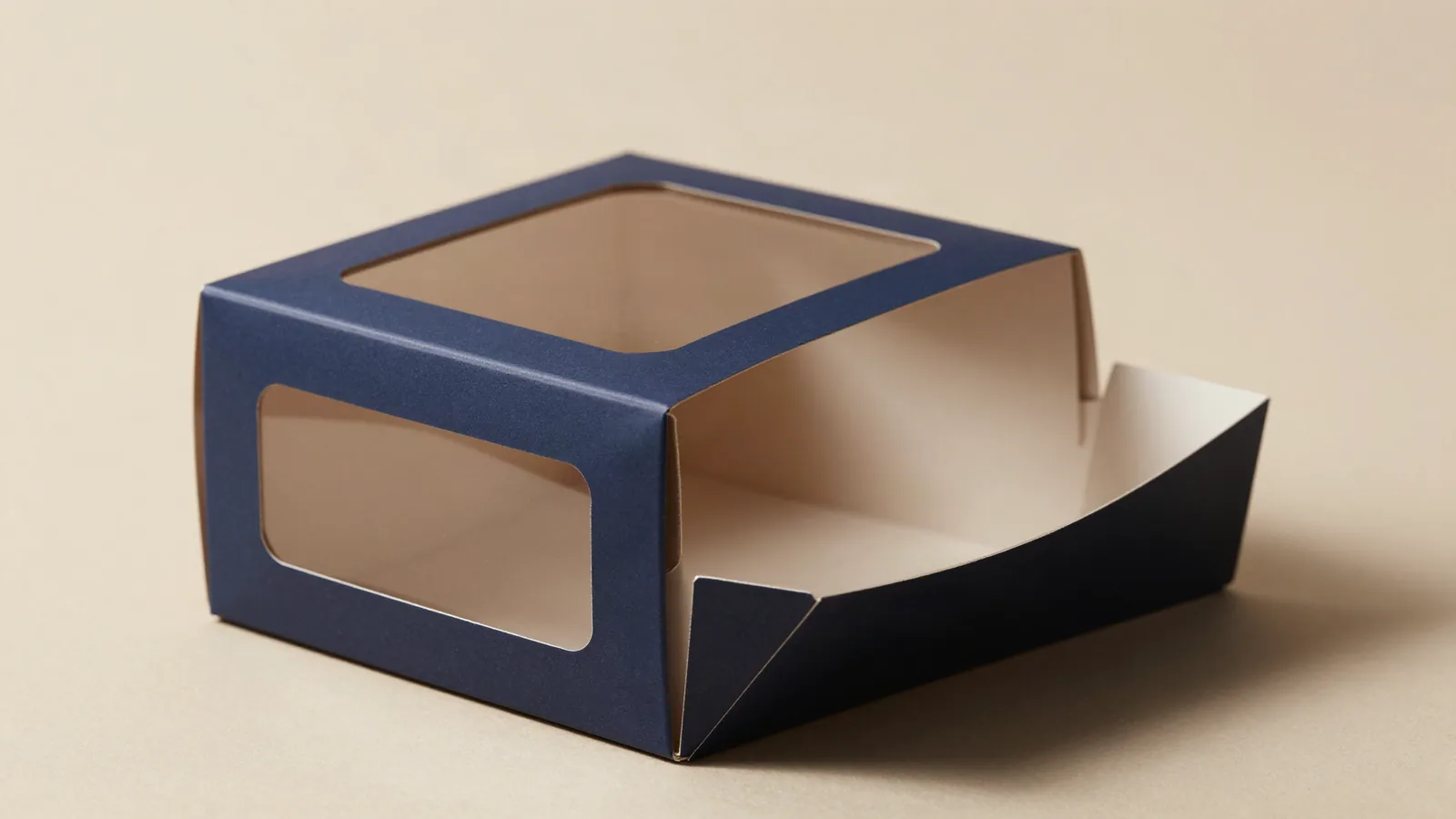




















































Custom cheesecake boxes are sized from the cake board and finished dessert outward. Measure the board, finished height, outside shape, lid clearance, and carry path before choosing a carton size. A box that fits the artwork but catches the cheesecake top creates a poor handoff, especially when staff lift it by the sides.
Food-contact selection is separate from the outer box structure. Ask us about food-contact options for your product before choosing a window, liner, or insert. Then build the box around the selected construction, print coverage, opening, and handling path.
What size should a cheesecake box be?
Typical outer length and width can each run from 10 to 16 in (25.4 to 40.6 cm), but the cake board and finished height set the actual box. Give inside length x width x depth, finished height, board thickness, and lid clearance. About 1/16 in (1.5 mm) is a common packaging tolerance reference, but the assembled sample decides whether the board slides in cleanly and the lid clears the topping.
Measure your own cake board and finished cheesecake. A nominal carton size does not show the height of the topping, the thickness of the board, or the space a hand needs to carry the box. A low profile can suit a counter handoff, while a taller structure needs enough sidewall and lid clearance around the decoration.
Which board is suitable for a cheesecake box?
Folding cartons commonly start with SBS, C1S, or C2S paperboard, while rigid formats use a wrapped chipboard build.
| Board direction | Typical industry reference | Common planning use |
|---|---|---|
| SBS, C1S, or C2S paperboard | 12 to 24 pt | Printed folding cartons with broad panels |
| Kraft board | 18 to 24 pt | Paper-forward presentation and firm folds |
| Rigid chipboard | 1.5 to 3 mm, wrapped in 100 to 157 gsm art paper | Stiff two-piece, drawer, or lid-and-base formats |
| Corrugated board | E, B, or C flutes, including 32 ECT references | Shipping-oriented outer packaging |
SBS, C1S, and C2S paperboard give a folding carton a printable surface. Kraft changes the paper appearance and ink behavior. Wrapped chipboard holds a rigid format without relying on a fold, while E, B, or C flute corrugated changes thickness and stacking support. These are typical industry references, and the footprint, wall height, lid, insert, and handling path still need a physical fit check.
Should a cheesecake box have a window?
A PET window commonly uses a 0.2 to 0.3 mm film reference, and it changes both the cut line and the panel layout. Use a window when visibility is part of the presentation brief. Use an enclosed top when uninterrupted artwork and a closed presentation matter more.
Window patching takes space from the panel and adds a seam around the opening. Put the window, inner surface, liner, and any insert into the first dieline discussion. Ask us about food-contact options for the intended product and construction.
Which box structure suits handoff or delivery?
A straight tuck end gives a folding carton a familiar closure, while a reverse tuck end changes the flap direction. An auto-lock or crash-lock bottom forms the base during setup. A mailer with a roll end tuck top, including the FEFCO 0427 format, combines a lid with a shipping-style shell. Two-piece rigid, magnetic flap, drawer or slide, sleeve, gable, and pillow structures each change the opening path.
Choose the structure around the cake board and carry method. If a separate insert holds the board, specify its position and thickness before the panel map is finalized. A package that opens neatly on a counter may still need a different closure when it travels inside a delivery order.
How should cheesecake box artwork and finish be planned?
Offset CMYK is common for folding-carton artwork, while digital print can suit short runs or a layout test. Matte or gloss lamination changes the surface, soft-touch changes hand feel, and spot UV isolates a logo or pattern. Foil stamping, embossing, and debossing add contrast or relief when the board and construction support them.
Build artwork from the assembled dieline. Mark folds, glue areas, window edges, seams, opening edges, and any food-contact question in the proof notes. Keep small type away from scores and glue tabs, and check the closed box as carefully as the open box.
What measurements belong in the box brief?
Inside length x width x depth belongs at the top of the brief, followed by finished height, cake board dimensions, board thickness, lid clearance, insert position, opening edge, and carry direction. A common packaging convention allows about 1/16 in (1.5 mm) tolerance, but the sample should confirm the fit around the finished dessert.
Include the delivery path and whether the box sits inside another package. That detail affects the outer structure, closure, and amount of exposed surface the buyer sees at handoff.
Where can I compare related box formats?
Review custom woozy bottle boxes for compartment planning, custom votive candle boxes for presentation-focused structure, and custom tuck top mailer boxes for an enclosed mailer direction. Small bakery teams can also use custom packaging for small business when the brief covers fit, print, and handoff together.
Send the cake board, finished cheesecake measurements, inside box dimensions, structure preference, window or enclosed-top direction, print coverage, finish, quantity, and delivery location. Custom Packaging Lane quotes to spec from a 100-unit minimum, with pricing from $0.49 per unit at volume, quoted to spec. Production is typically 8 to 10 business days after proof approval, plus delivery. Free US shipping, free design support, and a free dieline are available. Order the $19.99 sample kit, credited toward the first order, and ask us about food-contact options before proof approval.
Frequently Asked Questions
What measurements do custom cheesecake boxes need?
Custom cheesecake boxes need the cake board length, width, and thickness, plus the finished cheesecake length, width, and height. Provide inside length x width x depth, lid clearance, insert position, opening edge, and carry direction. About 1/16 in (1.5 mm) is a common packaging tolerance reference, but the assembled sample must confirm the fit.
Which paperboard thickness is common for cheesecake boxes?
SBS, C1S, or C2S paperboard commonly falls at 12 to 24 pt, while kraft board commonly falls at 18 to 24 pt. Rigid formats commonly use 1.5 to 3 mm chipboard wrapped in 100 to 157 gsm art paper. Corrugated options include E, B, or C flutes with 32 ECT references for shipping-oriented structures.
What is the typical outside size of a cheesecake box?
Typical outer length and width can each run from 10 to 16 in (25.4 to 40.6 cm), but the cake board and finished height set the actual box. Measure your own cake board and finished dessert, then provide inside length x width x depth, board thickness, lid clearance, and carry direction for the proof.
Is a window suitable for a cheesecake box?
A window can show the dessert, while an enclosed top leaves more uninterrupted panel area for artwork. A PET window commonly uses a 0.2 to 0.3 mm film reference, and the opening changes the cut line, seam, and panel layout. Ask us about food-contact options for the chosen window and inner package surfaces.
Which cheesecake box structure works for delivery?
A mailer with a roll end tuck top, including the FEFCO 0427 format, suits a shipping-style brief, while folding cartons, crash-lock bottoms, rigid boxes, drawers, sleeves, and gable structures create different opening paths. Choose around the cake board, lid clearance, carry method, and whether the box travels inside another package.












