




























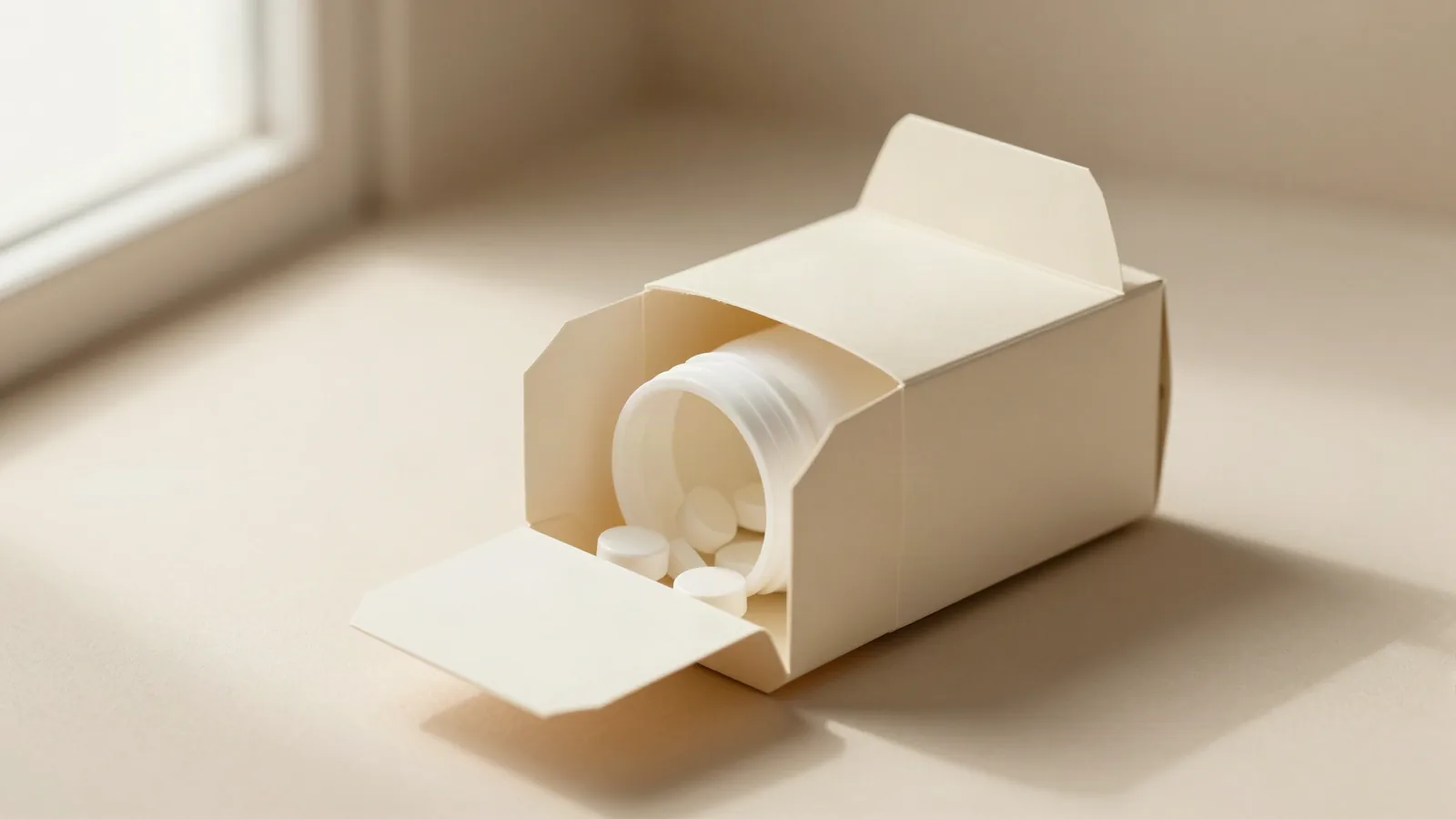




















































Custom medication packaging starts with the complete product set. List the container, cap or closure, label, leaflet, dosage panel, lot or batch field, accessory, and separator that will share the package. The structure must let the buyer identify the contents, remove the components, and read the intended information without fighting the folds.
A dieline is the flat cutting template used to print, cut, and fold the package. It should come from the loaded product set, not an empty carton. Have the person responsible for the product copy check the wording before artwork approval. The package can organize that information, but it does not replace that review.
What should custom medication packaging organize?
The loaded product set determines the panel order, opening path, insert position, and space around each container. Start with the closed product in its packed orientation, then add the leaflet, accessory, separator, or protective piece that will travel with it.
Decide which panel faces the buyer first. Keep the copy that must remain readable on a clear panel, away from scores, glue tabs, seams, and finish boundaries. A dosage panel, lot or batch field, and product label may need separate areas when the package is closed and when the insert is removed.
How should I measure a medication carton?
Inside length x width x depth is the starting record for a loaded medication package. Measure the container with its closure, label, leaflet fold, insert, and accessory in place. Record the removal direction and the contact points that hold the set. About 1/16 in (1.5 mm) is a common tolerance reference, but the filled structure still needs a physical check before approval.
| Package element | Measurement or content check | Packaging question |
|---|---|---|
| Primary container | Inside length, width, depth, closure, label, orientation | Does the cavity hold it without blocking identification? |
| Leaflet or insert | Folded size, panel order, removal path | Can it be removed without disturbing the container? |
| Information panel | Readable copy area, distance from folds | Does the closed box keep the copy on a clear panel? |
| Outer shipper | Outside length, width, height, stacking direction | Does it fit the planned handling path? |
Which carton structure fits a medication set?
Straight tuck end and reverse tuck end use different tuck directions and flap relationships. An auto-lock bottom changes assembly, while a crash-lock base creates a different bottom fold. A sleeve adds an outer information layer. A drawer or slide changes the removal path. A two-piece rigid or magnetic flap structure changes how the container and insert are presented.
Choose the structure from the loaded set, information hierarchy, and opening sequence. Mark the closure, folds, scores, glue tabs, front panel, and information panel on the dieline. A child-resistant feature can be discussed as a structural option when the product brief calls for it. Describe it as a feature, then have the responsible product owner confirm the package requirements.
When should I consider a tin or rigid format?
A tin changes the closure, surface, and opening path compared with a folding carton. Rigid chipboard in the 1.5 to 3 mm range wrapped in 100 to 157 gsm art paper creates a fixed base and lid. That choice changes the edge, insert, information-panel layout, and outside footprint.
For a paperboard carton, SBS, C1S, or C2S paperboard in the 12 to 24 pt range is a common reference. Kraft board in the 18 to 24 pt range creates a different surface and contrast direction. Board caliper changes the folds, glue tabs, edge feel, and space available for the loaded set.
How should medication packaging present information?
Offset CMYK suits detailed product copy, symbols, and panel artwork. Digital printing can suit a short run or an early layout. Matte or gloss lamination changes the surface, while soft-touch changes the hand feel. Spot UV can mark a logo or information header. Foil stamping, embossing, and debossing should sit on separate layers away from folds, seams, openings, and small copy.
Use a panel map before styling the art. Mark the front-facing panel, secondary information panel, insert location, closure, and any variable field. RGB art can shift when converted for CMYK, and a low-resolution file can soften small copy. If a window is proposed, PET in the 0.2 to 0.3 mm range is a common reference for window patching. Do not let the opening displace information the buyer needs to read.
Which CPL product pages help compare medication formats?
The catalog references separate construction questions. Custom tin packaging helps compare a metal container and separate lid. Custom screw packaging gives a closure-focused reference. Custom scissor packaging frames an accessory cavity and removal path. Custom stevia packaging provides a small printed-carton comparison. Use those pages to discuss format, then measure the actual medication set.
What should a medication proof show before approval?
A useful proof shows the loaded set, closed package, opening sequence, and information hierarchy together. The flat dieline alone cannot show whether a leaflet blocks the label or whether the insert holds the accessory in the intended position.
- Container, closure, label, leaflet, insert, accessory, and loading order.
- Inside length x width x depth, front panel, information panel, folds, scores, trim, and glue tabs.
- Closure feature, window patch, separator, variable field, and removal path.
- Base print, lamination, soft-touch, spot UV, foil, embossing, and debossing as separate layers.
- Copy review by the responsible owner and a check of the loaded package before approval.
How is a medication packaging project scoped?
CPL quotes custom medication packaging to spec from a 100-unit minimum, with pricing from $0.49 per unit at volume, quoted to spec. Production is typically 8 to 10 business days after proof approval, plus delivery. Free US shipping, free design support, and a free dieline are available. The $19.99 sample kit is credited to the first order. For a broader format discussion, use custom packaging solutions after the product set and proof requirements are clear.
Frequently Asked Questions
How much clearance should a medication carton have?
A medication carton should be measured around the loaded container, closure, label, leaflet, insert, and accessory. About 1/16 in (1.5 mm) is a common tolerance reference, but the correct result depends on the removal path and contact points. Check the filled package before approval because an empty carton cannot show movement or interference.
Can a medication carton use an insert?
A medication carton can use an insert to separate a container, leaflet, accessory, or second component. Show the folded insert size, panel order, contact points, glue areas, and removal direction on the dieline. The insert should hold the loaded set without blocking the label, information panel, closure, or opening path.
What is a child-resistant feature in packaging?
A child-resistant feature is a structural opening or closure choice built into the package design. The dieline should show the opening direction, folds, scores, panels, and user interaction. Treat the feature as a design requirement, then have the responsible product owner confirm the conditions that apply to the intended product.
Should I use a tin or paperboard carton?
A tin changes the lid, surface, and opening path, while a paperboard carton uses folded panels and glue tabs. Common paperboard references include SBS, C1S, or C2S in the 12 to 24 pt range. Compare the loaded set, information layout, insert, closure, and storage orientation before choosing the format.
What belongs on a medication packaging proof?
A medication packaging proof should show the loaded container, closure, leaflet, insert, accessory, opening direction, panel order, folds, scores, trim, glue tabs, and finish layers. Check the closed package as well as the flat dieline. Have the responsible product owner review the required product copy before approval.












