




























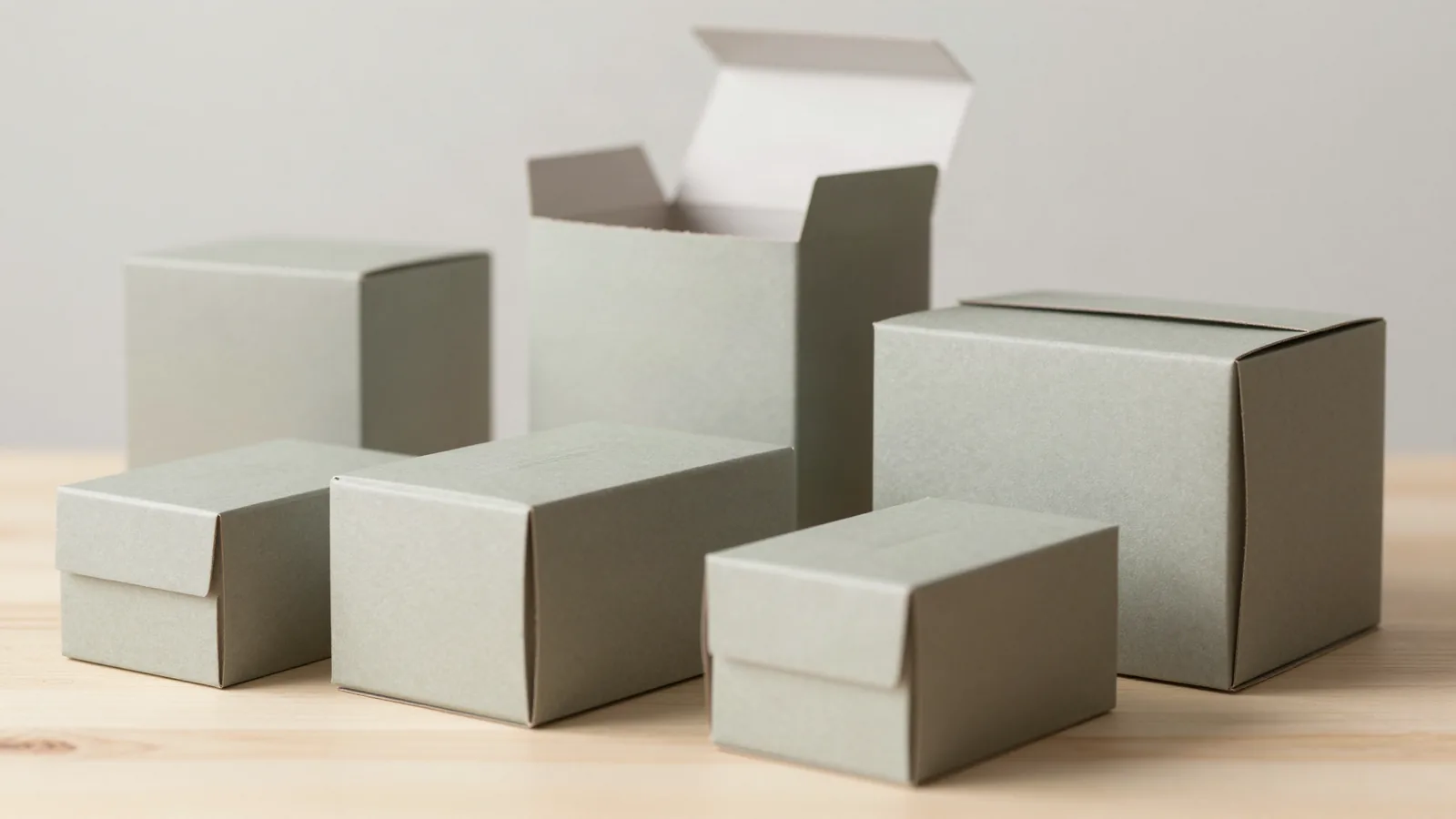




















































What does custom packaging fabrication include?
Fabrication turns a product brief into a package that can be cut, folded, glued, printed, and checked. A dieline is the flat cutting template for that package. It marks cut lines, scores, panels, glue tabs, openings, and inserts before artwork is placed. The brief should also state the product's inside length x width x depth, opening, closure, board or flute, print coverage, finish layers, and delivery path.
Screen artwork can hide a practical problem. A logo may cross a score, a glue tab may be too narrow for the assembly path, or a closure may catch the product. Review the flat blank, assembled package, and loaded package as one build.
Which material fits the fabrication job?
Paperboard, rigid board, and corrugated board solve different physical problems. SBS, C1S, or C2S paperboard in the 12 to 24 pt range is a common folding-carton reference. SBS means solid bleached sulfate, while C1S and C2S describe coating on one or two sides. Pt is a point-based thickness measure. Kraft board in the 18 to 24 pt range has a different surface and fold behavior. Rigid chipboard in the 1.5 to 3 mm range can be wrapped in 100 to 157 gsm art paper, where gsm means grams per square meter. Corrugated packaging can use E, B, or C flute. Flute is the corrugated wave profile inside the board, and 32 ECT, edge crush test, is a common industry strength reference.
| Fabrication direction | Common industry reference | Check before approval |
|---|---|---|
| Folding carton | SBS, C1S, or C2S paperboard, 12 to 24 pt | Crease, tuck, glue tab, and flat blank |
| Kraft carton | Kraft board, 18 to 24 pt | Contrast, grain direction, and fold behavior |
| Rigid format | 1.5 to 3 mm chipboard with 100 to 157 gsm art-paper wrap | Wrap turn-ins, lid or drawer fit, edge, and insert |
| Corrugated shipper | E, B, or C flute, with 32 ECT as a common reference | Score position, stacking direction, and footprint |
These are typical industry references, not a final material prescription. Product weight, handling, print surface, closure, and the delivery path decide the construction.
How do cutting and scoring change the package?
Cut lines define the blank, while scores guide controlled folds. Glue tabs join panels, so their width and position affect assembly, seam placement, and the usable interior. A straight tuck end and reverse tuck end fold in different directions. An auto-lock bottom and crash-lock base use different bottom panels. A roll end tuck top mailer, also called FEFCO 0427, has its own opening and fold pattern.
Mark grain or flute direction when it affects folding or stacking. The drawing should show trim, scores, glue tabs, the closed package, and the loaded product. Rigid work needs chipboard panels, wrap turn-ins, lid or drawer movement, and insert placement. Corrugated work needs panels, seam, scores, loading orientation, and the outside footprint.
Which print and finish choices belong in the build?
Offset CMYK, the four-color process used for detailed graphics, is a common reference for paperboard artwork. Flexo is a common print method for corrugated surfaces, while digital printing can suit a short run or early artwork direction. Matte or gloss lamination changes surface glare. Soft-touch changes hand feel. Spot UV is a localized gloss coating. Foil stamping, embossing, and debossing should be separate artwork layers. Window patching adds a cut-and-attach operation with its own placement check.
Keep important copy away from folds, seams, glue tabs, and high-contact edges. If a finish crosses a score, inspect the folded result, not only the flat art file. A press check looks at ink coverage, registration, and the result where print crosses a score. Name every panel so print and finishing notes stay attached to the correct face.
What should the fabrication proof show?
A fit check starts with inside length x width x depth and the product in its packed orientation. About 1/16 in (1.5 mm) is a common tolerance reference. Check the opening, closure, glue line, insert, removal path, cuts, scores, folds, seams, trim, and finish areas. For a shipper, record outside length x width x height and compare the footprint with the delivery plan. US ground dimensional weight commonly uses L x W x H / 139 as a planning formula, not a shipping quote.
Look for low-resolution art, RGB files that shift when converted for press, type too close to a score, and missing bleed. A window or insert needs an edge and contact check after assembly. If an insert is cut to the exact product size, test loading and removal so the product does not rattle or bind.
Which products show different fabrication routes?
Custom tin packaging shows a container-led route with a formed hard package and lid fit to review. Custom taper candle packaging gives a long-product structure where loading direction and clearance shape the dieline. Custom screw packaging is a compact reference for cavities and closure. Custom drone packaging boxes show why product shape and protective fit belong in the structural plan.
How should a fabrication handoff be checked?
- Record product orientation, inside length x width x depth, outside dimensions, and removal path.
- Label cuts, scores, folds, glue tabs, seams, trim, openings, inserts, and windows.
- Name the board, flute or wrap reference, print method, and finish layers.
- Show the flat blank, assembled package, loaded package, and outer shipper where relevant.
- Preserve the checked dieline as the build reference after approval.
How do I scope a custom packaging fabrication quote?
Send the product dimensions, structure, material direction, artwork status, finish request, quantity, and delivery location. Custom Packaging Lane quotes to spec from a 100-unit minimum. Pricing is from $0.49 per unit at volume, quoted to spec. Production is typically 8 to 10 business days after proof approval, plus delivery. Free US shipping, free design support, and a free dieline are available. The $19.99 sample kit is credited to the first order. For volume planning, see wholesale custom packaging.
Frequently Asked Questions
Which steps belong in a fabrication brief?
A fabrication brief should name the product, inside dimensions, opening, closure, board or flute, artwork panels, finish layers, and delivery path. It should also show the flat blank, assembled package, and loaded product. Those references give the structural and print review one set of physical instructions instead of a screen-only concept.
What changes when a box has scores and glue tabs?
Scores guide the folds, and glue tabs join the panels. Their position changes the seam, interior clearance, opening, and assembly path. Straight tuck, reverse tuck, auto-lock bottom, crash-lock base, and roll end tuck top constructions use different fold patterns. Check the flat blank and assembled box so a tab or score does not crowd the product or printed copy.
Should corrugated artwork use flexo or another print method?
Flexo is a common print reference for corrugated surfaces. Offset CMYK is commonly used for detailed paperboard artwork, and digital printing can suit a short run or early artwork direction. The board, flute, artwork coverage, and finish should be reviewed together. Keep key copy away from scores, seams, trim, and high-contact edges before approval.
How can I catch fit problems before the production run?
A fabrication proof can catch fit problems when it is checked as a flat blank, assembled package, and loaded product. Review inside and outside dimensions, opening, closure, insert, glue line, scores, folds, and removal path. Inspect low-resolution art, RGB conversion, missing bleed, and type near scores while the drawing is still being corrected.
When does a rigid or corrugated build make sense?
A rigid build suits a fixed presentation shape, while corrugated board suits a package that must be reviewed for flute direction, stacking, seam, and outside footprint. Folding-carton board follows another set of fold and print decisions. Compare the product, handling path, closure, and delivery package before choosing the fabrication route.












