




























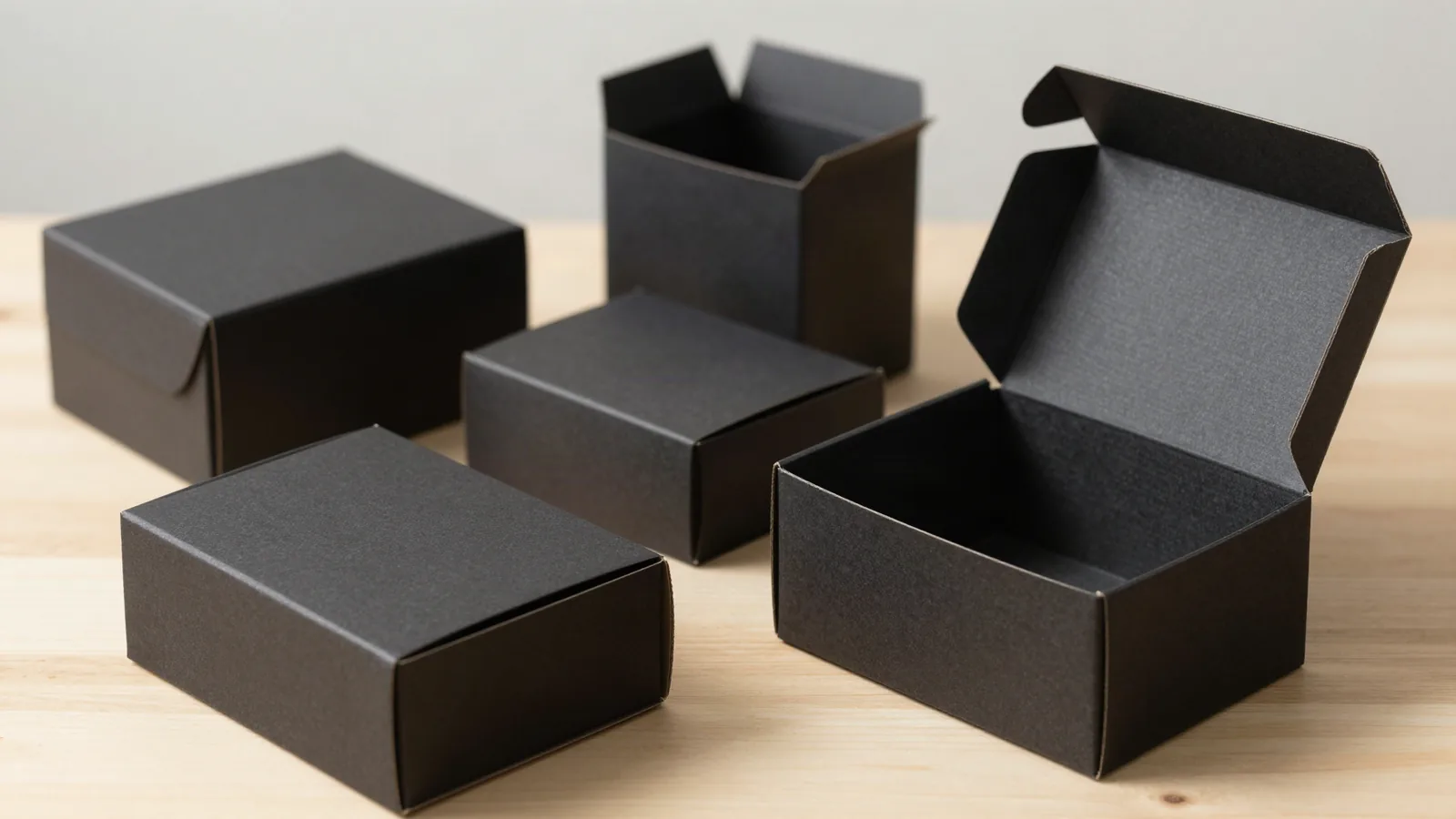




















































What belongs in a custom product package?
A custom product package is a coordinated set of primary packaging, presentation pieces, protective parts, and the outer pack that moves them. The unit of work is the complete pack-out, which is the sequence of product, label, accessory, insert, box, bag, display, and shipper as someone handles them. Separate parts can look correct and still fail when the insert blocks the lid or the bag is too small for the boxed product.
Start with the product's length x width x depth and the inside clearance. Inside measurements describe the space the contents occupy; outside measurements describe the packed footprint. About 1/16 in, or 1.5 mm, is a common planning tolerance. Record the closure sequence, which panel faces the buyer, and who packs or replenishes the unit.
Which parts need to work together?
The primary box controls the first opening, while the insert controls what moves inside it. A display piece changes how the product faces the buyer, and a carry or shipping piece changes the handoff after purchase.
| Component role | Common structure or format | Planning question |
|---|---|---|
| Primary presentation | Folding carton, rigid box, or specialty box | Check the first-view panel and opening |
| Display support | Product display box or sleeve | Set the stand, face, and replenishment direction |
| Carry or secondary pack | Paper bag or shipping mailer | Check packed size at the handoff |
| Protection | Foam insert, divider, or fitted cavity | Hold the product without blocking removal |
For a coordinated carton and display set, compare custom product boxes with product display boxes. A display box prioritizes access and visibility, while an enclosed product box can prioritize protection and a controlled opening. If the product is bottled, custom Woozy bottle boxes provide a useful reference for neck clearance, base support, and orientation.
How do materials change across one package?
Paperboard carries detailed print, while corrugated carries thicker construction and shipping loads. SBS, C1S, and C2S paperboard are common folding-carton references in the 12 to 24 pt range. Kraft board commonly falls in the 18 to 24 pt range. Rigid packaging uses chipboard from 1.5 to 3 mm wrapped in 100 to 157 gsm art paper.
E, B, and C flutes change the thickness, cushioning, stacking behavior, and print surface of corrugated pieces. 32 ECT is a common strength convention for corrugated planning. A mylar-style laminate can use PET, AL, and PE layers. The metallized layer blocks light and reduces moisture and odor transfer, while the layer combination also changes sealing behavior. Ask us about food-contact options for your product when the package touches food.
Can every component use the same print method?
One artwork system can span several print methods, but the substrate still controls the result. Offset CMYK suits detailed paperboard graphics, flexo is common for corrugated surfaces, and digital printing fits short runs or variable artwork. A logo can match in the file and look different on kraft board, white board, a bag, and a coated carton.
Matte or gloss lamination changes reflection. Soft-touch changes hand feel. Spot UV, foil stamping, embossing, and debossing affect selected areas and can alter fold placement, registration, tooling, or glue surfaces. Approve the box, display piece, bag, and insert as one proof set so inconsistent blacks or gloss levels show up before production.
How should a package be packed for storage and delivery?
Storage starts with the packed form. Folding cartons and sleeves can arrive flat, while rigid boxes need more space before use. Decide whether units arrive flat, partially assembled, or ready for packing, then define who inserts the product and how finished units are grouped in master cartons. For US ground planning, carrier dimensional weight commonly uses L x W x H / 139, so the outside packed footprint matters even when the product is compact.
- List every component and its role in the pack-out.
- Confirm inside fit with the complete product set.
- Adapt the artwork system to each substrate and print method.
- Test packing, replenishment, stacking, and parcel movement.
What should I send for a coordinated package quote?
A quote request is ready when it names the product dimensions, component list, inside clearance, structure, artwork status, finish, quantity, packed configuration, and destination. Include the order in which each piece is inserted and removed. A sample should contain the real product set, since an empty package hides blocked openings and loose accessories.
Custom Packaging Lane quotes custom product packages from a 100-unit minimum, with pricing from $0.49 per unit at volume, quoted to spec. Production is typically 8 to 10 business days after proof approval, plus delivery. Free US shipping, free design support, and a free dieline are available. The $19.99 sample kit is credited to the first order. Map the full component set through custom packaging solutions.
Frequently Asked Questions
Can a custom package contain several different components?
A custom product package can combine a box, display, bag, sleeve, insert, and shipping piece when those parts share one pack-out. Each component should have a defined job, fit, opening sequence, and storage method. Review the loaded set together because a small mismatch between parts can slow packing or block access.
Should every component use the same board?
Different components can use different materials. A printed folding carton may use paperboard, a shipping piece may use corrugated, and an insert may use foam, folded board, or a divider. Choose each material for presentation, cushioning, carry, or transit, then check how color and surface finish appear across the complete set.
What does pack-out mean in packaging?
Pack-out is the order and method used to place the product, accessories, inserts, labels, and packaging components into the finished unit. A useful pack-out check records who performs each step, whether the package arrives flat or assembled, and how the completed units are grouped for storage and delivery.
How do I keep artwork consistent across materials?
Keep the logo, color references, type hierarchy, and panel priorities consistent, then adapt the files to each substrate and print method. Kraft, white paperboard, corrugated, and bags can render the same color differently. Review physical proofs together and check folds, glue areas, windows, and visible faces before approval.
What should a physical package sample test?
A physical sample should be loaded with the actual product set and checked for fit, access, closure, insertion order, removal effort, and storage form. Turn the assembled package and inspect the display face, insert position, and outside footprint. An empty sample cannot show whether the pack-out works under real handling.












