




























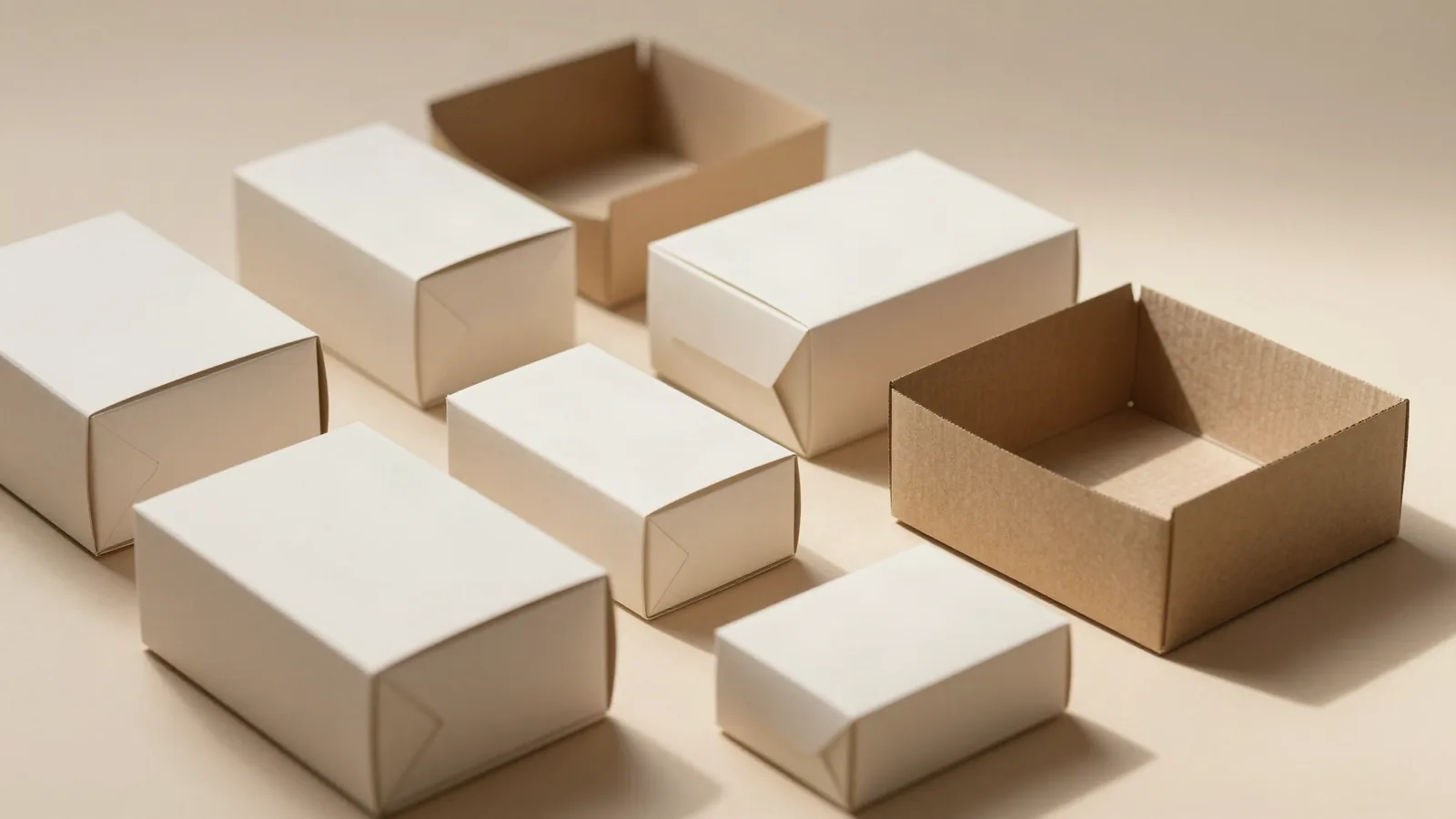




















































Custom packaging development is the work of turning a product requirement into a package someone can draw, print, cut, fold, and inspect. A dieline is the flat cutting template for that work. It maps panels, cut lines, score lines, glue areas, windows, and artwork. Catalog references cover small hardware, small-format, long-product, and metal-format directions. Use custom packaging design when a project starts with graphics but still needs a measured structure.
What should a development brief decide first?
The packed product sets the starting point, so record its dimensions, orientation, components, use, and delivery role before choosing a box. Note the packed length, width, and depth, the opening sequence, insert approach, artwork status, print coverage, finish direction, and destination. State what cannot move, such as product orientation or closure position. This stops a concept image from outrunning the package it has to become.
How do I turn a concept into a buildable package?
A useful development sequence has four gates: fit, structure, material, and proof.
Fit target
Inside length x width x depth sets the cavity. About 1/16 in (1.5 mm) is a common tolerance reference, but product fit and closure clearance still need a physical check.
Structure choice
Compare a straight tuck end, reverse tuck end, auto-lock bottom, crash-lock, sleeve, mailer, drawer or slide, or two-piece rigid construction against the loading and opening sequence.
Material reference
Common paperboard references are SBS, C1S, and C2S at 12 to 24 pt. Kraft board is commonly 18 to 24 pt. Rigid chipboard is commonly 1.5 to 3 mm wrapped in 100 to 157 gsm art paper.
Proof contents
Show cut lines, score lines, artwork orientation, finish areas, seams, closures, windows, and inserts on the same package map.
Which material and structure combinations are practical?
A folding carton, rigid box, and corrugated mailer solve different physical problems. The references below are typical industry ranges, and mills can produce different board behavior within the same label.
| Development direction | Common reference | Decision to test |
|---|---|---|
| Folding carton | SBS, C1S, or C2S paperboard at 12 to 24 pt | Fold behavior, print surface, and closure access |
| Kraft carton or wrap | Kraft board at 18 to 24 pt | Natural surface direction and required stiffness |
| Rigid presentation box | Chipboard at 1.5 to 3 mm with 100 to 157 gsm art paper | Lid fit, wrapped edges, and opening sequence |
| Corrugated mailer | E, B, or C flute, with 32 ECT as a common reference | Parcel handling, closure, and dimensional footprint |
SBS, C1S, and C2S give a printed folding surface. Kraft changes the surface direction. Wrapped chipboard holds a firm shape without a fold. E, B, and C flutes add corrugated depth for shipping-led construction. Test the formed package with the actual product before approval.
How should print and finish be checked?
Offset CMYK is commonly used for detailed paperboard graphics. Digital printing suits short runs or artwork that may change. Flexo is commonly used on corrugated surfaces. Matte or gloss lamination changes sheen; soft-touch changes hand feel; spot UV creates a hard glossy area; foil stamping, embossing, and debossing need room away from folds, scores, seams, and glue. A PET window commonly falls around 0.2 to 0.3 mm. Map window patching and the sightline before the dieline is approved.
Which product references help compare formats?
Different products expose different structure decisions. Custom tin packaging raises questions about an inner carton, rigid support, and the opening. Custom taper candle packaging tests long-product fit, clearance, and panel proportion. Custom stevia packaging gives a small-format presentation reference. Custom screw packaging frames organized placement and identification. These pages are catalog references; the product dimensions and brief decide the final format.
When is a development proof ready for approval?
Approval belongs after the folded sequence has been checked, not after a flat file has been admired. Confirm the product cavity, panel order, copy placement, print coverage, closure, seams, inserts, windows, and finish areas. Check that type does not sit too close to a score, that bleed reaches the cut edge, and that the insert does not steal clearance from the product. Record changes before approval so the next proof has a clear comparison.
How do I begin custom packaging development?
The first request should contain product dimensions, use, opening, artwork status, and destination. Custom Packaging Lane quotes to a 100-unit minimum, with pricing from $0.49 per unit at volume, quoted to spec. Production is typically 8 to 10 business days after proof approval, plus delivery. Free US shipping and free design support are available, with a free dieline. The $19.99 sample kit is credited to the first order.
Frequently Asked Questions
What does packaging development deliver beyond a concept?
Packaging development delivers a measured brief, selected structure, material direction, artwork plan, dieline, and proof check. It records why a format was chosen and what must be checked before approval. That record makes versions easier to compare and can expose a fit, fold, closure, or artwork conflict before the package reaches production.
How do I choose between folding and rigid packaging during development?
Choose between folding and rigid packaging by comparing stiffness, opening sequence, handling route, storage needs, and presentation goal. Folding cartons use paperboard and fold flat, while rigid chipboard formats hold a firm shape. Test both against inside measurements, closure behavior, insert needs, and artwork placement before selecting the format.
What belongs on a packaging development proof?
A packaging development proof should show the flat dieline and intended formed package, with cut lines, score lines, panel orientation, seams, closures, inserts, windows, artwork, and finish areas. Check the product inside the structure and confirm that copy stays on its intended panels. A proof is a decision checkpoint, not only a color preview.
When is a dieline useful in development?
A dieline is useful when product dimensions and opening direction are known. It gives the project a shared map for panels, folds, seams, closures, windows, and artwork. It also exposes conflicts early, such as a logo crossing a score or an insert occupying space needed by a closure. Physical checking still follows.
Can development compare several packaging formats?
Yes. Packaging development can compare a sleeve, straight tuck end, reverse tuck end, mailer, two-piece rigid box, drawer or slide, or magnetic flap against the same product requirements. Keep fit data and artwork goals constant while changing the structure. That creates a useful comparison with the same handling assumptions.












