











































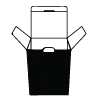

Accuracy on a dieline means the flat artwork agrees with the finished package. A dieline is the flat cutting template that marks panels, cuts, folds, glue zones, openings, and print-facing surfaces. Bleed is extra background artwork that extends past a cut edge, while a safety area keeps important copy away from that edge. The correct allowance depends on the structure and conversion method, so the supplier's file controls the final check.
What does accuracy on a dieline mean?
A dieline is accurate when its structural lines and artwork positions still make sense after the package is folded and assembled. A flat file can look tidy while a logo lands across a score or the front panel rotates to the wrong side. Check the assembled reading order, not only the sheet on screen.
| Dieline element | What it shows | What to check |
|---|---|---|
| Cut path | Where the board is separated | Keep copy inside the panel |
| Score line | Where the board folds | Keep type clear of the crease |
| Bleed | Background beyond the cut edge | Avoid an unprinted sliver |
| Safety area | Space inside the finished panel | Protect the logo and copy |
| Glue panel | Where package parts join | Keep essential artwork away |
| Orientation | How faces read after assembly | Check front, back, top, and base |
These are common prepress checks, not a replacement for the structure-specific file. Keep cut, fold, glue, and print layers clear while artwork is being placed. If the template does not identify a line clearly, ask before moving the design forward.
How much room should artwork have around cuts and folds?
Keep logos, type, barcodes, and product copy inside the supplied safety area, and extend background art through the supplied bleed. A score is the line where board is compressed or creased for folding. Type close to a score can break across the fold or become hard to read after assembly. Do not borrow an allowance from another box. The exact structure-specific file governs.
Which file problems cause prepress corrections?
Low-resolution images, RGB artwork, missing bleed, and type placed over a fold cause avoidable prepress corrections. Vector logos keep edges clean at different sizes. RGB is a screen color model, while packaging artwork is often converted to CMYK for press, and that conversion can shift color. Check image resolution at final size and separate the structural layer from the artwork layer before sending the file.
How do you check a dieline before proof approval?
Check the panel order first, then inspect the file at the size it will print. Use a short pass for each structural risk:
- Confirm the cut path and keep important artwork inside the usable panel.
- Check every score, fold, perforation, window, and opening.
- Read the front, back, sides, top, and base in the assembled order.
- Inspect logos, type, barcodes, and copy near edges or construction areas.
- Compare the artwork file with the supplied dieline before approving the proof.
What if you do not have a supplier dieline?
If you do not have a supplier dieline, request one before placing artwork. Send the product dimensions, opening direction, material preference, quantity, and package reference. Free design support can build the structure-specific dieline and return a digital proof before anything prints. The proof should show enough of the flat layout and assembled reading order to catch a wrong orientation or a logo sitting on a glue panel.
Which products need a structure-specific dieline?
Every custom format needs a file that matches its quoted structure. Custom mailer boxes use a folded mailer layout with panels and closure areas. Rigid printed boxes use wrapped panels around an assembled form. Custom shipping boxes need the artwork and opening mapped to a delivery-oriented structure. The product pages show format directions; the quoted size and construction control the final dieline.
What does CPL provide for dieline accuracy?
CPL provides free design support and a digital proof before anything prints. The MOQ is 100 units, and pricing is from $0.49 per unit at volume, quoted to spec. Production is typically 8 to 10 business days after proof approval, plus delivery. Free US shipping is available. The $19.99 sample kit is credited toward the first order and can help compare board and finishes. For a design-led starting point, use custom packaging design, then send the product dimensions and current artwork file.
Frequently Asked Questions
How can I tell whether a dieline is accurate?
An accurate dieline puts the cut paths, scores, bleed, safety areas, glue panels, and artwork in the right relationship for the assembled package. Accuracy is checked against the selected structure, not a generic box file. The final question is simple: does the proof still read correctly after the package is folded?
Is there one tolerance for every packaging dieline?
No single tolerance applies to every packaging dieline. Box style, board, converting method, folds, openings, and joining areas change the working file. Use the structure-specific dieline supplied for the quoted package, keep artwork clear of cuts and scores, and ask CPL to confirm any file requirement before proof approval.
Can RGB artwork affect dieline approval?
Yes. RGB artwork is built for screens, while packaging artwork is often converted to CMYK for press. That conversion can shift color, especially when a brand color is close to the edge of the printable range. Check color separately from structural accuracy, and keep the dieline layer visible during prepress.
Can CPL draw a structure-specific dieline?
Yes. CPL's free design support can draw a structure-specific dieline from the product dimensions, package format, opening direction, quantity, and artwork status. A rough sketch or package reference can clarify the intended shape. The supplier then sends a digital proof before anything prints, so the buyer can correct the file before approval.
When does the production clock start for an approved dieline?
For an approved dieline project, production is typically 8 to 10 business days after proof approval, plus delivery. CPL's MOQ is 100 units, and pricing is from $0.49 per unit at volume, quoted to spec. Free US shipping and free design support are available, and the $19.99 sample kit is credited toward the first order.