




























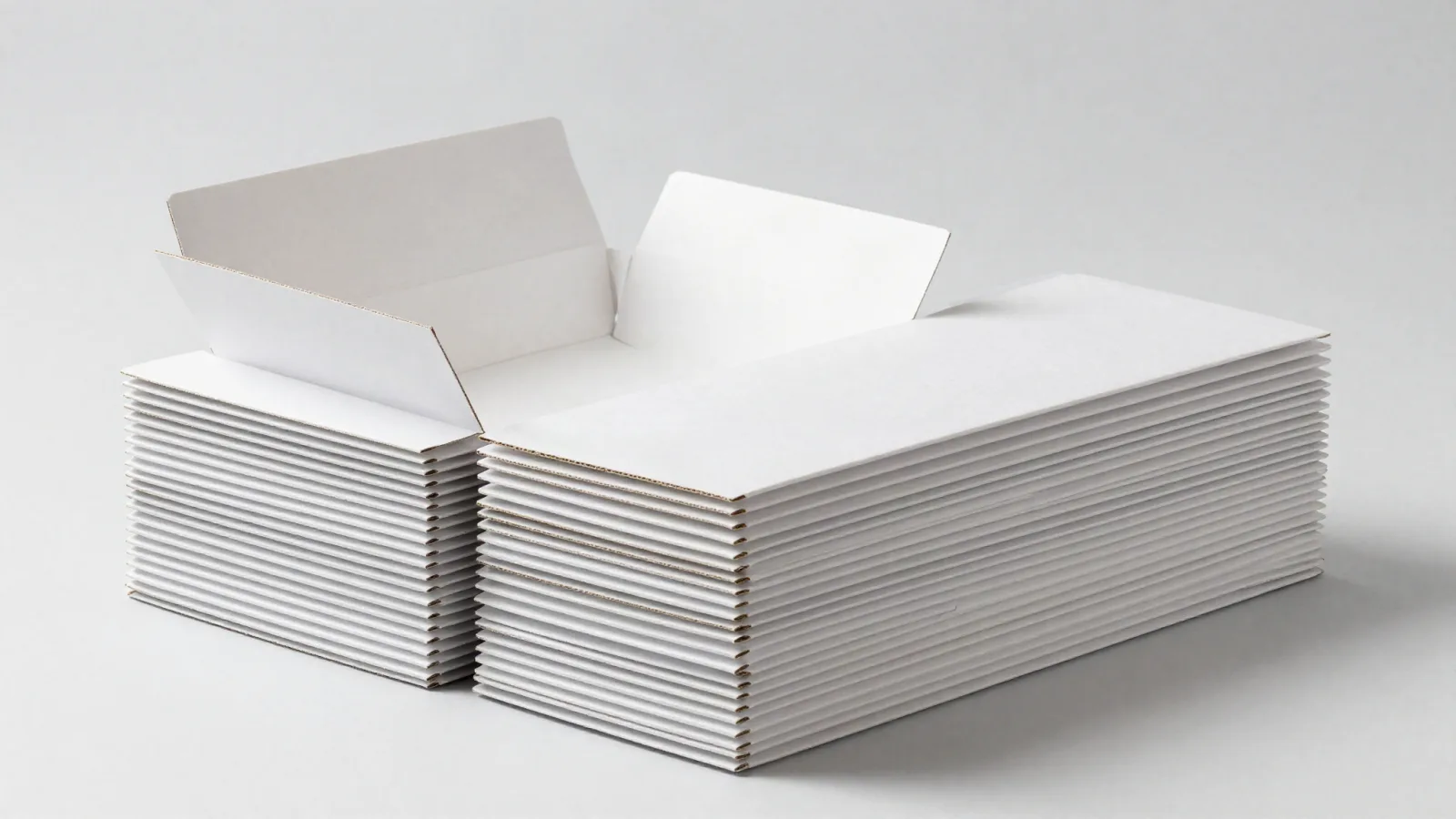




















































Fluted cardboard is corrugated board: a shaped paper layer, called the flute or medium, sits between linerboards. The flute creates thickness and stiffness. The linerboards form the outside faces, so they carry print, scores, folds, and the contact points that hold the box together.
A flute letter describes the wave profile inside the board. It does not describe the whole box. Box geometry, liner paper, closure, product fit, and handling still have to be checked before a board direction is approved.
What is fluted cardboard and how is it built?
Fluted cardboard is a paperboard construction with a corrugated medium glued between two linerboards. A single-wall sheet has one fluted layer and two liners, while the finished box adds cuts, scores, glue tabs, and a closure to that sheet.
The profile changes the sheet's thickness and the way it folds, prints, stacks, and uses interior space. A thicker profile can take more room inside a tight package. A lower profile can give a flatter print surface and tighter folds. Those are board effects, not promises about every finished box.
What do A, B, C, and E flute types mean?
A, B, C, and E are common corrugated flute labels. Typical industry calipers are about 1/4 inch for A-flute, 1/8 inch for B-flute, 3/16 inch for C-flute, and 1/16 inch for E-flute. Mills and board constructions vary, so the quoted material specification controls the finished order.
| Flute | Typical industry caliper | What the profile changes | Check on the package |
|---|---|---|---|
| A | About 1/4 inch | More interior thickness and a deeper corrugated structure | Clearance, box proportions, and stacking path |
| B | About 1/8 inch | Lower profile with a flatter sheet | Panel layout, folds, seams, and footprint |
| C | About 3/16 inch | General-purpose corrugated thickness | Board combination, closure, fit, and handling |
| E | About 1/16 inch | Thin structure with a smoother print direction | Fine detail, scores, opening, and retail appearance |
These are typical industry ranges, not a performance guarantee. Ask for the actual flute, liner, and caliper in the quote so the sample and proof match the board that will be ordered.
Which box design changes the flute decision?
Box design can matter more than the flute letter when the package has a narrow footprint, a deep cavity, a drawer, a tray, or an insert. A product with a concentrated load also puts different demands on the panels and closure than a light product spread across the base.
CPL's kraft cardboard boxes give you a board-led format to discuss. Custom cardboard drawer boxes add a different fold and opening conversation. Custom cardboard gift boxes and custom cardboard boxes with inserts show how the outer board and interior structure need to be planned together. The flute should fit the package, not the other way around.
How should artwork and inserts fit a fluted box?
Artwork belongs on the assembled box as well as the flat sheet. A dieline is the flat cutting template that shows panels, scores, folds, bleed, glue tabs, and cut edges. Send the product dimensions first, then check the dieline against the loading sequence before the artwork is finalized.
Keep small type and barcodes away from scores and folds. Leave the standard bleed around cut edges. RGB artwork can shift when it is converted for press, so inspect the digital proof for color, type size, panel position, and the way the box opens. An insert cut too loosely lets the product rattle. An insert cut too tightly can make packing slow or press against the product.
What should a fluted cardboard order include?
A workable brief includes the product dimensions, box style, closure, insert needs, print coverage, finish, quantity, handling path, and delivery destination. CPL orders start at 100 units. Pricing is from $0.49 per unit at volume, quoted to spec, with the final quote shaped by the material, size, construction, print, finish, and quantity.
Production is typically 8 to 10 business days after proof approval, plus delivery. Free US shipping and free design support are available. Order the $19.99 sample kit if you need to compare physical board and finish directions. The sample kit is credited toward the first order. For larger order planning, use wholesale custom packaging.
When is fluted cardboard better than solid paperboard?
Corrugated construction is usually the stronger choice when a package needs panel stiffness, edge protection, or a shipping-ready shell. Solid paperboard is better suited to compact cartons with tight scores and little wasted space. The packed load, stacking route, print detail, closure, and storage footprint should decide between them.
| Package job | Common board direction | Structural reason | Conversion check |
|---|---|---|---|
| Compact retail carton | SBS, C1S, or C2S paperboard selected for the score pattern | Tighter folds and less wall thickness | Crease quality and glue seam |
| Counter display | E flute corrugated | Shallow corrugated profile with a firm front lip | Slots, cut edges, and loaded tray angle |
| Roll end tuck front mailer | FEFCO 0427 in E or B flute | Integrated side walls and closing panel | Locking tabs and opening force |
| Insert-led transit box | B or C flute, with 32 ECT as a common reference | Separation between contents and outer panels | Divider slots and packed load |
A 32 ECT callout does not predict the performance of every converted box. Large panels, hand holes, perforations, humidity, seams, and concentrated loads can change the result. Compare structures in the custom mailer box catalog after the product and handling path are fixed.
Does flute direction change stacking strength?
Vertical flutes generally carry top-to-bottom compression more effectively in an erected carton. Rotating the sheet changes bending behavior, score response, and the path a load follows through the side walls. Mark the intended orientation on the cutting layout before tooling, especially when a display opening or tear strip removes board from a load-bearing panel.
Windows, hand holes, deep scores, and wide perforations interrupt that path. A suitable board grade can still buckle if the flute direction fights the seam or if an insert leaves the product weight concentrated in the middle of a broad panel. Check the closed box with the real packed load, then inspect the corners and glue joint for distortion.
Which printing process works best on fluted paper?
Flexographic printing is common for direct-print corrugated, digital printing suits short or versioned runs, and offset artwork is often printed on a separate liner before lamination to the fluted sheet. Fine graphics usually reproduce more evenly on a smooth liner than on a coarse direct-print surface.
Broad solid colors can reveal flute ridges, pinholing, or uneven ink transfer. A press check should inspect those solids, small reversed type, registration near scores, and finish alignment. Matte or gloss lamination can cover the printed liner before mounting. Keep spot UV and foil stamping clear of folds where repeated flexing may crack the effect.
How should unused fluted cardboard be stored?
Dry, level storage protects flatness and score behavior before packing begins. Paper exchanges moisture with the surrounding air, so uneven exposure can warp sheets, soften panels, or make a previously clean fold resist assembly. Keep flat blanks supported across the full footprint instead of leaning them against a wall.
Avoid narrow straps and heavy loads across exposed corrugated edges. Rotate converted stock so older blanks are used first, and let material moved between sharply different environments settle before folding. Label the chosen surface against the sample kit reference, then evaluate the final board under the storage and packing conditions planned for the job.
Frequently Asked Questions
What does fluted cardboard mean?
Fluted cardboard is corrugated board with a shaped paper medium between linerboards. The medium creates the flute profile, while the linerboards form the printable outside faces. Fluted cardboard can be cut and scored into boxes, trays, and inserts, but the finished package also depends on box geometry, product fit, closure, and handling.
What are A, B, C, and E flute types?
A, B, C, and E flute types are common labels for corrugated profile thickness. Typical industry calipers are about 1/4 inch for A, 1/8 inch for B, 3/16 inch for C, and 1/16 inch for E. The quoted board specification controls because mills and liner combinations can change the final construction.
Can fluted cardboard work for retail packaging?
Fluted cardboard can work for retail packaging when the board, liner, print, finish, folds, and opening are planned together. E-flute is often discussed for finer print detail, while a gift box, drawer box, or insert-led format may need a different construction check. CPL can check the box direction through free design support.
What is the minimum order for fluted cardboard boxes?
The minimum order for fluted cardboard boxes from CPL is 100 units. Pricing is from $0.49 per unit at volume, quoted to spec, and depends on the material, size, construction, print, finish, and quantity. Production is typically 8 to 10 business days after proof approval, plus delivery.
How can CPL help choose a flute profile?
CPL provides free design support for flute and box planning. Send product dimensions, box style, closure, insert needs, artwork, quantity, handling path, and destination. The check can connect the flute profile to the actual construction. A $19.99 sample kit can help you compare physical board and finish directions before ordering.












