




























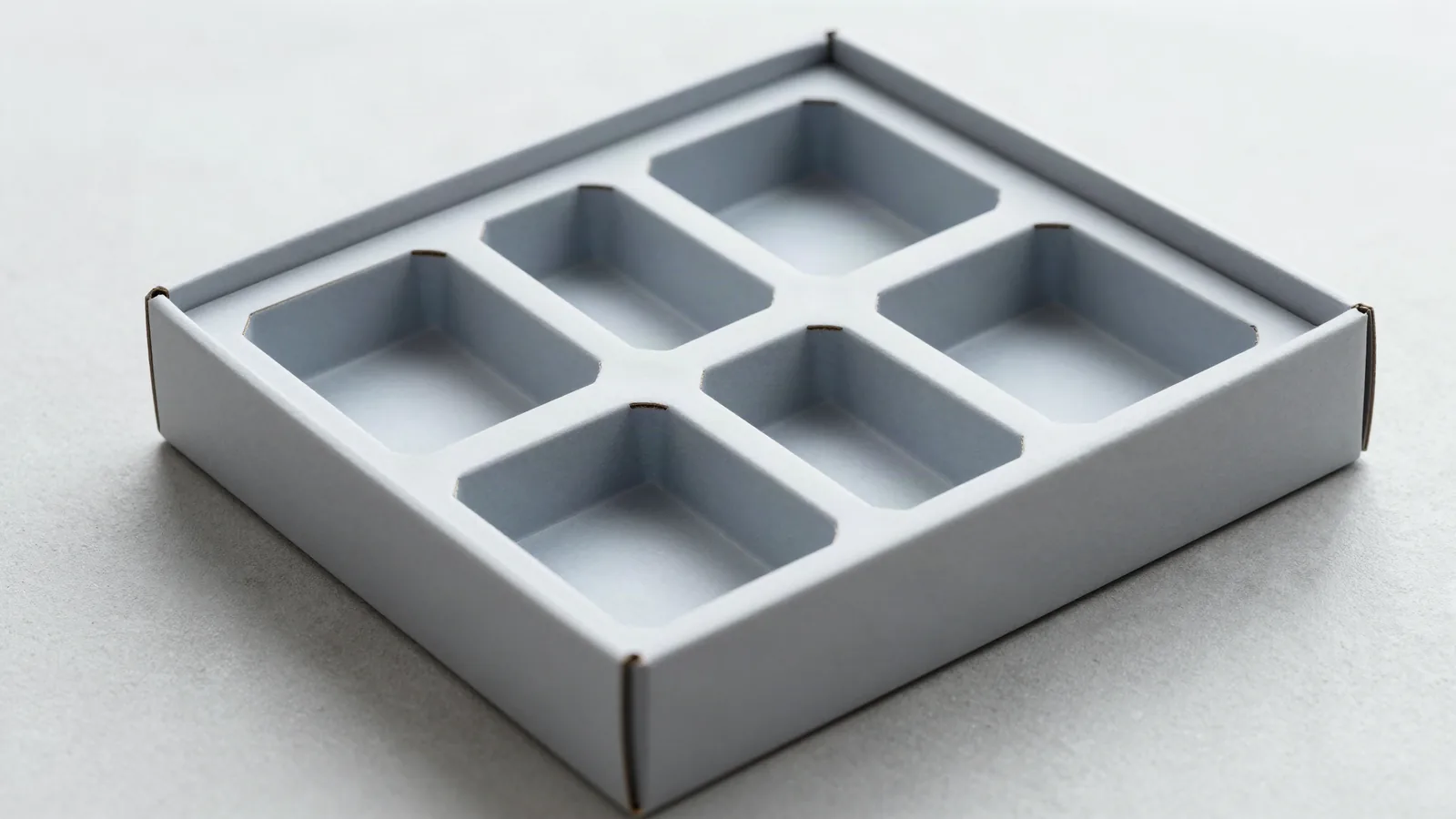




















































Foam inserts are shaped interior components that hold products inside a box. A die-cut cavity is an opening cut to the product outline, so the package can keep the item in a planned position instead of leaving it loose. Custom Packaging Lane pairs foam insert work with rigid boxes and other box formats. Start with the product footprint, height, contact points, and number of cavities.
What are foam inserts used for in packaging?
Foam inserts hold a product in a defined position and organize the inside of the box. A shaped cavity can separate an item from the box wall and keep accessories in their own spaces. The insert should be designed with the box interior and closure, because a cavity that fits the product but crowds the lid is still a bad fit.
For a broader project brief, use custom packaging solutions. Send the product dimensions and orientation first. Then record the number of items, the visible face, and any lift-out or finger access needed when the box opens.
How do density grades and cavity cuts affect the fit?
Density grade and cavity geometry are separate choices. Density changes the feel and support of the foam, while the cavity cut controls where the product sits and how much contact it has with the insert. The proof should show both decisions, not only an outline of the product.
| Specification | What to define | What the buyer checks |
|---|---|---|
| Density grade | Foam grade for the product and presentation | Support, hand feel, and contact with the product |
| Cavity layout | Number, shape, and position of die-cut cavities | Product orientation and access for removal |
| Box pairing | Insert footprint and rigid box interior | Insert fit, lid clearance, and closure |
| Visible surface | Insert face, cover, or exposed areas | How the open box looks before the product is lifted |
Provide a product outline that includes irregular edges and contact points. If the product has several components, draw the cavity map around the complete set. This prevents the largest item from receiving all the attention while smaller pieces rattle in unused space.
Which box formats pair with custom foam inserts?
The direct insert option is custom foam box inserts. For a presentation-led construction, compare custom rigid boxes with inserts. A category-specific project may fit jewelry boxes with inserts, custom candle boxes with inserts, or cosmetics boxes with inserts. If the interior should use a different material, inspect cardboard inserts.
Box pairing is a construction decision, not a page-category decision. Check the insert footprint, cavity height, lid clearance, and opening direction against the actual box selected for the order.
How should buyers prepare a cavity layout?
Prepare the cavity layout with the product in its intended orientation. Include the number of units or components, the face that should show first, and any edge that needs hand access.
- Provide product length, width, height, and irregular contours.
- Mark the product face that should appear when the box opens.
- List every accessory and give it a cavity or placement.
- Show the insert footprint inside the selected box.
- Check the digital proof before production.
RGB artwork can shift when converted for press, and type set too close to a score can be cut off or weakened. A digital proof is the right place to catch bleed, cavity position, and box closure issues before anything prints. Free design support is available.
What are the order terms for custom foam inserts?
The MOQ is 100 units. Pricing is from $0.49 per unit at volume, quoted to spec, and the final quote depends on the insert material, density grade, cavity layout, box construction, finish, and quantity. Production is typically 8 to 10 business days after proof approval, plus delivery.
Free US shipping and free design support are available. The $19.99 sample kit can help you inspect packaging direction before approval. If the product may touch food, ask us about food-contact options.
Frequently Asked Questions
What does a die-cut foam insert do?
A custom foam insert is a shaped interior component with die-cut cavities that hold a product inside a box. Custom Packaging Lane can pair the insert with a rigid box or another selected format. The specification should include product dimensions, orientation, cavity count, access needs, and the box interior before proof approval.
Can Custom Packaging Lane specify more than one foam density?
Custom foam inserts can be specified with density-grade choices. Density affects the foam's feel and support, while the die-cut cavity controls product position and access. The approved proof should identify the chosen grade, cavity layout, product orientation, and box pairing so the construction is clear before production.
What MOQ applies to custom foam inserts?
The minimum order quantity for custom foam inserts is 100 units. Pricing is from $0.49 per unit at volume, quoted to spec, with the final quote based on density, cavity layout, box construction, finish, and quantity. Production is typically 8 to 10 business days after proof approval, plus delivery.
Do foam inserts fit rigid boxes?
A foam insert can be paired with a rigid box, and Custom Packaging Lane lists custom rigid boxes with inserts as a product direction. The insert footprint, cavity height, lid clearance, and opening direction should be checked together. Free design support is available before the digital proof is approved.
When does production take place for custom foam inserts?
Production for custom foam inserts is typically 8 to 10 business days after proof approval, plus delivery. The timing starts after the insert, box, and artwork are approved. Custom packaging uses a 100-unit MOQ, with free US shipping and free design support available.












