
























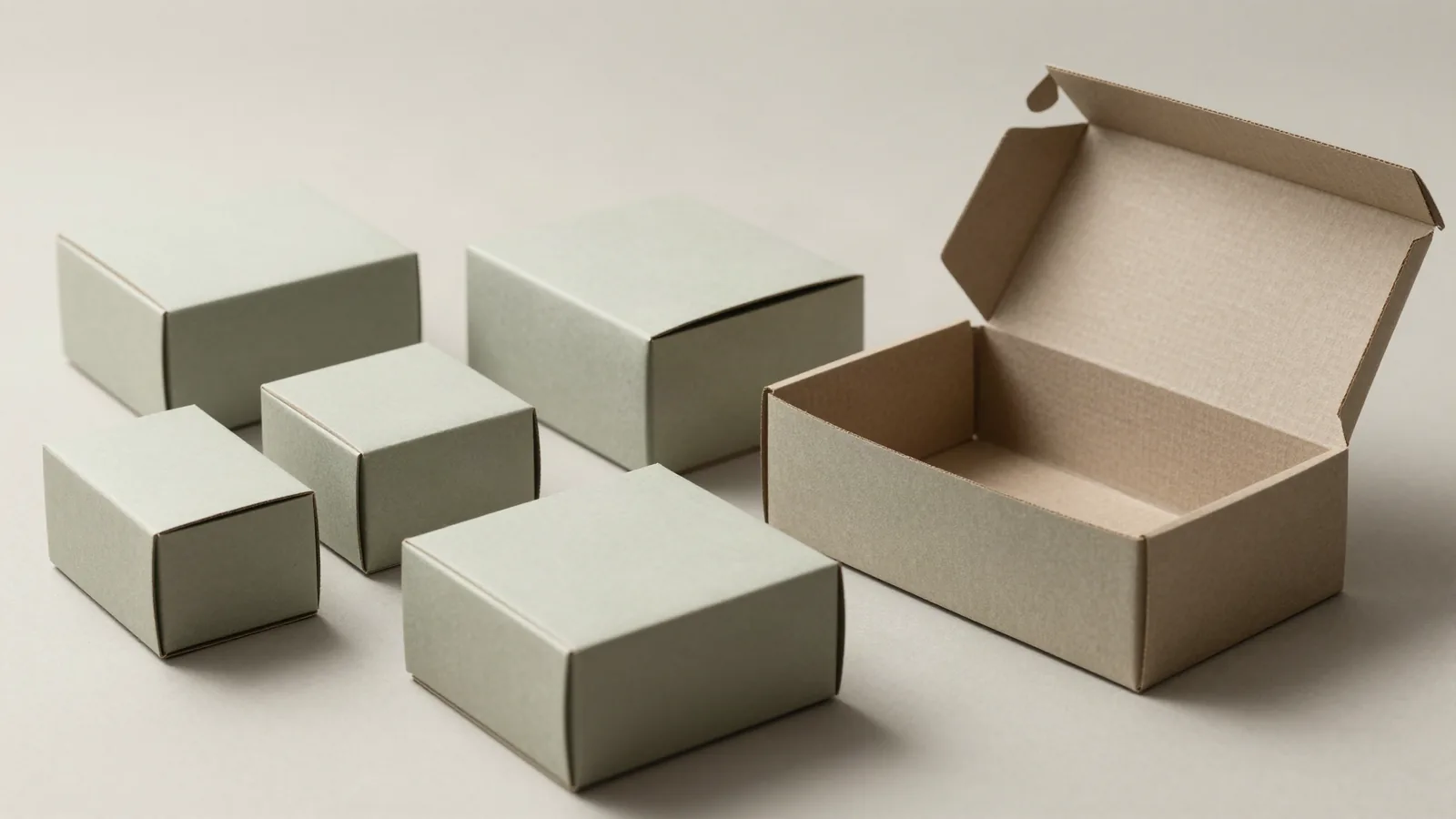





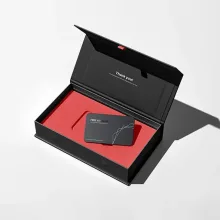










































A folding box starts as a flat paperboard blank and becomes a package through scores, cuts, folds, glue, and closure panels. A dieline is the flat cutting template that shows those features before the blank is made. The structure should follow the packing sequence: how the operator fills the box, how the user opens it, where it is stored, and whether a corrugated shipper carries it. Use the custom packaging design page to organize the brief.
Which folding box structure fits my packing sequence?
The packing sequence usually narrows the choice faster than artwork does. Straight tuck end and reverse tuck end cartons close from opposite directions. Auto-lock bottom and crash-lock structures change how the base forms and how the operator loads the product. Mailers use a roll end tuck top, sleeves remove the ends, and gable cartons, pillow boxes, and two-piece formats create different opening paths.
FEFCO 0427 is a common mailer convention: sidewalls and a tuck top form a parcel-style closure. Folding boxes are the broad reference. Wine box packaging adds tall-product fit; shoe box packaging adds a wider opening. If the carton is the parcel, compare custom folding shipping boxes for the outer-pack role.
| Structure | Opening or base action | Buyer checkpoint |
|---|---|---|
| Straight tuck end | Tuck panel closes in one direction | Front panel, dust flaps, and tuck clearance |
| Reverse tuck end | Opposing tuck layout | Seam location and panel orientation |
| Auto-lock bottom | Base forms during setup | Loading order and bottom folds |
| Crash-lock bottom | Pre-glued base locks open | Flat storage and setup motion |
| Roll end tuck top mailer | Sidewalls and top tuck close a parcel box | Inside fit, opening experience, and shipping route |
What paperboard caliper belongs in the brief?
Board caliper sets the fold and closure behavior. SBS, C1S, and C2S paperboard are common references from 12 to 24 pt, where pt means points, one point equals one-thousandth of an inch. SBS is coated paperboard with a clean print surface. C1S has one coated side, and C2S has coated surfaces on both sides. Kraft board around 18 to 24 pt is another reference when a natural board tone is part of the design.
Caliper affects scoring, crease recovery, edge stiffness, and closure force. Rigid chipboard around 1.5 to 3 mm wrapped in 100 to 157 gsm art paper is a separate construction. GSM means grams per square metre. Its shell, wrap, hinge, lid, and clearance need a separate brief.
How do I check a folding-box dieline?
Inside length x width x depth should anchor the drawing. Mark front, back, sides, top, bottom, glue flap, score lines, cuts, window, and insert. About 1/16 in, or 1.5 mm, is a common planning tolerance reference. Clearance depends on the product surface, wrap, insert, friction, and removal direction, so fold an assembled proof before approving graphics.
If the carton has a window, PET around 0.2 to 0.3 mm is a common patch reference. Keep it inside the cavity and viewing angle. Mark bleed, the extra printed area beyond the cut line, keep type away from scores, and check the blank after glue.
Which print and finish choices fit the carton?
Offset CMYK is commonly used for detailed paperboard artwork, while digital printing can suit short runs or artwork variations. Flexo is more common for corrugated outer packaging. Matte or gloss lamination changes reflection. Soft-touch changes hand feel. Spot UV isolates a selected logo or pattern. Foil stamping, embossing, and debossing need clear space around folds and closures.
Plan print coverage with the score map. Full coverage can make a fold look darker or show cracking at a crease, while a restrained front-panel mark leaves more board around the opening. Kraft changes how colors appear. Check a barcode and small instruction after lamination, coating, folding, and glue.
When should a folding box also carry the parcel?
A retail folding carton and an outer shipper carry different jobs. When the printed carton sits inside another case, prioritize display panels, product fit, and flat storage. When it travels as the parcel, compare corrugated E, B, or C flute references and 32 ECT, a common edge crush test reference.
US ground dimensional weight commonly uses L x W x H / 139, so assembled outer size belongs in the shipping brief. Measure the closed carton, outer shipper, and case arrangement. A carton that fits the product can still take more parcel space once the shipper and packing orientation are included.
What should I send for a folding-box quote?
A quote brief needs the packed product and the job it must do. Include:
- Inside length x width x depth, product orientation, wraps, inserts, lids, and accessories.
- Straight tuck, reverse tuck, auto-lock, crash-lock, mailer, sleeve, gable, pillow, or two-piece structure.
- SBS, C1S, C2S, kraft, rigid, or corrugated direction and the desired surface tone.
- Print coverage, scores, glue areas, windows, lamination, spot UV, foil, embossing, or debossing.
- Packing order, flat storage, case packing, shipping role, destination, and proof checkpoints.
CPL quotes folding boxes to spec from a 100-unit minimum, with pricing from $0.49 per unit at volume, quoted to spec. Production is typically 8 to 10 business days after proof approval, plus delivery. Free US shipping and free design support are available, and we draw a free dieline and send a digital proof before anything prints. The $19.99 sample kit is credited to the first order. Start with the kit, then approve the proof.
Frequently Asked Questions
What does a folding box blank include?
A folding box blank is a flat paperboard sheet with cut lines, score lines, panels, glue flaps, and closure parts. The dieline shows those features before the blank is folded. It should also mark any window, insert, bleed, and artwork-safe area so the assembled carton can be checked against the product.
Which folding carton bottom is easiest to load?
An auto-lock bottom forms during setup, while a crash-lock bottom arrives pre-glued and locks open as the carton is erected. Straight tuck and reverse tuck cartons use different top closures. Watch the actual pack-out sequence, because the easiest base depends on how the operator loads the product and stores the flat blank.
When is rigid chipboard a separate choice?
Rigid chipboard is a separate box construction when the package uses a board shell wrapped in printed paper instead of one folded carton blank. A typical reference is 1.5 to 3 mm chipboard with 100 to 157 gsm art paper. Its hinge, lid, corners, and clearance need their own drawing.
What does the 0.2 to 0.3 mm window reference describe?
The 0.2 to 0.3 mm reference describes PET patch material for a carton window. It does not set the carton size or replace the dieline. Check the cavity, viewing angle, patch edge, glue area, and artwork around the window on the assembled folding box.
Can a folding box travel as a parcel?
A folding box can be considered as an outer parcel package, but the retail carton and shipper need separate checks. Compare the packed product, E, B, or C flute, 32 ECT reference, closure, case arrangement, and assembled dimensions. US ground dimensional weight commonly uses L x W x H / 139, so outside size belongs in the shipping brief.