



























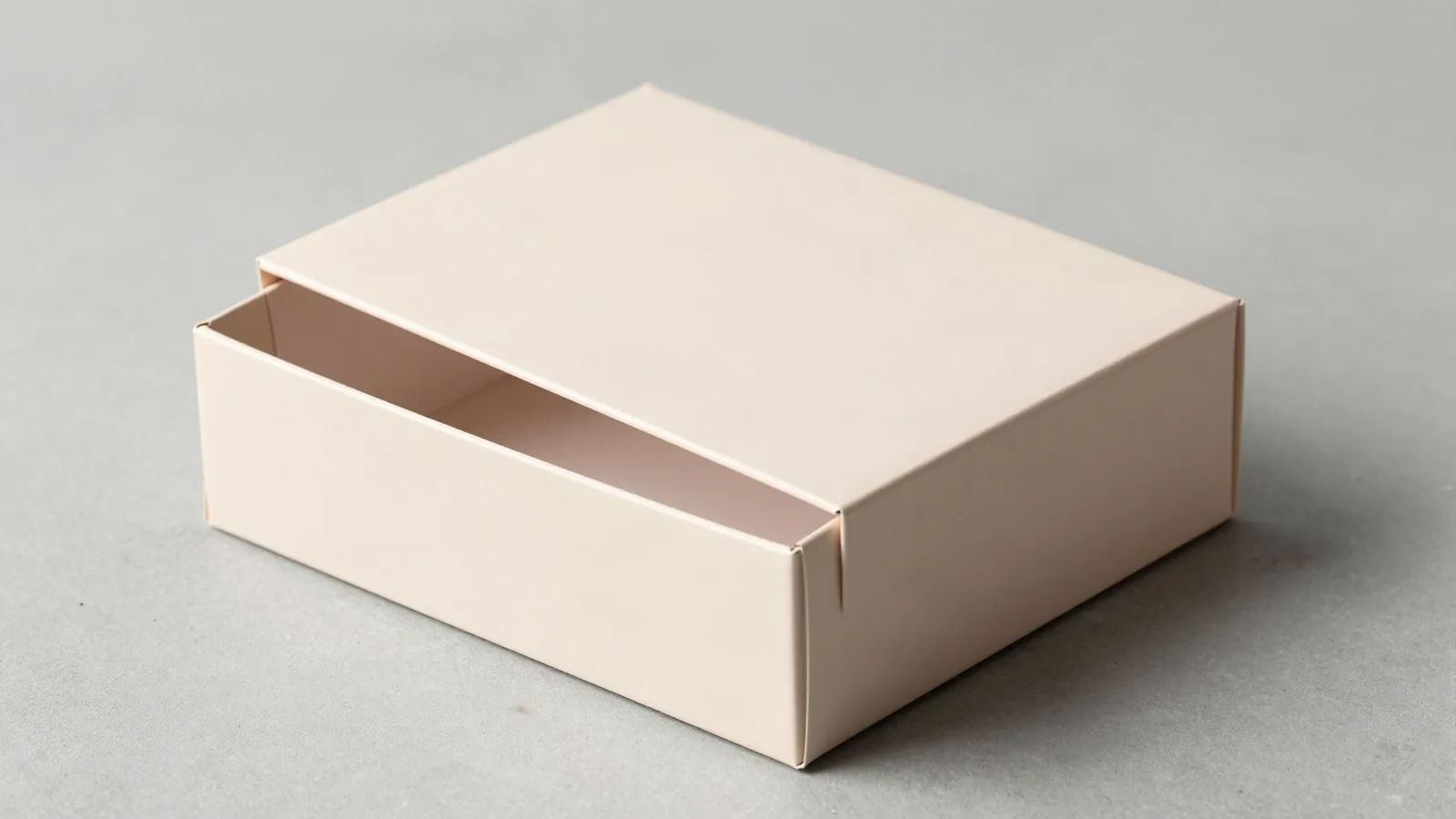



















































Luxury tray and sleeve packaging uses an inner tray and an outer sleeve to control product access, printed surface, and the order of the reveal. The tray can hold the product or an insert. The sleeve can hide the tray until the buyer pulls it forward. That movement needs to work before the finish plan is approved.
What makes tray and sleeve packaging work well?
Tray travel and sleeve friction decide whether the package feels controlled or awkward. Give the buyer a clear place to grip the tray, leave enough clearance for the product and insert, and mark the point where the tray should stop. A sleeve that binds can damage edges during opening. A cavity cut to the exact product size can make removal frustrating.
Plan the reveal in order. Decide what the sleeve hides, which panel appears first, and where the product sits when the tray reaches its final position. If a lid, ribbon pull, finger notch, removable platform, or window is part of the package, include it in the structural drawing. Those parts change the usable interior and the artwork panels.
Which tray structure should I compare?
A two-piece rigid box gives a lift-off opening, while a tray and sleeve gives a pull-out reveal. A drawer or slide uses repeated movement through an outer component. A magnetic flap adds a hinged presentation panel. Compare the motion, not only the outside shape.
| Structure | Presentation role | What to confirm |
|---|---|---|
| Two-piece rigid box | Separate base and lid with lift-off opening | Fit, lid clearance, wall thickness, opening direction |
| Tray and sleeve | Pull-out reveal through a printed sleeve | Tray travel, sleeve friction, finger access, stop points |
| Drawer or slide box | Contained product with repeated sliding access | Rail feel, pull feature, interior fit, sleeve alignment |
| Magnetic flap format | Hinged presentation panel with closure | Flap clearance, magnet placement, fold behavior |
Which board materials support a rigid tray?
Rigid chipboard in the typical 1.5 to 3 mm range is commonly wrapped in 100 to 157 gsm art paper. Chipboard forms the base, walls, lid, or tray. The art-paper wrap carries print and finish. A folding sleeve may use SBS or C1S paperboard in the typical 12 to 24 pt range. Kraft board in the typical 18 to 24 pt range gives a natural paperboard surface.
These are typical industry ranges, not fixed requirements for every package. The product weight, tray depth, sleeve tension, stacking method, insert, and packing sequence set the practical choice. If a window is needed, PET window film commonly falls around 0.2 to 0.3 mm. Put the window on the structural drawing and check that it does not block the product reveal or reduce the glue area.
How should print and tactile finishes be placed?
Offset CMYK is commonly used for detailed wrapped paper and folding sleeves. Digital printing can suit a short run or an artwork check. Matte or gloss lamination changes the base reflectivity. Soft-touch changes the hand feel. Spot UV creates selective gloss. Foil stamping adds a reflective detail. Embossing raises the surface, and debossing presses it down.
A dieline is the flat cutting template used to print and cut the package. Build the artwork from it, not a flat rectangle. Mark the tray orientation, sleeve opening, panel order, folds, seams, glue areas, and hidden surfaces. Keep finish treatments away from places that rub during opening. RGB art can shift during press conversion, low-resolution art can soften, and missing bleed can expose an unprinted edge after cutting.
How should dimensions be specified for a tray?
The dimension line needs both a size and a reference point. State length x width x depth and label each measurement as inside or outside. Inside dimensions control product and insert fit. Outside dimensions describe the closed package and affect display and shipping space. About 1/16 inch, or 1.5 mm, is a common box-planning tolerance reference, but the assembled tray and sleeve still need physical confirmation.
Include product orientation, tray clearance, sleeve direction, lid or flap movement, insert depth, finger access, and stop points. The template cannot be finalized from outside dimensions alone because the board, wrap, insert, and sleeve each reduce usable space.
Which tray and sleeve products should I compare?
The product pages below cover rigid, pull-out, fitted, and compact tray references. Compare rigid boxes with sleeve and tray for a rigid presentation system. Review custom sleeve and tray boxes for another pull-out format. Jewelry boxes with lid and tray can clarify fitted presentation details, and custom lid and tray soap boxes provide a compact tray reference.
What should I include in a tray and sleeve brief?
The brief has to describe the movements that a flat artwork file cannot show. Send the product dimensions, inside clearance, tray structure, sleeve direction, opening sequence, insert needs, board preference, artwork files, finish priorities, and any window or pull feature. Separate structural artwork from finish instructions. Mark the surfaces that receive repeated rubbing so the proof can show where the package will be handled. For design coordination, see custom packaging design.
- Describe the first reveal and the final product position.
- Mark tray travel, sleeve opening, finger access, and stop points.
- Identify insert depth, removable parts, windows, and pull features.
- Keep scores, seams, glue areas, and finish locations visible in the file.
Custom Packaging Lane quotes tray and sleeve packaging to spec from a 100-unit minimum, with pricing from $0.49 per unit at volume, quoted to spec. Production is typically 8 to 10 business days after proof approval, plus delivery. Free US shipping and free design support include a free dieline. The $19.99 sample kit is credited to the first order. Send the product dimensions and opening sequence with the quote request.
Frequently Asked Questions
What is the difference between a tray and sleeve box and a rigid box?
A tray and sleeve box uses an inner tray that moves through an outer sleeve, while a two-piece rigid box uses a separate base and lid. The tray and sleeve depends on travel, friction, finger access, and stop points. The rigid box depends on lid clearance and base fit. Choose from the product reveal, insert, packing method, and opening motion.
How thick is chipboard for a rigid tray package?
Rigid chipboard commonly falls in the 1.5 to 3 mm range and is often wrapped in 100 to 157 gsm art paper. The practical choice depends on tray depth, product weight, wall construction, sleeve tension, and stacking method. Treat those figures as typical industry ranges, then check the assembled tray, sleeve, insert, and closure in a physical proof.
How should I specify tray and sleeve dimensions?
Specify length x width x depth and label the figures as inside or outside measurements. About 1/16 inch, or 1.5 mm, is a common box-planning tolerance reference. Include product orientation, tray clearance, sleeve direction, insert depth, finger access, and stop points so the usable interior is not confused with the closed exterior.
Which finishes work on a luxury sleeve?
Matte or gloss lamination sets the base surface, soft-touch changes the hand feel, spot UV creates selective gloss, foil stamping adds reflection, and embossing or debossing changes the surface profile. Offset CMYK is commonly used for detailed artwork. Map the finish areas to the dieline and keep them away from folds, seams, glue areas, and high-rub edges.
Can a tray include a window or removable insert?
A tray can include a fitted insert, finger access, removable platform, or coordinated window when those features are drawn into the structure. PET window film commonly falls around 0.2 to 0.3 mm. Confirm window position, product clearance, tray travel, sleeve reveal, and removal access together, because an added feature can block the product or reduce usable glue area.