















































































What should a magnetic flap box closure decide?
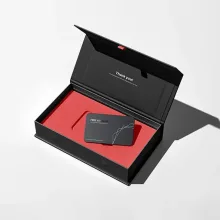
The front flap, hinge, and front wall set the opening path before the magnet is placed. A magnetic flap box is a rigid box with a hinged front flap and a concealed or covered closure area; the flap length, board construction, wrap, interior clearance, insert, and artwork all affect how it opens.
Start by describing the opening in plain language. State whether the flap lifts from the front, folds over a lid, or forms part of a sleeve-like outer panel. A dieline is the flat cutting template that maps panels, scores, trim, bleed, and glue tabs before the printer cuts the sheet. Mark the closure area on it and keep important artwork away from the hinge and closure.
- Identify the front panel and the direction the flap travels.
- Mark the closure location, fold lines, seams, and any pull point.
- State whether the product sits in a tray, cavity, or open base.
- Check the closed and open states, because each exposes different artwork panels.
Which rigid construction fits the package?
Rigid chipboard gives the body a fixed shape, while the closure determines how the customer enters it.
| Construction | Common packaging reference | Key decision |
|---|---|---|
| Magnetic flap | Rigid body with a hinged front flap and concealed closure area | How do the flap, front wall, and magnet align? |
| Two-piece rigid | Separate lid and base for a structured presentation | What clearance does the lid need over the loaded base? |
| Drawer or slide | Tray and outer shell with a pull-led opening | Where will the tray stop, and how will the product be lifted? |
| Sleeve | Printed outer wrap around a tray or existing package | How will the sleeve stay aligned during handling? |
Rigid chipboard in the 1.5 to 3 mm range, wrapped in 100 to 157 gsm art paper, is a common reference for structured presentation boxes. The wrap needs room for corners, seams, folds, and the area where the flap meets the body. If the product is light and the brief needs a folding carton, SBS, C1S, or C2S paperboard in the 12 to 24 pt range may be a more suitable starting point.
How should the box dimensions be specified?
Inside length x width x depth gives the clearest starting point for product fit. Identify the product orientation and the clearance needed for the insert or lift point. About 1/16 in (1.5 mm) is a common packaging convention, but the loaded package still needs a physical fit check. A magnetic flap can close when empty and behave differently when the product, tray, or wrap occupies the available space.
Keep the flap length and front-panel proportion visible in the structural drawing. A short flap may not cover the intended face, while a long flap can affect the opening path and artwork placement. Put the closure layout on the approved dieline, along with the insert, tray, lid, or sleeve that shares the interior.
Which print and finish choices support the closure?
Ink coverage and fold location matter more than a decorative treatment on its own. Offset CMYK is commonly used for detailed paperboard or art-paper artwork, while digital printing can suit short runs or artwork that may change. Matte or gloss lamination changes the surface. Soft-touch changes the hand feel. Spot UV, foil stamping, embossing, and debossing can emphasize selected panels, but map each treatment around folds, seams, and the closure area.
Keep small type and essential information on surfaces that remain readable when the flap is closed. Check scores that cross solid color, foil near a fold, and any spot UV at a point where the flap rubs against the front wall.
How should an insert work with a magnetic flap?
An insert changes the cavity, lift point, and space available for the closing flap. Its purpose should be stated before the box is finalized because the insert changes interior clearance and the way the flap closes. Custom foam box inserts can prompt a comparison of cavity layout, edge clearance, and product orientation. Check the loaded insert with the flap open and closed.
Which catalog products can guide the structure?
Rigid boxes with magnetic closure provide the closest catalog reference for a structured magnetic format. Magnetic closure gift boxes can frame questions about lid proportion and presentation. Flip-top boxes with magnetic closure can prompt a comparison of hinge direction and front-panel artwork. Flap boxes are another reference for the relationship between the flap and the body. For broader structural planning, the custom packaging solutions hub connects format, material, artwork, and proof decisions.
What should I check before approving a magnetic flap box?
The loaded box gets the final vote: open it, close it, and inspect the front face. Test the package with the actual product and insert. Close the flap without pressing the product, then inspect whether the front panel sits square. Check artwork at the hinge, seam, and closure area, along with wrapped corners, tray clearance, and the outer shipper.
US ground carriers commonly calculate dimensional weight with L x W x H / 139, so provide the destination and outside carton dimensions. Keep the presentation box, outer shipper, and delivery assumptions separate. A retail box can fit the product perfectly and still need a different packed carton for transit.
How can I request a magnetic flap box?
A useful quote brief puts the closure, inside dimensions, product, insert, and finish on the same page. Send the flap direction, magnet location, product orientation, rigid body or folding-carton preference, board, wrap, artwork status, quantity, and delivery location.
Custom Packaging Lane quotes to spec from a 100-unit minimum, with pricing from $0.49 per unit at volume. Production is typically 8 to 10 business days after proof approval, plus delivery. Free US shipping, free design support, and a free dieline are available. The $19.99 sample kit is credited to the first order.
Frequently Asked Questions
How does a magnetic flap box work?
A magnetic flap box uses a hinged flap as part of the opening sequence, with the closure area aligned between the flap and front wall. The rigid body, wrap, folds, insert, and product clearance matter just as much as the magnet. Mark the closure on the dieline and check the loaded package open and closed before approval.
What board is common for a rigid magnetic box?
Rigid chipboard in the 1.5 to 3 mm range, wrapped in 100 to 157 gsm art paper, is a common reference for structured presentation packaging. SBS, C1S, or C2S paperboard in the 12 to 24 pt range may suit a lighter folding-carton direction. Choose after checking stiffness, wrap seams, folds, flap movement, and interior fit.
Can a magnetic flap box use an insert?
A magnetic flap box can use an insert to create a defined cavity, lift the product toward the opening, separate pieces, or reduce movement inside the base. The insert also consumes clearance and can change how the flap closes. State the insert purpose and product orientation, then test the loaded insert with the flap open and closed.
Which finishes suit magnetic flap packaging?
Offset CMYK is commonly used for detailed artwork, while digital printing can suit short runs or changing designs. Matte or gloss lamination changes the surface, soft-touch changes the hand feel, and spot UV, foil stamping, embossing, or debossing can emphasize selected panels. Keep finishes away from folds and closure areas when they could affect readability or movement.
How should magnetic flap box dimensions be measured?
State inside measurements as length x width x depth and identify the product orientation, insert, tray, flap, and clearance. About 1/16 in (1.5 mm) is a common packaging convention, but a loaded physical check remains important. Also provide outside carton dimensions and destination because US ground dimensional weight uses L x W x H / 139.