




























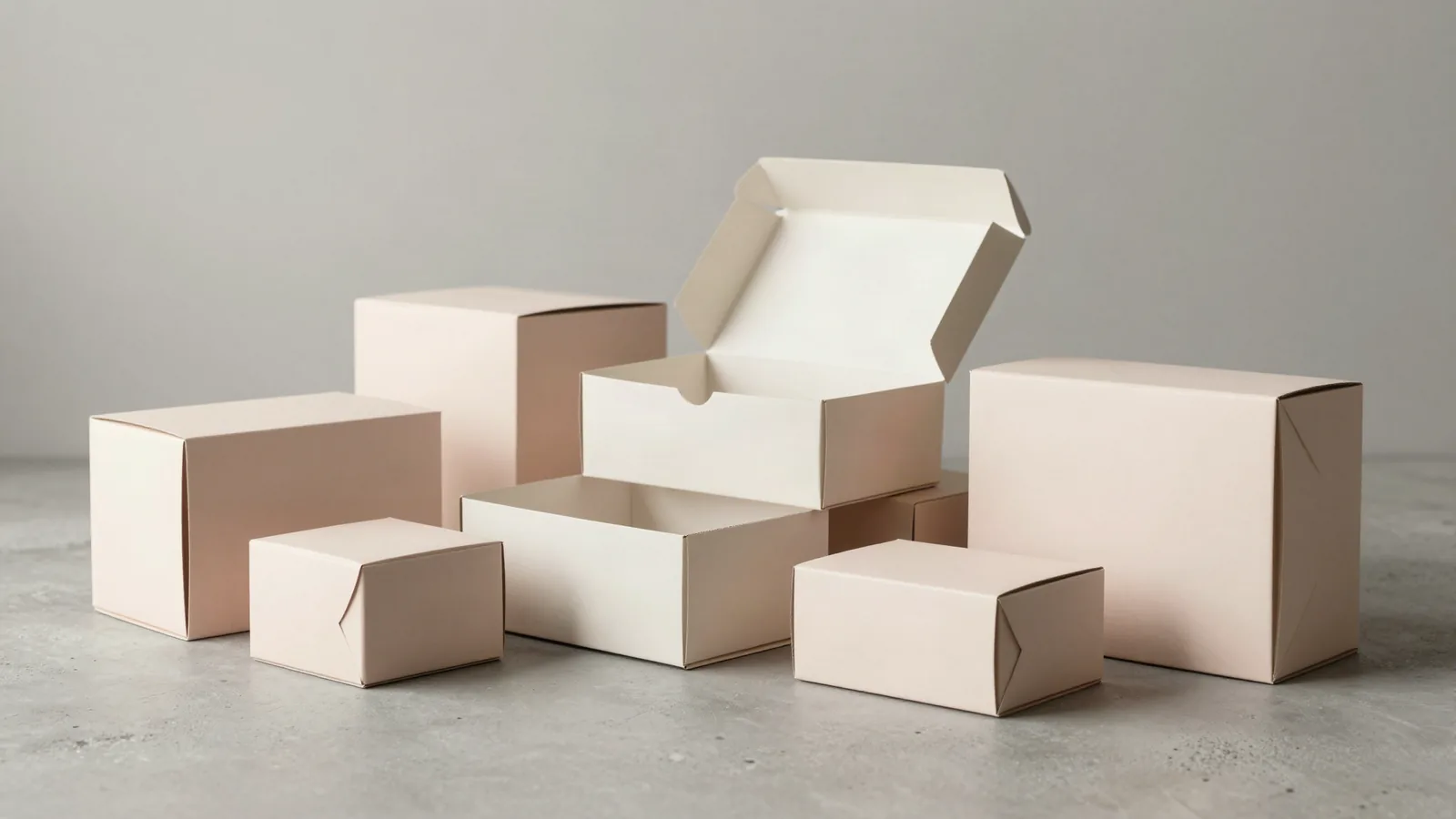




















































What should a set box company decide first?
The packed arrangement decides the box before the artwork does. A set box is one coordinated pack for two or more items, with each item placed in a planned order. List the products, their loading direction, the way the buyer removes them, and every insert, divider, wrap, or card that sits inside. A two-piece rigid set-up box separates a lid and base. A drawer or slide box creates a pull-out opening. A sleeve over separate cartons keeps several products under one printed outer layer.
Measure the packed products inside the proposed arrangement. Box dimensions are conventionally written as length x width x depth, and the inside measurement controls fit. About 1/16 in, or 1.5 mm, is a common planning tolerance reference. Product shape, board thickness, and insert compression can change the actual fit, so check the arrangement in a physical sample before approving the proof.
Which set box structure fits the opening?
The opening motion usually narrows the structure choice. A lid that lifts, a tray that slides, and a sleeve that pulls away create different access points for the buyer and different jobs for the packer.
| Structure | Typical use | What to check |
|---|---|---|
| Two-piece rigid | Gift sets and coordinated assortments | Lid fit, base clearance, and opening force |
| Drawer or slide | Curated kits and subscription-style reveals | Tray travel, stop position, and product removal |
| Sleeve over carton | Several inner packs under one outer design | Sleeve alignment and friction at the corners |
| Auto-lock or crash-lock | Retail and shipping-oriented sets | Bottom lock, fold order, and loading access |
What board should hold a coordinated set?
A folding carton commonly starts with SBS paperboard in the 12 to 24 pt range. C1S has one coated printable side, while C2S has coated surfaces on both sides, so the interior can carry graphics when the second coated side is useful. Kraft board is commonly found around 18 to 24 pt and gives a more fibrous surface. Rigid chipboard is a dense board that holds a box shape without a fold. A common rigid reference is 1.5 to 3 mm chipboard wrapped in 100 to 157 gsm art paper.
These are typical industry ranges, not a construction promise for every box. Caliper changes the edge feel, fold behavior, glue-tab width, and resistance to panel flex. A heavy product may need a different board discussion than a light set with a large printed lid. Confirm the board against the packed weight, insert contact points, and stacking arrangement.
How should an insert stop items moving?
The insert should control the places where products can slide, rattle, or rub. A custom foam insert creates dedicated cavities for uneven products. A paperboard partition is lighter and suits similarly shaped pieces that need separation. Draw the insert around contact points and the removal path, not only around the outside silhouette. An insert cut to the exact product size can make loading difficult, while an oversized cavity lets the product move.
For an upright bottle set, compare wine box packaging. For footwear or apparel assortments, review shoe box packaging as a fit reference. If a small metal component belongs in the set, an embossed tin box can be one component inside the wider presentation. The product arrangement still controls the final insert.
Which finishes fit the set without causing fold problems?
Matte and gloss lamination change sheen and surface protection. Soft-touch lamination changes the hand feel. Spot UV creates a hard glossy patch over a selected logo or pattern. Foil stamping adds a reflective mark. Embossing raises a surface area, while debossing presses it in. Put every finish on its own proof layer so the printer can see where it crosses a score, fold, glue tab, or edge.
Keep the finish plan consistent across the lid, base, sleeve, and insert unless the contrast is deliberate. A finish that looks right on a flat panel can crack along a score or make a glue area harder to bond. The proof should show the finish location, not a vague note about the coating.
What should a set box proof show?
The proof needs the full pack, not only the lid artwork. Check the dieline, which is the flat cutting template that marks cuts, folds, scores, glue tabs, and print panels. Review panel orientation, bleed, type near scores, insert clearance, label direction, and the order in which each item comes out.
- Confirm the inside length x width x depth and the packed product arrangement.
- Mark lid, base, sleeve, divider, insert, glue, and fold zones.
- Keep small type, barcodes, and important artwork away from scores and high-contact edges.
- Separate offset CMYK, digital print, lamination, spot UV, foil, embossing, and debossing instructions.
- Confirm whether the quoted scope includes the inside, outside, sleeve, insert, and any shipping protection.
Offset CMYK suits detailed paperboard graphics and repeated color across panels. Digital printing is often considered for short runs or artwork tests. Flexo is commonly associated with corrugated parts. The right print process follows the board, run, artwork, and surface rather than the name of the box.
How do I request a set box quote?
Send the item list, product measurements, target structure, artwork status, insert preference, and delivery destination. Add photos or a physical reference when a product has curves, closures, or fragile surfaces. For a reusable outer presentation, compare custom rigid set-up boxes with the folding structures above. Use custom packaging design for the planning route, then request the sample kit to check fit, board, finish, and opening force.
Custom Packaging Lane is a US-based packaging supplier. Projects start at a 100-unit minimum, with pricing from $0.49 per unit at volume, quoted to spec. Production is typically 8 to 10 business days after proof approval, plus delivery. Free US shipping, free design support, and a free dieline are available. The $19.99 sample kit is credited to the first order. Send the product arrangement before the proof is approved.
Frequently Asked Questions
Should a set box have a lid, drawer, or sleeve?
A lid suits a box opened from the top, a drawer suits a pull-out reveal, and a sleeve suits several inner packs that need one printed outer layer. The choice for a set box should follow product removal, insert access, pack-station loading, and the amount of movement inside the package.
What measurements control a coordinated set box?
The inside length, width, and depth of every packed item control a coordinated set box. Also record closures, rounded corners, handles, insert thickness, divider positions, and the removal path. Measure the complete arrangement in its loading orientation, because separate product measurements do not show how the items share the cavity.
Can a set box combine rigid and folding parts?
A set box can combine a rigid chipboard base, a folding carton, a paperboard divider, a sleeve, or a tin. Rigid chipboard is commonly referenced at 1.5 to 3 mm and can be wrapped in 100 to 157 gsm art paper. Each part still needs its own fit, fold, finish, and loading check.
How should finishes be coordinated across a set?
Coordinate finishes by panel and by handling point. Matte or gloss lamination sets the surface sheen, soft-touch changes hand feel, spot UV isolates a mark, and foil, embossing, or debossing adds a separate surface effect. Keep scores, glue tabs, and removal areas clear when the finish crosses several components.
What does a physical set box sample reveal?
A physical set box sample reveals fit, board stiffness, opening force, insert clearance, panel alignment, and the order of product removal. It can also show a bowed lid, a tight drawer, a loose cavity, or a finish crossing a fold. Check the full packed set, not only an empty box.












