












































































What should a test box hold?
The component list should be complete before the box drawing starts. A test box is a carton or case that keeps a defined kit together from pack-out to user opening. It may hold a device, strip, card, tube, pouch, instructions, collection item, or accessory, depending on the product brief. Decide what the user sees first, then record the opening sequence, internal position, removal path, information panels, and whether the box is a primary package or an outer presentation around another pack.
| Kit arrangement | Common structure | Design priority |
|---|---|---|
| Single component | Straight tuck end carton | Compact fit and clear information panel |
| Several loose components | Carton with paperboard insert | Position, separation, and removal order |
| Flat card or strip | Sleeve, reverse tuck end, or window carton | Visibility and protection from movement |
| Kit shipped in a larger pack | Crash-lock carton or corrugated shipper | Closure, packed protection, and outside dimensions |
How should a test kit open?
An insert gives each component a place before the user opens the package. A paperboard insert can create compartments, keep a card or strip visible, and stop small pieces from moving across the box. A sleeve can hold an inner tray, while a drawer or slide box can create a controlled reveal. If the package uses a window, decide whether it shows the product, the insert, or a selected panel.
Keep instructions and required information on panels that remain readable when the box is closed. Mark folds, glue zones, tuck flaps, insert edges, window patches, and closure areas before placing small copy. A filled pack-out check should confirm that one component can be removed without disturbing the others.
Which material and board range fits a test box?
SBS, C1S, and C2S paperboard in the 12 to 24 pt range are common folding-carton references. Kraft board around 18 to 24 pt is another option when the paper surface is part of the visual direction. A PET window is commonly about 0.2 to 0.3 mm thick. If the test box travels in a secondary shipper, corrugated E-flute, B-flute, or C-flute are common directions. ECT means edge crush test, and 32 ECT is a general board-strength reference.
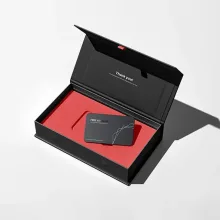
A rigid box uses chipboard around 1.5 to 3 mm wrapped in 100 to 157 gsm art paper, so it holds its shape without a fold. Separate that construction from the folding-carton specification because the lid, tray, wrap, and insert change the assembly. Choose the board around the component set, closure, print coverage, handling, and delivery configuration.
Which structure keeps components in place?
The closure and insert have to agree with the removal sequence. Straight tuck end and reverse tuck end cartons change the opening and panel arrangement. An auto-lock bottom creates a repeatable formed base, while a crash-lock structure gives a firm base after folding. A sleeve with an inner tray can create a controlled reveal. A drawer or slide, pillow, or gable shape changes the way the user reaches the kit.
Test the package with the actual component sizes and any protective wrap. Check whether one piece can come out without disturbing the others, whether the insert stays seated, and whether the closure can be understood from the printed panels. Similar-shaped parts need a clear order, especially when the information panel competes with the opening.
How should test box dimensions be checked?
Write length x width x depth twice: once for inside clearance and once for the outside packed size. Measure each component, the insert, and any local high points. About 1/16 in, or 1.5 mm, is a common planning tolerance reference. Then check the filled box for movement, removal, closure alignment, panel visibility, stacking, and fit inside the intended outer shipper.
For US ground planning, carrier dimensional weight is commonly discussed as L x W x H / 139 using the outside packed configuration. Record whether the test box ships flat, assembled, nested, or inside a corrugated shipper. The product box and the shipping arrangement should remain related but separate specifications.
How should test box printing and finishes be planned?
Print the instructions after the folds, glue zones, window patch, and closure are on the drawing. Offset CMYK suits detailed folding-carton artwork, and digital printing can suit short runs or an early packaging direction. Flexo is common for corrugated packaging. Matte or gloss lamination changes the surface appearance. Soft-touch, spot UV, foil stamping, embossing, and debossing can emphasize a logo or selected area. Keep component labels away from folds, glue zones, window patches, and closure movement.
RGB artwork can shift when converted for press, and low-resolution art stays soft. Leave bleed in the file and keep type away from scores. The digital proof should show the panel order, insert edge, window, finish layer, and reading direction before the filled kit reaches production.
Which CPL test-box products can I compare?
The catalog gives four relevant pack-out references. Compare vitamin test kits boxes for a compact component set, testosterone test kit boxes for a different kit arrangement, and pregnancy test kit boxes for another presentation direction. Health test kit boxes provide a broader catalog reference. These pages frame the discussion; the actual components and filled dimensions still set the final package.
What should I send in a test-box brief?
A pack-out sketch is worth more than a product name alone.
- List every component, instruction, insert, pouch, card, strip, tube, and accessory.
- Define the opening order, component visibility, removal path, and internal position.
- Provide product, inside, and outside measurements, including high points and clearance.
- Mark folds, closures, windows, insert edges, artwork-safe areas, and finish zones.
- Share the packed configuration, delivery destination, and secondary shipper requirements.
How do I request a test-box quote?
Once the filled kit passes a fit check, send the approved dimensions and artwork status through custom packaging for small business. Custom Packaging Lane is a US-based packaging supplier. Quotes are built to spec from a 100-unit minimum, with pricing from $0.49 per unit at volume, quoted to spec. Production is typically 8 to 10 business days after proof approval, plus delivery. Free US shipping and free design support are available, with a free dieline for the box. The $19.99 sample kit is credited toward the first order.
Frequently Asked Questions
What belongs in a test kit box?
A test kit box can hold a device, strip, card, tube, pouch, instructions, collection item, or accessory. The exact contents should be listed before the dieline is drawn. Add the count, orientation, opening order, insert requirement, internal clearance, information panels, and shipping arrangement so the box matches the filled kit.
How do I stop test-kit parts from moving?
A paperboard insert can give each component a fixed compartment and a defined removal path. Measure local high points, check the insert edge, and test the filled package. The useful test is simple: remove one item without disturbing the others, then close the box and confirm the insert stays seated.
Should I use a folding carton or a rigid test box?
A folding carton ships flat and folds at scores, while a rigid box holds its shape without a fold. Rigid construction commonly uses chipboard around 1.5 to 3 mm wrapped in 100 to 157 gsm art paper. Compare assembly, lid or tray design, component access, print surface, and shipping arrangement.
What does a PET window add to a test box?
A PET window is commonly discussed around 0.2 to 0.3 mm thick and can show a selected component, insert, or panel. The opening must be checked against the board, folds, patch area, and information layout. Test visibility and component movement with the filled package before the window position is approved.
How should the packed carton be measured for shipping?
Measure the filled carton as length x width x depth, record inside clearance and outside size, and use about 1/16 in, or 1.5 mm, as a general tolerance reference. For US ground planning, dimensional weight is commonly discussed as L x W x H / 139. Check the box inside its intended outer shipper before finalizing the structure.