




























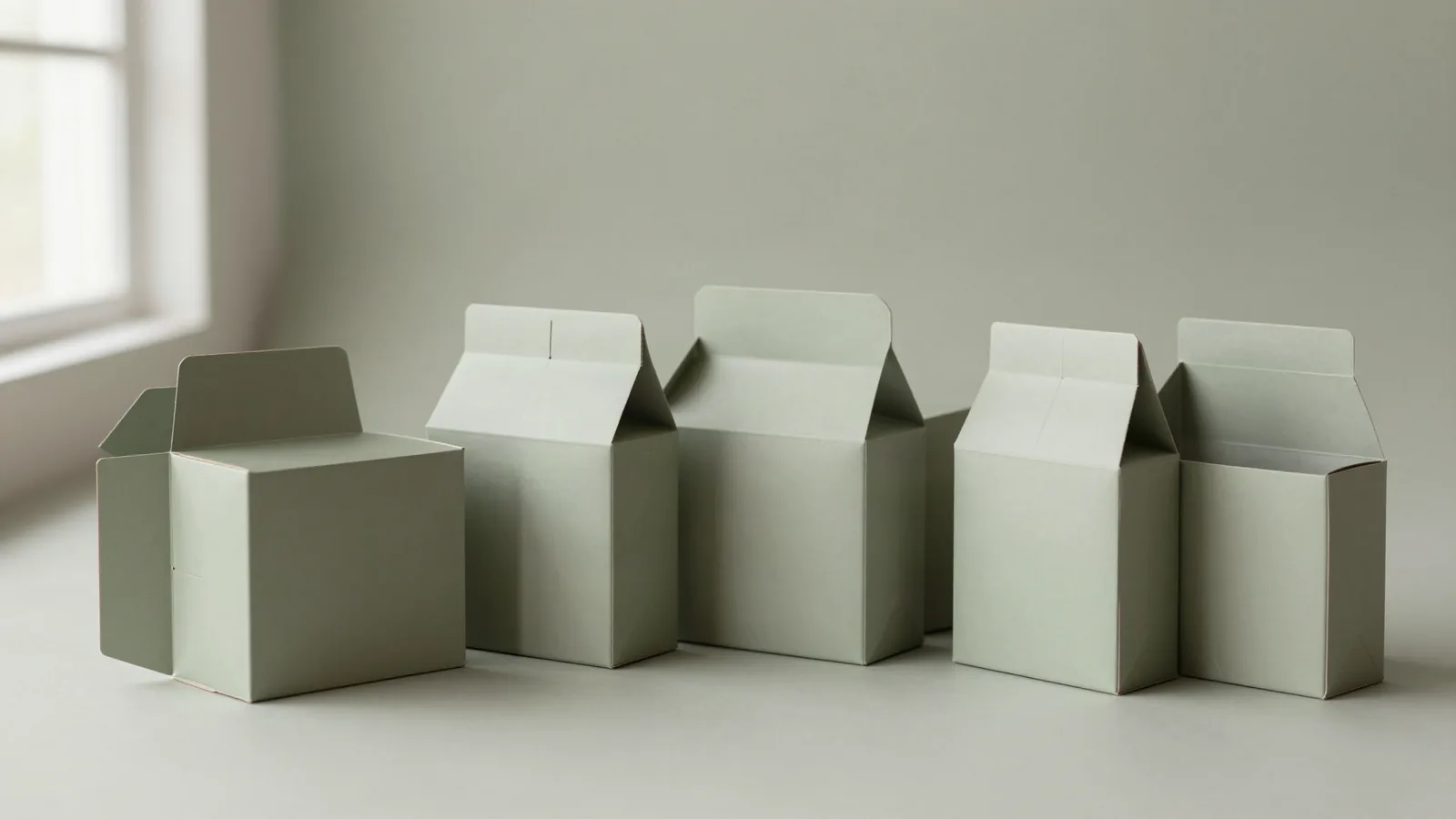




















































A tuck box is a folding carton that closes with flaps tucked into the body. Tuck end is the family term. Straight tuck and reverse tuck name two different flap arrangements. A dieline is the flat cutting template used to print, cut, score, and fold the carton. That file sets the panel order, glue flap, cut lines, scores, and closure direction before a proof is approved.
What is the difference between a straight tuck box and a reverse tuck box?
A straight tuck box has top and bottom tuck flaps that fold in the same direction, while a reverse tuck box has the two end closures folding in opposite directions. That changes how the carton loads, where the opening appears, and how the front panel sits when the box is closed. The names describe the closure. They do not replace the product dimensions or the full dieline.
On a straight tuck carton, the opening sequence is easier to follow when both ends use the same general fold direction. A reverse tuck carton changes the end sequence, which can affect how a packer reaches into the box and how the printed panels face the buyer. The assembled proof should show both ends, not just the flat artwork.
How should a buyer compare tuck box styles on a proof?
Read the flap direction first, then check the score lines, glue seam, front panel, and packed product position. The proof is where a box stops being a label and becomes a physical plan.
| Style | Flap arrangement | Practical difference | Proof check |
|---|---|---|---|
| Straight tuck | Top and bottom flaps fold in the same direction | One end direction guides loading and closing | Flap clearance, front panel, score position, and glue seam |
| Reverse tuck | Top and bottom flaps fold in opposite directions | Each end has its own opening sequence | Both ends, panel alignment, and closing order |
| Tuck top | The top flap tucks into the carton body | The upper opening gets its own presentation role | Top flap fit, bottom construction, and product loading |
| Tuck end | A broad family term for tuck flap closures | The exact flap direction still needs a specific name | Construction label, complete dieline, and assembled view |
What does tuck end box mean in a product search?
Tuck end box is a broad construction label, not a complete product brief. A search for tuck end may lead to straight tuck, reverse tuck, tuck top, or another carton with a tuck closure. Add the product and the intended opening direction before treating the term as final. A candle box, gift box, or hair extension box may share tuck language while using a different layout.
Which CPL product pages show tuck construction?
The CPL catalog gives four useful references with different product and construction cues. Roll-end tuck front boxes use a roll-end body with a tuck front, so they should not be treated as interchangeable with straight tuck or reverse tuck. Reverse tuck candle boxes keep the reverse tuck term attached to a product category. One-piece color tinted kraft tuck top gift boxes put the tuck top and gift context together. Hair extension tuck boxes show how the packed product narrows the search.
What should the dieline and digital proof catch?
A digital proof should settle the physical questions before anything prints. Bleed is artwork that extends past the cut line, so trimming does not leave a white edge. Keep type and fine lines away from scores and glue tabs. RGB artwork can shift when it is converted for press, especially where the file uses heavy ink coverage. A barcode also needs its quiet zone, the clear space around the bars, and enough physical size to scan.
- Check the packed product dimensions against the folded panels.
- Check the front panel after every score and fold.
- Check that glue tabs do not cover artwork or instructions.
- Check bleed, color conversion, barcode space, and small type.
How do board and finish change the same tuck style?
Flap direction stays the same, but board and finish change the carton in the hand. Kraft board shows its brown paper base. White board gives printed colors a cleaner background. Matte lamination cuts surface glare, while gloss lamination reflects more light and makes color look sharper. Spot UV adds gloss to a selected area. Foil adds a metallic surface, and embossing raises the board. Keep any heavy finish away from scores and folds unless the printer confirms the treatment works there.
What terms apply when you order tuck boxes?
The MOQ is 100 units. Pricing is from $0.49 per unit at volume, quoted to spec. Production is typically 8 to 10 business days after proof approval, plus delivery. Free US shipping and free design support are available. We draw the dieline free and send a digital proof before anything prints. Order the $19.99 sample kit to compare physical references, then use custom packaging solutions to send the product dimensions, packed item, artwork, quantity, and destination.
Frequently Asked Questions
Do straight tuck and reverse tuck boxes close the same way?
Straight tuck and reverse tuck boxes differ in the direction of their end flaps. In a straight tuck construction, the top and bottom tuck flaps fold in the same direction. In a reverse tuck construction, they fold in opposite directions. That changes the loading sequence, closure view, and proof checks, so the assembled carton matters more than the shorthand label.
Is tuck end a style or a family term?
A tuck end box is the broader family term for a folding carton that closes with tuck flaps. Straight tuck and reverse tuck are more specific flap arrangements inside that family. A tuck top label describes the top opening, so the final request should record the exact flap direction, product, dieline, material, finish, quantity, and destination.
Which CPL products can I use as tuck box references?
Useful CPL references include roll-end tuck front boxes, reverse tuck candle boxes, one-piece color tinted kraft tuck top gift boxes, and hair extension tuck boxes. These pages anchor different construction or product terms. They do not make the styles interchangeable, so the final selection still needs a product profile and approved artwork.
What should I send before a tuck box proof?
Before a tuck box proof, send the packed product dimensions, preferred flap direction, front panel, artwork, material, finish, quantity, and destination. CPL provides free design support, draws the dieline, and sends a digital proof before anything prints. Check bleed, score placement, glue tabs, and text position on that proof.
What is the MOQ and timing for custom tuck boxes?
Custom tuck boxes have a MOQ of 100 units. Pricing is from $0.49 per unit at volume, quoted to spec. Production is typically 8 to 10 business days after proof approval, plus delivery. Free US shipping, free design support, and a $19.99 sample kit are available.












