




























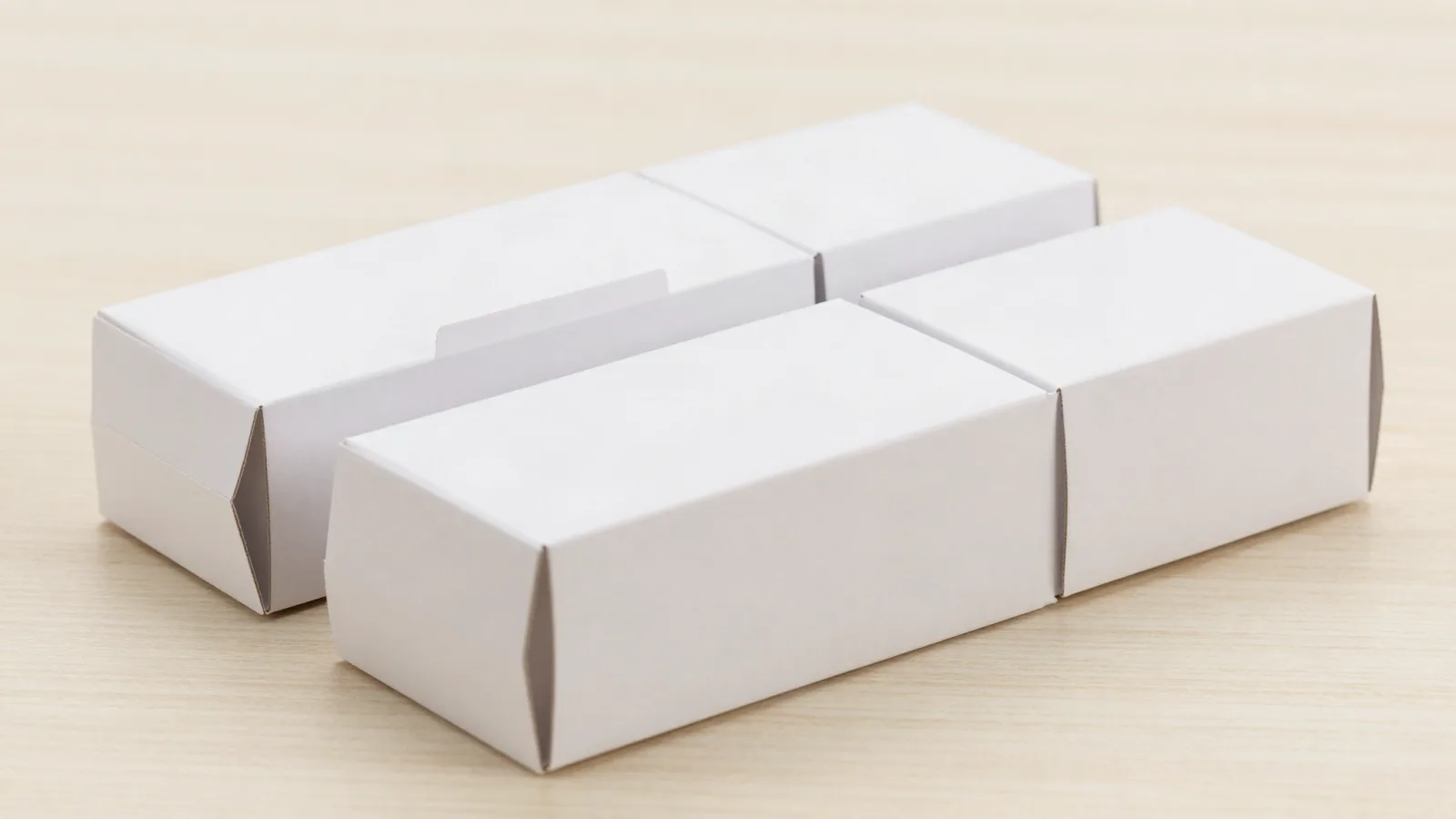




















































Tuck box packaging is a folding carton whose panels close through tuck flaps at one or both ends. A reverse tuck end box uses opposing tuck directions, while a straight tuck end box uses the same general direction. A dieline is the flat template used to print, cut, and crease the carton.
The closure label belongs beside the packed product dimensions, board direction, artwork, and finish. Buyers searching for reverse tuck end box, straight tuck end box, tuck top boxes custom, or tuck box dimensions are asking for related structures, but the physical opening still needs to be named.
How are reverse and straight tuck end boxes different?
A reverse tuck end box has opposing tuck directions at its two ends. A straight tuck end box has the same general tuck direction. The difference changes the panel order, opening end, and way the carton sits at the packing table.
| Carton label | Structural description | Proof check |
|---|---|---|
| Reverse tuck end box | Opposing tuck directions | Show both ends and the opening face |
| Straight tuck end box | Same general tuck direction | Keep front, back, top, and bottom aligned |
| Custom tuck-top box | Top access with a specified base | Confirm top clearance and closing sequence |
| Roll end tuck front | Rolled body with a front tuck | Separate the front panel from the side folds |
Name the closure from the carton you want built. A loose phrase such as tuck top can leave the opening, base, and product orientation unclear. Put the selected direction in the quote and carry it into the proof.
What tuck box dimensions should you use to plan?
Use inside dimensions for early tuck box planning, written as width x depth x height. The published references below compare proportions, not universal stock sizes. Measure the packed product in its loading orientation, then confirm the final dieline around the actual board, folds, tuck depth, and closure clearance.
| Planning format | Inside reference | Metric reference | Early use |
|---|---|---|---|
| Small vertical | 2 x 2 x 4 in | 51 x 51 x 102 mm | Compact item or upright presentation |
| Tall retail | 3 x 2 x 6 in | 76 x 51 x 152 mm | Tall product with a front panel |
| Long format | 4 x 3 x 8 in | 102 x 76 x 203 mm | Long item or end-opening presentation |
| Shallow display | 6 x 4 x 2 in | 152 x 102 x 51 mm | Flat product or gift presentation |
| Broad format | 8 x 5 x 2 in | 203 x 127 x 51 mm | Multi-item presentation |
Label every measurement as inside or outside. Include a sleeve, wrap, insert, tray, or component that remains inside the carton. The packed object sets the usable cavity. The board and folds set the outside footprint.
Which paperboard weights fit tuck cartons?
SBS cardstock from 16 to 24 pt is a published carton direction for tuck packaging. SBS is a smooth paperboard stock used for printed folding cartons. Kraft, metallic paper, pearl card, box board card, holographic, black kraft, textured paper, and white stock create different surface and print choices.
| Material field | Published direction | What to confirm |
|---|---|---|
| SBS cardstock | 16 to 24 pt | Selected weight, folds, print, and closure |
| Corrugated | E, B, or AB flute | Flute direction and assembled carton use |
| Paper surface | Kraft, metallic, pearl, holographic, textured, or white | Print contrast and finish placement |
Corrugated flute changes thickness, stiffness, and the way artwork sits across a fold. E-flute gives a finer printed surface than B-flute, while AB-flute adds a thicker wall direction. Confirm the board and flute in the project record instead of treating the material label as the full spec.
When should you choose reverse tuck or straight tuck?
Choose reverse tuck when opposing end directions suit the packing sequence, and choose straight tuck when the same general direction works at both ends. The product length, loading side, shelf orientation, and hand movement decide the practical choice. Neither label replaces a closed and open proof.
Check the tuck flaps against the product and any insert. Type set too close to a score can fold into the closure. Missing bleed can leave a white edge after cutting. Low-resolution art and RGB files can also change the printed result after prepress conversion.
Which CPL products show related tuck constructions?
Wine box packaging gives an upright product reference. Shoe box packaging shows a broader product envelope. gives a category-specific carton reference, while wax packaging covers a compact product direction. Roll end tuck front boxes show a related tuck construction.
What should a tuck box proof show?
A tuck box proof should show the flat carton, the assembled carton, both ends, the opening face, the packed product, and the artwork after folding.
- Inside or outside dimensions, with the measurement label stated.
- Front, back, top, bottom, side panels, scores, glue areas, and tuck flaps.
- Product orientation, insert, wrap, tray, or component that remains inside.
- Bleed, logo placement, copy, color conversion, and finish areas.
- Artwork version, quantity, destination, and approval record.
What are the MOQ, price, and production terms?
The MOQ is 100 units. Pricing is from $0.49 per unit at volume, quoted to spec. Production is typically 8 to 10 business days after proof approval, plus delivery. Free US shipping and free design support are available. The $19.99 sample kit is credited toward the first order. Use custom packaging design when the carton needs a broader artwork brief.
Frequently Asked Questions
Which tuck end should open from the front?
The tuck end that opens from the front should match the selected reverse tuck, straight tuck, or tuck-top construction and the way the product is loaded. State the opening face, product orientation, and insert in the quote. The digital proof should show the carton open and closed from the packing side.
Are the listed tuck box dimensions inside or outside?
The listed tuck box dimensions are inside planning references, written as width x depth x height. They include 2 x 2 x 4 in, 3 x 2 x 6 in, 4 x 3 x 8 in, 6 x 4 x 2 in, and 8 x 5 x 2 in. Confirm the final outside size after board and folds are set.
Can tuck cartons use corrugated board?
Tuck cartons can be discussed with corrugated E, B, or AB flute directions when the product and assembled use support that choice. Flute changes wall thickness, stiffness, and print behavior. Confirm the flute direction, product cavity, folds, tuck depth, artwork, and finish in the proof.
Can custom tuck boxes have a window or insert?
Custom tuck boxes can be planned with a window or insert when the opening, product position, scores, and closure leave enough room. The window must be mapped around the artwork and fold lines. The insert should be checked with the packed product so it does not block the tuck or make loading tight.
What are the commercial terms for custom tuck boxes?
The commercial terms for custom tuck boxes include a 100-unit MOQ and pricing from $0.49 per unit at volume, quoted to spec. Production is typically 8 to 10 business days after proof approval, plus delivery. Free US shipping and free design support are available, and the $19.99 sample kit is credited toward the first order.












