


























































What are waxed boxes made from?
Waxed boxes are paperboard packages with a wax-coated finish selected for added resistance to incidental moisture. Wax is a surface treatment, not a box shape. The board still has scores, folds, seams, openings, cut edges, and closure points. Custom Packaging Lane's material catalog includes wax-coated finishes for food and produce box projects, quoted to spec. If a product may touch the package, ask us about food-contact options for your product before the material and wording are approved.
Where does a wax coating help?
A wax coating helps most when the brief calls out light surface moisture, brief condensation, or handling where untreated paperboard is not the preferred direction. The treated face can slow moisture contact compared with an untreated face. Exposure still matters. Pressure, abrasion, temperature, repeated wetting, and long contact can affect the finished box, so the quote should describe the real use.
| Use condition | Wax-coated board behavior | Quote detail |
|---|---|---|
| Light surface moisture | Treated faces have added resistance to incidental moisture | List exterior panels, print coverage, and exposed edges |
| Condensation | Moisture can collect at folds, seams, and the base | Describe where the package sits and how it is handled |
| Food or produce contents | Contact needs its own material discussion | Ask about food-contact options for the product |
| Retail display | Wax changes surface feel and can affect print treatment | Confirm artwork, opening, visibility, and display position |
What changes at seams and folds?
Waxed paperboard does not behave as one continuous coated sheet after conversion. Scores compress the board. Folds bend it. Glue tabs join panels. Cut edges expose the board. A wax coating can also change how ink and adhesive sit on the surface, so the finish callout should be checked against the print and assembly plan.
Put the finish note on the flat layout. Keep type away from scores, leave bleed beyond the cut line, and mark the seam, closure, base, and inner wall. A barcode that crosses a fold is a prepress problem, not a shipping problem. Catch it on the digital proof.
Are waxed boxes waterproof?
Waxed boxes should not be described as universally waterproof. A wax-coated surface is a paperboard direction for a stated moisture-resistance need. The result can differ across broad panels, corners, seams, folds, openings, and closures. If the box faces more than incidental moisture, describe the duration, contact point, storage setting, and handling route before the finish is quoted.
Which box formats should I compare?
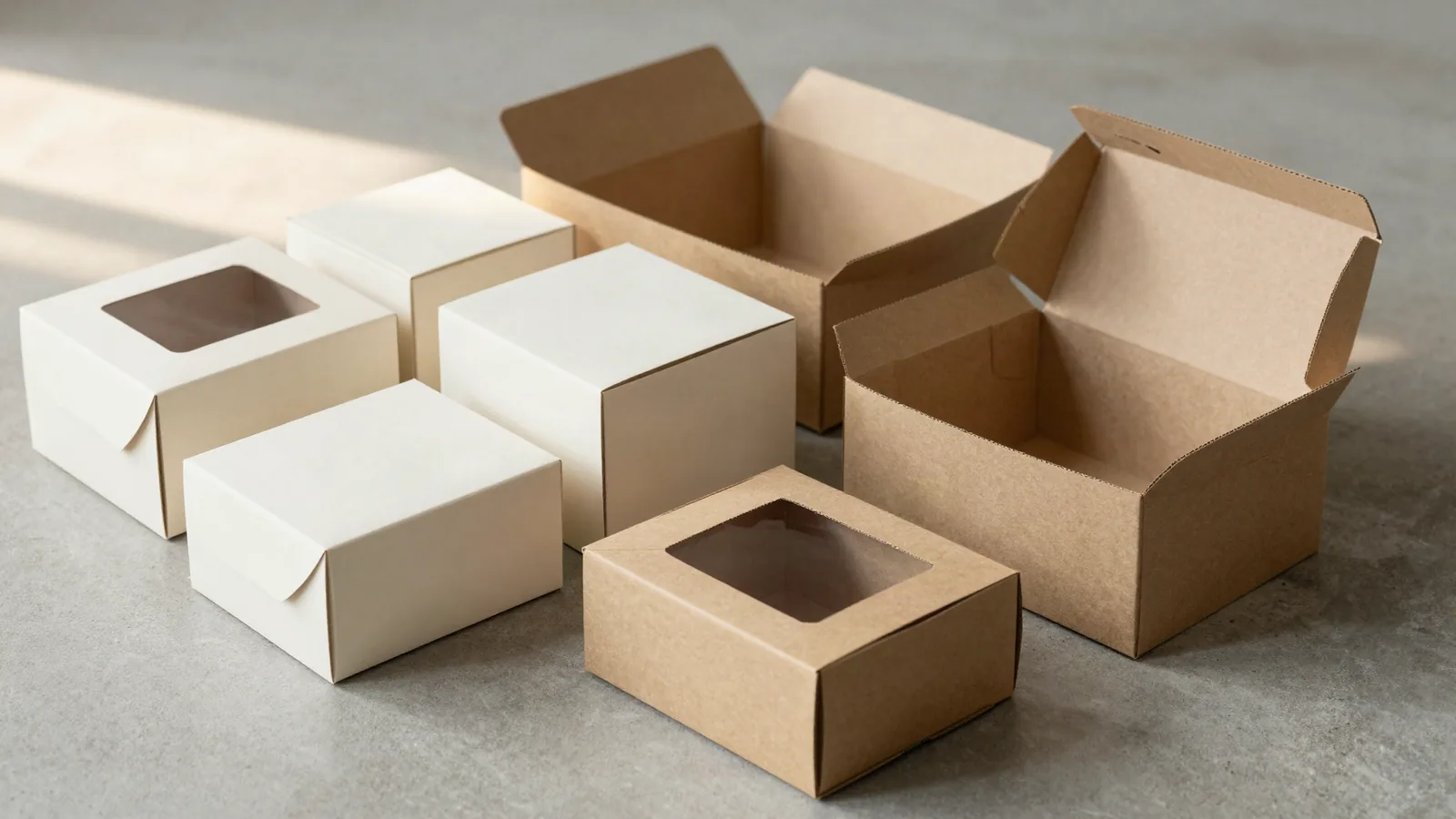
Choose the structure from the product, opening sequence, and display requirement. Compare window soap boxes, window display boxes, and window boxes when product visibility and panel placement matter. For a different food-related format, review waffle boxes. These product pages frame box styles. The wax-coated board, coverage, artwork, and use conditions still need a project quote.
What should food and produce buyers ask about?
Food and produce buyers should state the contents, fill process, contact surface, storage conditions, and expected moisture exposure. If any part of the box may touch the product, ask us about food-contact options before choosing the wax-coated finish. Do not infer contact suitability from the word waxed, the product category, or a general coating description.
Also describe how the box is opened and emptied. A hand-packed carton, a display box, and a box handled through a shipping workflow place different demands on scores, tabs, and closures. Those details belong beside the material request.
How should I prepare a waxed box quote?
Send the assembled dimensions, box style, opening direction, product description, artwork status, expected moisture exposure, finish preference, quantity, and destination. A dieline is the flat cutting template used to print, cut, and fold the box. With free design support, we draw it from the product dimensions and send a digital proof before anything prints.
The MOQ is 100 units. Pricing may be from $0.49 per unit at volume, quoted to spec. Production is typically 8 to 10 business days after proof approval, plus delivery. Free US shipping and free design support are available. For quantity planning, use wholesale custom packaging. To compare surface feel and folding behavior, order the $19.99 sample kit before proof approval.
How can waxed cardboard box suppliers be compared for shipping jobs?
Converted-sample results, exact board callouts, and pallet records provide the clearest supplier comparison. Compare 32 ECT single-wall, E, B, or C flute, liner combinations, and the converted case under the planned load. The 48 x 40 in Grocery Manufacturers Association, or GMA, pallet is a common US footprint. The table lists trade references, not Custom Packaging Lane order data.
| Control point | Common industry reference | Purchasing use |
|---|---|---|
| Corrugated strength | 32 ECT single-wall | Shipping-case comparison baseline |
| E-flute | Broad print panels and folds | Inspect solid coverage and score cracking |
| B-flute | Die-cut edges and corners | Inspect puncture exposure and cut quality |
| C-flute | Packed cushioning and storage | Check product support and case footprint |
| Pallet footprint | 48 x 40 in GMA pallet | Pattern, overhang, and stack planning |
A 32 ECT callout alone is incomplete. Liners, box dimensions, wax coverage, seam, stacking orientation, and packed weight still affect performance. On a regular slotted case, equal-depth outer flaps meet along the center seam. A full-overlap slotted case uses longer outer flaps that nearly cover the opening, adding board layers across the top and bottom panels.
Which print process should a waxed cardboard supplier quote?
Flexographic printing is the usual starting point for corrugated cases, offset printing handles detailed paperboard graphics, and digital printing supports short or versioned runs. The production specification should identify the print sequence, ink system, drying method, wax coverage, and approved color target as separate choices.
For flexographic work, check solid ink density, color-to-color registration, trapping, fine reversed type, and barcode orientation on the press sheet. Trapping is the slight overlap between adjacent colors that prevents a white gap when registration shifts. A barcode quiet zone is the blank margin around the code, so keep it clear on the printed and converted sample. Repeat the rub check across a broad panel, a fold, and an area next to the wax boundary.
What should a supplier sample prove before production?
A production sample should confirm packed fit, opening force, panel flatness, printed color, and case-pack orientation under the intended environment. Record gross packed weight, product movement after handling, panel bow, stack alignment, and the force needed to open and close the box. Handwritten lot marks or labels should also be tried on the actual waxed surface if the packing line uses them.
Use custom packaging solutions to frame the print and distribution scope. A sample kit can establish a common physical vocabulary when suppliers use different names for a surface. Tie final approval to the production sample ID and artwork revision so the finished run has one dated reference.
How do case pack and pallet plans change the box order?
Flat-pack orientation, master-carton count, pallet pattern, and packed weight can change freight and storage requirements before the waxed boxes are used. Set the master-carton count from the flat blank size, bundle height, packing direction, and gross weight. Then place the case on the planned pallet footprint and check overhang, compression direction, and total stack height.
The distribution comparison should include the number of boxes per bundle, bundles per master carton, master cartons per pallet, and orientation of every layer. Cardboard display boxes need the display face protected in the bundle, while cardboard boxes with inserts add loose components that may require separate packing counts.
Frequently Asked Questions
What does wax coating do to paperboard?
Wax coating adds a treated surface to paperboard and can increase resistance to incidental moisture on the covered face. It does not remove the need to specify scores, folds, seams, openings, cut edges, or closures. Wax can also change surface feel and affect ink or adhesive planning, so the finish belongs in the material and proof notes.
Do waxed boxes work for direct food contact?
A waxed box that may touch food needs a product-specific material discussion. Ask Custom Packaging Lane about food-contact options for your product before choosing the finish or approving artwork. Do not infer contact suitability from the word waxed, the box category, or a general coating description. State the contents, contact surface, filling method, and storage conditions.
Can waxed boxes go through folds and seams?
Waxed boxes still use scores, folds, glue tabs, seams, openings, and cut edges, and each area can behave differently from a broad coated panel. Put the finish note on the dieline and check the closure, seam, base, and inner wall on the digital proof. The intended moisture exposure belongs in the quote.
Which formats can I compare for a waxed box?
Waxed box format comparisons can include window soap boxes, window display boxes, window boxes, and waffle boxes. Each structure changes panel placement, visibility, opening direction, and assembly. Those product pages frame box styles, but the wax-coated board, finish coverage, artwork, product contact, and moisture exposure still need a project-specific quote.
What is the MOQ for custom waxed boxes?
Custom waxed boxes have a 100-unit MOQ. Pricing may be from $0.49 per unit at volume, quoted to spec. Production is typically 8 to 10 business days after proof approval, plus delivery. Free US shipping and free design support are available, and the sample kit is $19.99.