




























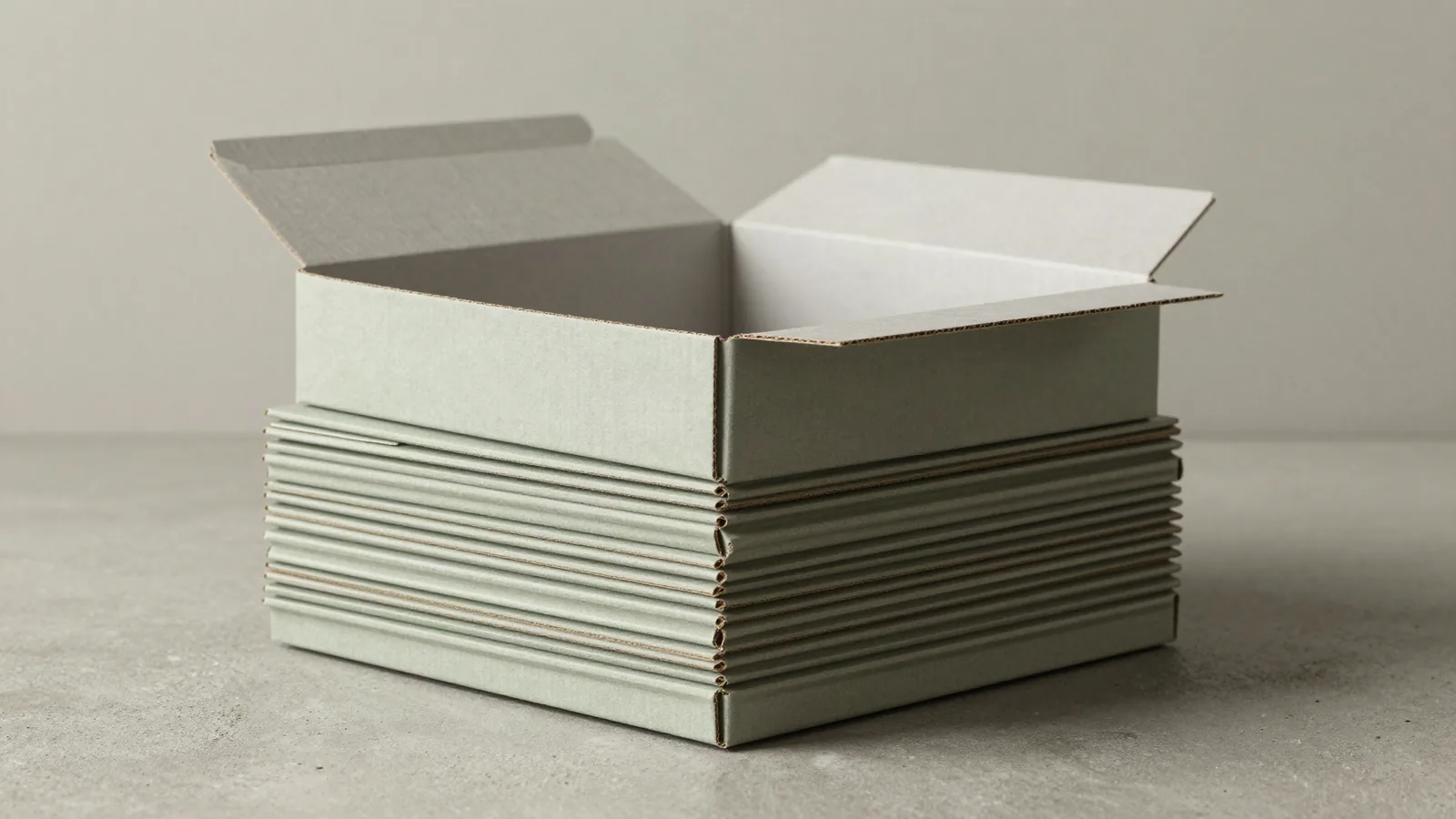




















































Wedding cake tasting box shipping has two jobs: present the tasting set clearly and survive the parcel route. A shipper is the outer carton used for transit. It may be the branded tasting box itself, or it may surround a separate presentation box. Start with custom shipping boxes and custom folding shipping boxes when the outside route needs to be planned before the inside layout.
What does a carrier need to see outside the tasting set?
Dimensional weight starts with the packed outside carton, not the cake pieces alone. Record the outside length, width, and height after the insert, cake board, card, wrap, and inner presentation box are in place. Mark the label panel, closure, seams, corners, and any space that remains empty. The recipient sees the opening sequence, but the carrier handles the carton as a cube with edges, folds, and a label surface.
When should I use one parcel carton or two packages?
One package combines the reveal and transit shell, while two packages assign those jobs to separate cartons. A single mailer reduces the number of components to check, but its printed panels, closure, insert, and outside corners all travel together. A presentation box inside a shipper gives the inner box its own lid, tray, or sleeve, while the outer carton takes the parcel handling. Two packages require two dimension sets, two closure reviews, and a measured clearance around the inner box.
| Package setup | Transit layer | Measurements to record | Presentation question |
|---|---|---|---|
| One mailer | Printed box is also the shipper | Outside length, width, height, and closure clearance | Does the opening survive parcel handling? |
| Presentation box inside shipper | Separate outer carton | Inner box, outer box, and clearance between them | Can the branded box open without carrier labels on it? |
| Corrugated outer carton | E, B, or C flute shell | Outer carton size, board reference, and insert fit | Where does the tasting box sit inside the shell? |
| Insert-led carton | Tray or divider fixed to the package | Each cavity, divider height, and lid clearance | Does every piece stay in its assigned position? |
How does a mailer structure change the opening?
FEFCO 0427 is a roll end tuck top mailer reference with a defined folding opening. A folding shipping carton can use a straight tuck, reverse tuck, or another closure path. A rigid presentation box inside an outer shipper creates a separate reveal. Compare the tuck, sleeve, lid, tray, seam, and label areas on the dieline before choosing the format. Tall cake boxes are a useful cake-format reference, but the packed parcel still needs its own outside measurements.
How should I calculate the space a carrier sees?
For US ground shipping, dimensional weight commonly uses the standard formula L x W x H / 139. Measure the outside carton after the cake board, insert, presentation box, card, and wrap are packed. Keep the product fit and the shipping cube in separate notes. A tight carton can reduce unused space, but the closure still needs room to fold and the insert still needs room to hold each tasting piece.
What should the insert control during delivery?
The insert should fix each tasting piece in its assigned cavity before the lid closes. Map every cavity, divider, tray edge, card slot, and removal path. About 1/16 in, or 1.5 mm, is a common packaging tolerance reference, but the finished clearance follows the piece shape, folds, board thickness, and closure. Custom foam box inserts are a useful comparison when shaped support or separated zones matter. If a cake sample may touch an interior surface, ask us about food-contact options.
Which board and flute references belong on the shipping side?
Board choice changes thickness, print surface, fold behavior, and stacking performance. Folding cartons commonly reference SBS, C1S, or C2S paperboard in the 12 to 24 pt range. Kraft board in the 18 to 24 pt range gives a different surface direction. A flute is the corrugated paper wave inside a shipping board. E, B, and C flutes are common references, and 32 ECT, meaning edge crush test, is a familiar shipping-board specification. A rigid presentation box commonly uses 1.5 to 3 mm chipboard wrapped in 100 to 157 gsm art paper. These are general packaging references, not CPL order data.
How should parcel artwork be separated from presentation artwork?
Keep carrier-facing information on the shipping layer and the tasting message on the presentation layer. Offset CMYK is commonly used for detailed paperboard artwork, while digital printing can suit a short run or artwork test. Matte or gloss lamination changes the surface. Soft-touch, spot UV, foil stamping, embossing, and debossing can sit on a selected presentation panel. Convert RGB artwork before press review because color can shift during conversion, keep type away from scores and glue tabs, and show bleed on the dieline.
What belongs in the shipping-side dieline brief?
A dieline is the flat cutting template used to print, score, and cut the package. Put these decisions on the same brief:
- Separate the tasting layout, inner presentation box, and outer shipper.
- Show cavities, tray, divider, card, wrap, lid clearance, and orientation.
- Choose a mailer, folding shipper, corrugated outer, rigid box, or combined construction.
- State flute, board, print coverage, finish, closure, seam, and label areas.
- Provide packed dimensions, destination, and shipping zone.
CPL quotes wedding cake tasting box shipping to spec from a 100-unit minimum. Pricing is from $0.49 per unit at volume, quoted to spec, with board caliper, print coverage, finishing, quantity breaks, tooling, and shipping zone considered in the scope. Production is typically 8 to 10 business days after proof approval, plus delivery. Free US shipping and free design support are available, and a free dieline is included. The $19.99 sample kit is credited to the first order. Use custom packaging solutions when the presentation and parcel plans need to be scoped together.
Frequently Asked Questions
Can my branded tasting box ship as the outer carton?
A branded tasting box can also act as the outer carton when its closure, printed panels, insert, and corners are planned for the parcel route. A separate shipper is another option when the presentation box needs a cleaner reveal. Compare the packed dimensions, label panel, insert clearance, and opening path before choosing.
What does FEFCO 0427 mean for a tasting shipment?
FEFCO 0427 is a standard reference for a roll end tuck top mailer. The structure combines a folding body with a defined tuck opening. Review the mailer's packed length, width, height, insert, closure, label panel, and print area before treating the reference as a finished package specification.
Does the tasting box count toward dimensional weight?
The outside package used for transit is the measurement that matters for dimensional weight. For US ground shipping, a common carrier formula is L x W x H / 139. Measure the packed outer carton after the inner box, cake board, card, wrap, and insert are in place, then compare that cube with the actual product fit.
Is E-flute or B-flute better for a cake tasting shipper?
E-flute and B-flute are corrugated references with different thickness and print behavior. E-flute is commonly chosen when a finer printed surface matters, while B-flute gives a thicker profile for a shipping carton. Review the outside package, packed dimensions, insert, handling route, and required printed area together.
What details should I send for tasting box shipping?
Send the tasting piece layout, cake board size, insert, card, inner wrap, presentation box, outer shipper, packed dimensions, opening path, board, print coverage, finish, quantity, destination, and shipping zone. State whether the inner box ships inside another carton. That distinction separates presentation fit from parcel fit and label placement.












