










































































What does cabinetry packaging need to protect?
A door, drawer front, trim piece, handle set, hinge kit, or hardware bundle needs a package built around its contact points, exposed finish, and handling route. Start with the part's length, width, and depth, then mark surfaces that can touch board, foam, dividers, and the outer carton.
Corrugated board is paperboard with a fluted, wave-shaped layer between liner sheets. E flute is thinner and prints finer detail, while B and C flutes add more space and structure for larger packs. The 32 ECT reference, where ECT means edge crush test, describes a common edge crush strength grade for corrugated board. These are industry references, so the part weight, stacking load, and route still determine the board choice.
Which cabinetry package structure fits the part?
A mailer carton suits a smaller kit, while a corrugated shipper, sleeve with insert, or rigid format handles a different contact and handling problem.
| Package format | Typical cabinetry use | First check |
|---|---|---|
| Mailer carton | Trim or hardware kits | Can corners stay restrained? |
| Corrugated shipper | Larger panels | What load reaches the stack? |
| Sleeve and insert | Finished faces | Where can abrasion occur? |
| Two-piece rigid | Samples and presentation kits | Does the lid and base keep the part organized? |
| Drawer or slide | Hardware presentation | Is the opening path easy to follow? |
Common carton structures include mailers, sleeves, two-piece rigid boxes, drawer or slide boxes, straight tuck end cartons, and auto-lock bottom cartons. A roll end tuck top mailer is a parcel-oriented structure often discussed under the FEFCO 0427 reference. For a finished panel, a sleeve alone may leave edges exposed, so pair it with corner protection, a divider, or a fitted insert after the contact map is drawn.
How should inserts and cushioning be specified?
The insert should restrain the part without putting a hard point against a painted, laminated, or wrapped face. A custom foam insert is a shaped foam piece cut to hold a part in repeatable position. Use a paperboard divider for separation, corrugated pads for simple spacing, foam or molded pulp for shaped support, and edge blocks where corners need a buffer.
Draw the contact map before cutting an insert. An insert cut to the exact product size can make the product rattle when coatings, handles, or hardware change the fit, so test the filled pack instead of trusting the screen.
Write packed dimensions as length x width x depth and label them as inside measurements or outside measurements. A common fit convention is about 1/16 inch, or 1.5 mm, around the intended fit. Cabinetry parts still need a physical pack test because coatings and protruding hardware change the contact pattern. For parcel planning, the common US ground dimensional-weight convention is L x W x H / 139. That formula is a planning standard, not a shipping quote.
Which materials and finishes work for cabinetry brands?
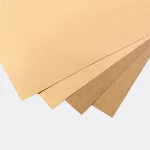
SBS or C1S paperboard, where C1S means coated one side, in the typical 12 to 24 pt range fits printed sleeves and cartons when a smooth graphics surface matters. A point, written pt, is one-thousandth of an inch of board caliper. Kraft board in the typical 18 to 24 pt range gives a natural paper direction. Rigid chipboard commonly measures 1.5 to 3 mm and can be wrapped in 100 to 157 gsm art paper for a sample kit or hardware presentation. GSM means grams per square meter.
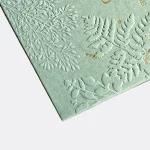
Offset CMYK, the standard four-color process, suits detailed graphics. Digital print can suit short runs or version testing, and flexo is common on corrugated shipping formats. Matte or gloss lamination changes glare and scuff visibility. Soft-touch changes the hand feel, while spot UV, foil stamping, embossing, and debossing create localized surface effects. Check ink coverage and type placement around scores, folds, and glue tabs before choosing a finish.
What should a cabinetry packaging quote include?
The part, the pack, and the route set the quote before artwork is discussed. Send component drawings or a physical sample, packed orientation, exposed finish, hardware list, inner protection, inside and outside dimensions, shipping channel, and artwork status. We use those inputs to draw the dieline. A dieline is the flat cutting template that shows trim, scores, glue tabs, folds, and bleed. The digital proof is where you check panel order, barcode size, color conversion from RGB to CMYK, and type set too close to a score before anything prints.
At a press check, inspect ink coverage, registration at scores, glue-tab clearance, and the first folded sample. Low-resolution art softens small type, and RGB artwork can shift when converted for press. Leave bleed beyond trim and keep marks away from the score.
Custom Packaging Lane is a US-based packaging supplier. Quotes start at a 100-unit minimum, with pricing from $0.49 per unit at volume, quoted to spec. Production is typically 8 to 10 business days after proof approval, plus delivery. Free US shipping is available. Free design support includes a free dieline. The $19.99 sample kit is credited toward the first order. Order the sample kit to inspect fit, cushioning, opening, and surface feel with the actual component. The catalog includes custom foam box inserts, perforated packaging, private label packaging, and shoe box packaging. Use the custom packaging solutions hub when the structure needs to connect to a wider pack-out plan.
Frequently Asked Questions
Can a mailer protect a cabinet door or drawer front?
A mailer can protect a smaller cabinet door, drawer front, trim piece, or hardware kit when the inside has enough clearance and the corners are restrained. Larger panels usually need a corrugated shipper, divider, edge block, or fitted insert. The correct format follows the part's size, finish, weight, orientation, and handling route. Test the filled package before approval.
What does 32 ECT mean for cabinetry cartons?
32 ECT is a common edge crush strength reference for corrugated board. E flute, B flute, and C flute describe the wave-shaped middle layer, and each flute changes thickness, print surface, and stacking behavior. The grade does not select the package by itself. Compare the board with panel weight, stack load, and the route through parcel handling.
Should I choose E flute, B flute, or C flute?
E flute is thinner and supports finer print detail, while B and C flute provide more space and structure. The right flute depends on whether the cabinet part needs a cleaner print surface, more stacking support, or both. Use the actual packed part to check compression, edge contact, and closure before selecting board.
How much clearance should a cabinet insert have?
A common fit convention is about 1/16 inch, or 1.5 mm, around the intended fit. Cabinetry inserts still need a physical pack test because a finish, handle, hinge, or protective wrap changes the contact points. Measure the part and the package as length x width x depth, then label inside or outside dimensions.
What should I send with cabinetry artwork?
A cabinetry packaging brief should include component drawings or a sample, packed orientation, exposed finish, hardware, inside and outside dimensions, inner protection, shipping channel, and artwork status. Mark the score, glue tabs, folds, and bleed on the dieline. Check the digital proof with the part before the package goes to print.