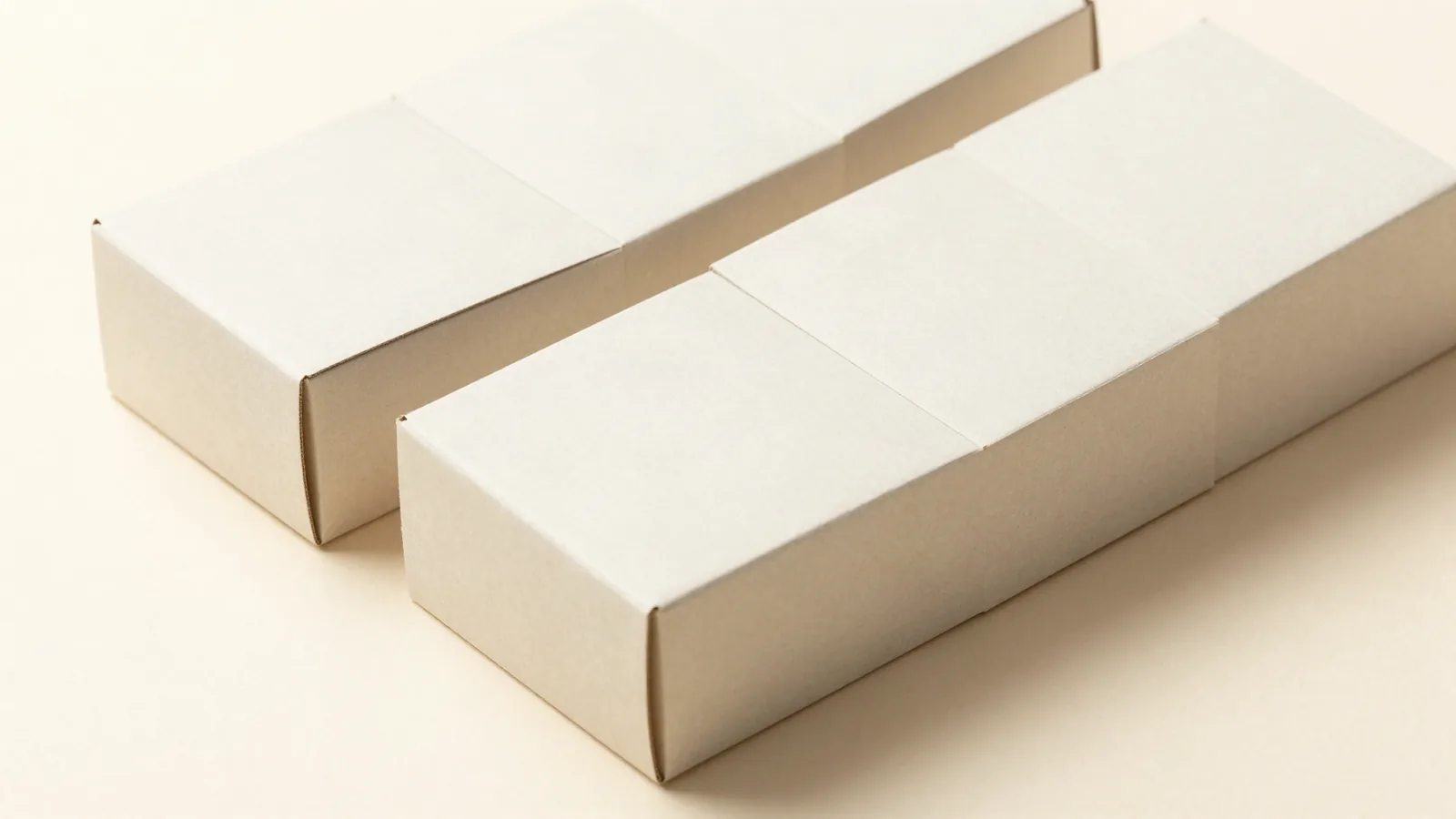



















































Cardboard drawers are drawer boxes with a fixed sleeve and a sliding inner drawer. The word cardboard describes the material direction, while drawer describes the opening. That distinction keeps a catalog record tied to the physical package instead of treating every small presentation box as the same format.
A catalog label is useful only when it stays tied to the opening method. Keep sleeve-and-drawer, lid-and-tray, insert, jewelry, and gift labels separate in the request. That prevents a buying note for a sliding package from being routed to a lift-off lid structure. The record should name the physical motion before the product category.
CPL's rigid box catalog includes drawer-style boxes, so the buying record can separate the sleeve, drawer, board, interior support, artwork, and finish. A catalog label does not establish the final fit. The packed product still sets the dimensions.
What is a cardboard drawer box?
A cardboard drawer box has a fixed sleeve around a sliding inner piece. The sleeve controls the outside print and opening frame; the drawer carries the packed product or an insert.
For a clean specification, record the sleeve length, width, and height separately from the drawer cavity. State whether the drawer needs a flat base, divider, die-cut support, or another interior piece. The opening sequence matters too. If a product catches on the sleeve edge, the problem is structural, not an artwork issue.
How do cardboard drawers differ from other box formats?
Cardboard drawers differ from nearby formats because the inner section slides through a sleeve rather than lifting off as a lid. That changes the opening, the visible panels, and the way an insert sits inside.
| Catalog label | Physical construction | Record before quoting |
|---|---|---|
| Cardboard drawer box | Fixed sleeve and sliding drawer | Drawer fit, sleeve opening, board, and print |
| Cardboard box with lid and tray | Top closure over a tray | Lid overlap, tray position, and reveal |
| Cardboard box with inserts | Outer box with interior support | Insert material, cavity layout, and access |
| Cardboard gift box | Presentation-led cardboard package | Opening format, artwork panels, and finish |
For the direct structure, use custom cardboard drawer boxes. Compare custom cardboard boxes with lid and tray and custom cardboard boxes with inserts when the opening or interior changes. Custom cardboard jewelry boxes and custom cardboard gift boxes are adjacent catalog references, not universal drawer dimensions.
Which board choices belong in the drawer specification?
SBS cardstock, kraft, corrugated flute, and rigid stock are the board choices to record for a drawer. Put the board beside the drawer structure in the record.
| Board direction | Practical difference | Drawer-box question |
|---|---|---|
| SBS cardstock, 16 to 24 pt | Smooth paperboard with a printed face | Will the folds and panel detail fit the design? |
| Kraft | Natural paper tone with different ink contrast | Which panels need the clearest print? |
| Corrugated E, B, or AB flute | Flute profile changes thickness and handling | Does the board profile change the sleeve fit? |
| Rigid stock | Wrapped board with a more fixed shape | Should the sleeve and drawer use rigid construction? |
SBS is a smooth paperboard reference. A flute is the wave-shaped layer inside corrugated board. E-flute is typically thinner and prints finer detail than B-flute, while B-flute has a deeper profile; AB combines two flute profiles and changes the assembled thickness. Those are material facts, but the selected board still needs to match the drawer size and handling context.
What does a complete catalog record prevent?
A complete catalog record prevents a sleeve-and-drawer request from being treated as a lid-and-tray carton. List the opening motion first, then the outside and inside measurements, board profile, insert, print panels, closure, and finish. If the request changes from a folding drawer to a rigid drawer, open a new version instead of changing one field and keeping the old dieline.
Can a cardboard drawer include an insert?
An insert is an interior component, so it can sit inside a cardboard drawer without changing the outer format name. The insert may divide a set, support a small item, or create a defined cavity.
Record the insert separately from the sleeve and drawer. Note its material, footprint, product position, and removal path. A support cut to the exact product size can hold the item in place, but it can also make hand removal awkward if the clearance is missing.
What should you send for a cardboard drawer quote?
Send the structure name, packed product dimensions, measurement label, board direction, insert request, artwork status, finish, quantity, and destination. A dieline is the flat template used to cut and fold the package, so it should follow the product dimensions rather than a guessed stock size.
Check the artwork before approval. Keep type away from scores, add bleed to cut edges, and flag any barcode that sits near a fold. RGB art can shift when it is converted for press. Low-resolution files can soften on large panels. CPL sends a digital proof before anything prints.
The MOQ is 100 units. Pricing is from $0.49 per unit at volume, quoted to spec. Production typically takes 8 to 10 business days after proof approval, plus delivery. Free US shipping and free design support are available. Use the $19.99 sample kit when comparing board, print, or finish direction, then use custom packaging solutions to frame the project.
Frequently Asked Questions
How is a cardboard drawer different from a lid-and-tray box?
A cardboard drawer uses a fixed sleeve and a sliding inner drawer. A lid-and-tray box uses a separate top closure over a tray. The difference changes the opening sequence, visible panels, insert placement, and the dimensions that belong in the package specification.
Which cardboard materials can CPL discuss for drawer boxes?
CPL can discuss SBS cardstock from 16 to 24 pt, kraft, corrugated E, B, and AB flute directions, and rigid stock for drawer-box projects. The selected board depends on the box structure, packed product, handling context, artwork, and finish. The final board belongs in the proof.
What does an insert do inside a cardboard drawer?
A cardboard drawer can include an insert as a separate interior component. The insert may divide products or support a defined position, but its footprint and removal clearance need their own notes. Keep the sleeve, drawer, and insert records separate so the fit remains clear.
Which CPL page is the direct cardboard drawer reference?
The direct catalog reference is <a href='/product/custom-cardboard-drawer-boxes/'>custom cardboard drawer boxes</a>. Related lid-and-tray, insert, jewelry, and gift-box pages help separate nearby structures. The product dimensions, board direction, drawer fit, artwork, and finish still need project-specific confirmation before the quote can be finalized and the proof approved.
What are the commercial terms for cardboard drawer boxes?
The MOQ for cardboard drawer boxes is 100 units, with pricing from $0.49 per unit at volume, quoted to spec. Production typically takes 8 to 10 business days after proof approval, plus delivery. Free US shipping and free design support are available, and the sample kit costs $19.99.