




























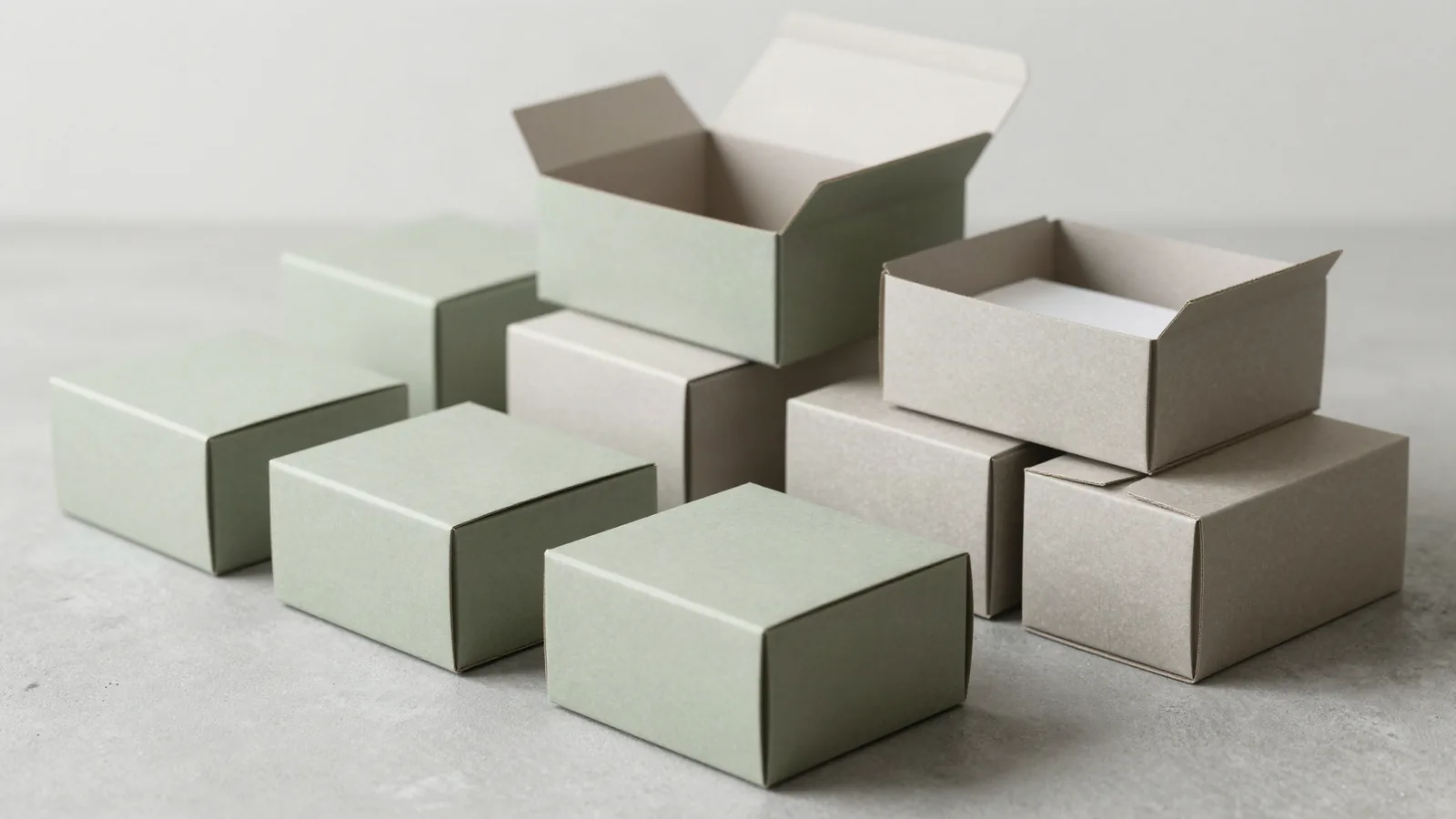




















































A custom box shop is useful when it narrows a packaging decision to a structure that can be drawn, sampled, and quoted. Start with the object inside the box and the work the package must do after packing. A small retail carton, a bottle box, a mailer, and a rigid presentation box can carry the same artwork while handling the product in very different ways.
How should I narrow a custom box shop search?
Start with the product shape and the way the finished package will be handled. A box with a cavity, divider, window, or insert needs a different brief from a flat retail carton. Write down the inside length x width x depth, the opening direction, and whether the box will sit on a shelf, travel by parcel, or do both.
- Record the product shape and the space needed for a cavity, partition, window, or insert.
- Choose the opening style, such as tuck, drawer, slide, lid, sleeve, gable, or pillow.
- Decide whether display, parcel handling, or both will drive the structure.
- Select paperboard, kraft, rigid, or corrugated construction before decorative effects.
- Mark the artwork status, destination region, and any physical package worth comparing.
Structure controls how the box opens and holds the item. Material changes stiffness, print surface, fold behavior, and hand feel. Finish changes glare and texture. Dimensions control fit and the way the packed box occupies shipping space. Keeping those decisions separate makes it easier to reject a good-looking format that cannot pack cleanly.
Which structures should I compare first?
A compact retail carton usually starts with a straight tuck end or reverse tuck end, while a parcel-led package may need a roll end tuck top mailer.
| Packaging need | Common structure | What to compare |
|---|---|---|
| Compact retail carton | Straight tuck end or reverse tuck end | Panel direction, closure overlap, and shelf-facing artwork |
| Heavier or repeated-use pack | Auto-lock bottom or crash-lock | Base support, assembly motion, and bottom clearance |
| Parcel presentation | Roll end tuck top mailer, commonly associated with FEFCO 0427 | Closure security, opening sequence, and packed dimensions |
| Layered presentation | Sleeve, drawer or slide, or two-piece rigid | Reveal, lid clearance, tray movement, and wrap alignment |
| Handle-led carryout | Gable structure | Handle placement, top closure, and product position |
Use the catalog to compare physical decisions. Custom foam box inserts suit projects that need a defined cavity or protected arrangement. Wine box packaging gives a bottle-shaped reference, while shoe box packaging gives a broader folding-carton comparison for footprint, lid movement, and panel proportions.
Which materials fit the product and presentation?
Caliper is the thickness of a board, and it changes the force required at folds and closures. SBS, C1S, and C2S paperboard commonly fall in the 12 to 24 pt range. Kraft board commonly falls in the 18 to 24 pt range. Rigid formats commonly use chipboard in the 1.5 to 3 mm range wrapped in 100 to 157 gsm art paper.
| Material reference | Common industry range or construction | Useful question |
|---|---|---|
| SBS, C1S, or C2S paperboard | 12 to 24 pt | Will the surface support the artwork and fold pattern? |
| Kraft board | 18 to 24 pt | Will the natural tone keep the chosen ink readable? |
| Rigid chipboard | 1.5 to 3 mm wrapped in 100 to 157 gsm art paper | Does the wall thickness suit the product and opening? |
| Corrugated board | E, B, or C flutes, with 32 ECT as a common reference | Does the flute profile fit the handling path? |
Corrugated flute changes thickness, stiffness, stacking behavior, and print surface. E, B, and C flutes are not interchangeable just because the box outline looks similar. Flexible formats can use mylar or foil laminates built from PET, AL, and PE layers. Specify the construction, not only the material nickname.
How do print and finish choices change the shelf read?
Offset CMYK suits detailed paperboard graphics, digital printing can suit short runs or versioned files, and flexo is commonly used for corrugated packaging. Matte or gloss lamination changes glare. Soft-touch changes hand feel. Spot UV, foil stamping, embossing, and debossing add localized contrast. Keep the logo, product name, and instructions clear before assigning a decorative treatment.
For a narrow bottle format, custom Woozy bottle boxes prompt questions about clearance and vertical presentation. For a compact carton, custom votive candle boxes prompt questions about front-facing artwork, closure panels, and the amount of empty space around the product.
How should I check fit before choosing a box?
Inside measurements should drive the cavity, stated as length x width x depth. A common industry convention allows about 1/16 in (1.5 mm) tolerance, subject to the material and structure. Assemble the box with the actual product, insert, lid, sleeve, or closure, then check movement, corner pressure, panel bowing, difficult removal, and artwork that disappears around a fold.
What should a quote-ready shop brief contain?
A useful brief names the physical decision before it names the finish. Include the following:
- Product type, filled dimensions, count per package, and any cavity or divider requirement.
- Preferred structure, board, print process, finish, window, and insert direction.
- Whether the package will sit on a shelf, travel by parcel, or support both uses.
- Artwork status, dieline needs, destination region, and physical samples to compare.
- The result that matters most, such as easy opening, controlled fit, or a clear front panel.
A focused brief lets the supplier compare the real trade-offs in the custom box shop. When two formats look alike online, the assembled sample usually exposes the difference in lid movement, cavity space, and pack-out effort.
Custom Packaging Lane quotes to spec from a 100-unit minimum, with pricing from $0.49 per unit at volume, quoted to spec. Production is typically 8 to 10 business days after proof approval, plus delivery. Free US shipping, free design support, and a free dieline are part of the process. The $19.99 sample kit is credited to the first order. Compare wholesale custom packaging and request the sample kit once the shortlist is clear.
Frequently Asked Questions
What should I compare first in a custom box shop?
Start with the item shape, finished dimensions, opening style, and handling path. Then compare board, structure, insert needs, print method, and finish. This order keeps the decision tied to fit and use. Decorative effects come later, after the package can hold, open, and present the product properly.
Which structures cover common box needs?
Straight tuck and reverse tuck cartons suit many compact retail formats. Auto-lock and crash-lock structures change the base assembly. Roll end tuck top mailers are commonly associated with FEFCO 0427. Sleeves, drawers, slides, two-piece rigid boxes, gable structures, and pillow boxes each change the opening and presentation.
How do I choose between paperboard, kraft, rigid, and corrugated?
SBS, C1S, and C2S paperboard commonly range from 12 to 24 pt, while kraft commonly ranges from 18 to 24 pt. Rigid chipboard commonly measures 1.5 to 3 mm and can be wrapped in 100 to 157 gsm art paper. Corrugated options include E, B, and C flutes, with 32 ECT as a general reference.
When should I add an insert?
Add an insert when the product needs a defined position, separation, or layered reveal. Foam, paperboard partitions, trays, and fitted cavities create different removal experiences. Check the insert inside the assembled box with the real product, because a flat dieline cannot show movement, compression, or difficult removal.
Which finish should come after the structure is chosen?
Choose the finish after the board, opening, and panel hierarchy are settled. Offset CMYK supports detailed paperboard graphics, digital printing can suit short runs, and flexo is common for corrugated work. Matte or gloss lamination changes glare. Soft-touch, spot UV, foil, embossing, and debossing add focused emphasis.












